
How to Start a CNA School in Colorado (2026 Guide)
July 27, 2026 · Colorado
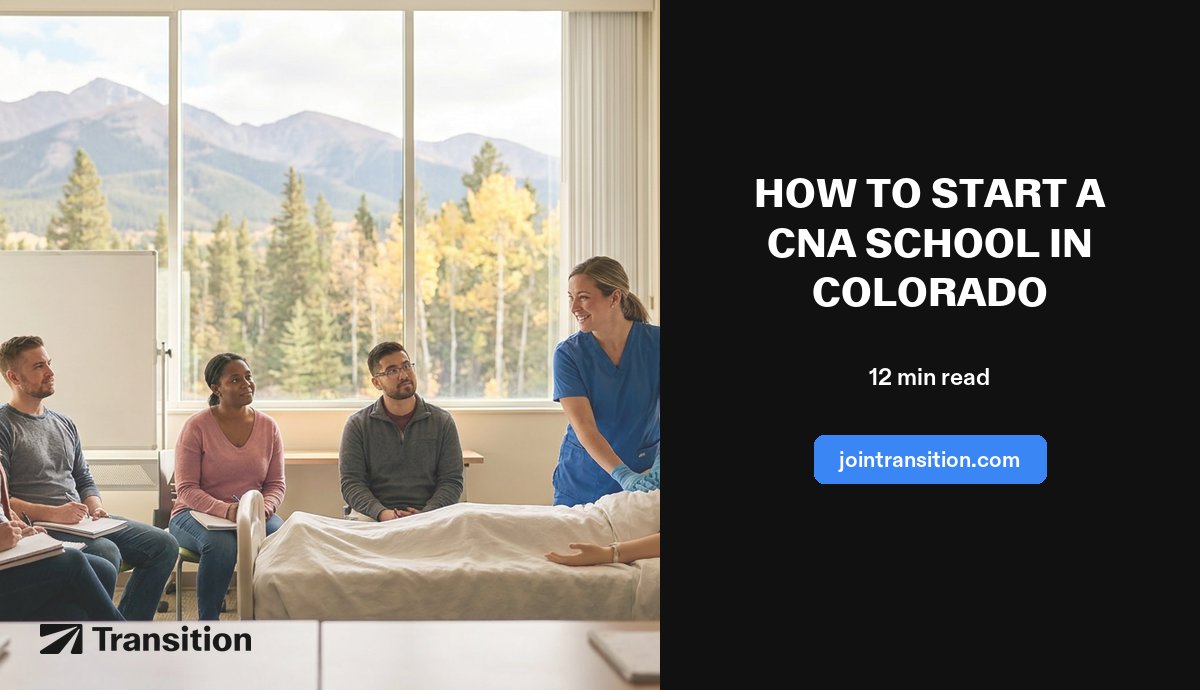
Colorado's health systems have been short on certified nurse aides for years — the Front Range keeps adding residents faster than long-term care can staff up, and mountain and Eastern Plains facilities struggle to recruit at all. Every approved training program that opens in Colorado tends to fill seats quickly, because employers are actively funneling candidates toward them.
Here's what makes Colorado distinctive: you'll likely need two separate state approvals to run a private CNA school. The Colorado State Board of Nursing (under DORA) approves your nurse aide training program itself, and the Division of Private Occupational Schools (DPOS) — a different agency, inside the Colorado Department of Higher Education — certifies you to operate as a private occupational school. Miss the second one and you can be fully Board-approved and still operating illegally.
We help CNA and allied-health schools run their day-to-day operations — enrollment, records, payments, messaging — so we've watched a lot of founders go through this process. This guide walks the whole path. One note before we start: this is operational guidance from people who work with schools, not legal advice. Verify everything with the agencies named below, because rules and fees change.
Quick Facts: CNA School Requirements in Colorado
| Item | Colorado Requirement |
|---|---|
| Total training hours | 75 minimum |
| Classroom/clinical split | Not fixed by rule; ≥16 hours clinical, first 16 hours pre-clinical classroom (no resident contact) |
| Credential issued | Certified Nurse Aide (CNA) |
| Approving agency | Colorado State Board of Nursing (DORA – Division of Professions and Occupations) |
| Application | NATCEP application forms to the Board of Nursing; Board reviews within 90 days |
| Second approval | DPOS Certificate of Approval (CO Dept. of Higher Education) for private schools |
| Exam vendor | Credentia (NNAAP), via the CNA365 platform |
| Registry | Colorado Nurse Aide Registry |
| Typical time to approval | Roughly 4–9 months across both agencies |
| Instructor requirement | Program coordinator: RN, 2 yrs experience with elderly/chronically ill (1 yr in long-term care) + teaching preparation |
Step 1 — Form Your Business Entity
Colorado makes this the easiest step in the whole process. All business filings go through the Colorado Secretary of State's online filing system — there's no paper option, and approval is typically instant. Filing Articles of Organization for an LLC costs $50 (label that as of this writing; check the current fee), and you'll owe a $25 Periodic Report each year to stay in good standing.
Most single-owner schools we work with start as an LLC for liability protection and simplicity. Once the entity exists, get a free EIN from the IRS (online, ten minutes) and open a dedicated business bank account. Keep tuition revenue completely separate from personal funds from day one — DPOS will later ask about your financial practices, and clean books make everything easier.
Step 2 — Register for State Taxes
Register with the Colorado Department of Revenue — the easiest route is MyBizColorado, the state's combined registration portal, which handles Department of Revenue accounts and unemployment insurance with the Colorado Department of Labor and Employment (CDLE) in one pass.
Tuition for instructional services is generally not subject to Colorado sales tax, but if you sell textbooks, scrubs, gait belts, or supply kits separately, those sales may be taxable — ask your accountant. Once you hire your first instructor, you'll need wage withholding and CDLE unemployment insurance accounts set up before the first payroll run.
Step 3 — Secure Your Location, Classroom, and Skills Lab
The Board of Nursing expects a training environment that mirrors real care: a classroom for theory plus a skills lab where students practice on equipment before ever touching a resident. Plan on at least one hospital bed, a mannequin, a wheelchair, transfer equipment, hygiene supplies, blood pressure cuffs, and handwashing access. Colorado doesn't publish a square-footage formula, but both the Board (via survey) and DPOS (via its application) will evaluate whether your facility fits your program and projected class size.
Check local zoning before signing a lease — educational use isn't permitted in every commercial space, and a landlord's assurance is not a zoning determination. Budget for a certificate of occupancy inspection where your municipality requires one.
Step 4 — Apply for State Program Approval (and DPOS Certification)
This is the heart of the process, and in Colorado it's a two-track effort.
Track one: Board of Nursing NATCEP approval. Colorado's nurse aide training rules live in 3 CCR 716-1 (the nurse aide training program chapter). You'll submit an application package to the Colorado State Board of Nursing covering your curriculum (75+ hours mapped to the required content), instructor and program coordinator credentials, clinical site agreements, skills lab inventory, and program policies. By rule, the Board reviews applications within 90 days and can grant interim approval when you're in substantial compliance — full approval follows after a survey. Expect on-site surveys at least every two years afterward, plus annual reporting. Questions go to the Board's licensing office (dora_dpo_licensing@state.co.us).
Track two: DPOS Certificate of Approval. As a private school charging tuition for occupational training, you almost certainly also need a certificate from the Division of Private Occupational Schools in the Colorado Department of Higher Education. New schools apply through the DPOS Connect portal for a provisional certificate (valid one to two years, then converted to a standard three-year certificate). The application covers your catalog, enrollment agreement, refund policy, financials, surety bond, and program details, with non-refundable fees due at submission — check DPOS's current fee schedule. DPOS advises allowing 60–90 days for review and revisions.
The schools that get open fastest run both applications in parallel rather than sequentially. Confirm your exact DPOS obligations directly with the Division (DPOS@dhe.state.co.us) before enrolling your first student.
Step 5 — Hire a Qualified Program Coordinator and Instructors
Colorado's rule sets these bars:
- Program coordinator — must be an RN with an active, unencumbered license; at least 2 years of nursing experience caring for the elderly or chronically ill, including 1 year in a long-term care facility; plus teaching preparation (a course in teaching adults, documented teaching experience, or a year supervising nurse aides).
- Primary instructor — RN or LPN with an active, unencumbered license and at least 1 year of experience with the elderly or chronically ill, plus the same teaching-preparation requirement.
- Ancillary instructors (for specialty topics) — at least 1 year of current experience in their field with the applicable license or certification.
Note the Colorado-friendly detail: LPNs can serve as primary instructors here, which widens your hiring pool compared to RN-only states. Collect license verifications, resumes, and teaching documentation before you apply — incomplete instructor files are one of the most common reasons applications stall.
Step 6 — Build or Buy a State-Compliant Curriculum
Colorado requires a minimum of 75 hours, with two hard floors inside it: at least 16 hours of supervised clinical instruction, and a 16-hour pre-clinical block covering communication, infection control, safety and emergency procedures, promoting client independence, and client rights — completed before any student has direct resident contact. The state doesn't fix the rest of the split, so most programs land somewhere around 55–60 classroom/lab hours and 16–24 clinical hours, and some run longer than 75 total to better prepare students for the exam.
Map every required content area from 3 CCR 716-1 to specific lessons and hours in a curriculum grid — the Board wants to see the crosswalk, not just a topic list. You can build your own or license a published curriculum, but either way it must align to Colorado's rule and the federal OBRA content areas.
Step 7 — Set Up Clinical Site Agreements
Your clinical hours must happen under RN or LPN supervision in a facility that meets federal nursing facility standards. Colorado's rule adds a screen: the facility can't have been terminated from Medicare/Medicaid or hit with penalties that bar it from hosting training within the past two years — check a facility's standing before you sign anything.
Get a written affiliation agreement that spells out student ratios, supervision, scheduling, and liability insurance requirements. Common snags we see: facilities that already host a competing program and have no clinical capacity, and agreements that take 60+ days to clear a corporate nursing office. Start these conversations early — a signed clinical agreement is part of your Board application, not something to sort out afterward.
Step 8 — Understand Testing and the Colorado Nurse Aide Registry
Colorado contracts with Credentia to run the NNAAP written (or oral) exam and skills evaluation — the state moved from Pearson VUE to Credentia's CNA365 platform, where your graduates create accounts, and your school verifies training completion. The full exam runs about $135 (verify current pricing on Credentia's Colorado page).
Established training programs can pursue becoming in-facility test sites through Credentia, which is a real enrollment advantage: students strongly prefer testing in the same skills lab where they trained. Graduates who pass both parts are placed on the Colorado Nurse Aide Registry, maintained through DORA — and unlike many states, Colorado treats CNA certification as a DORA credential you can verify through the state's license lookup.
Track your first-time pass rates from cohort one. The Board looks at program performance, and pass rates are also your best marketing asset.
Step 9 — Set Up Enrollment, Payments, and Student Records
Between the Board of Nursing and DPOS, you're now accountable for enrollment agreements, attendance records, skills checklists, grades, refunds calculated to DPOS's required policy, and completion records you can produce on demand at a survey. Most new schools try to run this on spreadsheets, Jotform, Square, and a filing cabinet — and it breaks by the third cohort.
This is where we come in. Transition gives CNA schools one system for branded online enrollment, payment plans, attendance and grade tracking, e-signed enrollment agreements, automated onboarding emails and texts, and exit surveys. When a DPOS or Board surveyor asks for a student file, you pull it up in seconds instead of digging through three apps and a binder.
Step 10 — Launch with a Local Marketing Plan
- Google Business Profile first. "CNA classes near me" is how most students find you. Claim it, add photos of your lab, and ask every graduating cohort for reviews.
- Connect with the workforce system. The Colorado Department of Labor and Employment funds training through local Colorado Workforce Centers — get on their eligible training lists and build relationships with case managers who can send funded students your way.
- Partner with employers. Nursing homes and assisted living operators along the Front Range will pre-commit to interviewing (or sponsoring) your graduates. That pipeline sells seats.
- Keep the website simple — schedule, price, exam pass rate, and an online enrollment link. Then answer inquiries fast; the school that responds within minutes wins the student.
What It Really Costs
Realistic estimated ranges for a Colorado startup (label everything an estimate and verify current fees):
| Line item | Estimated range |
|---|---|
| Entity formation + registered agent | $50 – $350 |
| Insurance (liability + professional) | $2,000 – $5,000/yr |
| Rent, deposit, build-out | $8,000 – $25,000 |
| Skills lab equipment | $5,000 – $15,000 |
| Curriculum (build or license) | $500 – $5,000 |
| Instructor payroll (pre-revenue) | $5,000 – $15,000 |
| DPOS application, bond, and fees | $2,000 – $6,000 |
| Marketing at launch | $1,500 – $5,000 |
| Bottom line | $25,000 – $75,000 |
The DPOS surety bond and application fees are the line most founders in other states don't expect — budget for them early.
How Long It Takes
Plan on 4–9 months from entity formation to first class. The Board of Nursing's 90-day review window and DPOS's 60–90 day review can overlap if you file in parallel; the variance usually comes from application revisions, slow clinical-site negotiations, and facility build-out. Founders who show up with complete instructor files and a signed clinical agreement consistently land at the short end.
Common Mistakes to Avoid
- Skipping DPOS. Board of Nursing approval alone doesn't authorize you to operate a private occupational school in Colorado. This is the state's #1 trap.
- Filing the two applications sequentially instead of in parallel — it can add months for no benefit.
- Thin instructor documentation. Colorado wants proof of the teaching-preparation requirement, not just an RN license.
- Choosing a clinical site without checking its Medicare/Medicaid standing over the past two years.
- Ignoring the 16-hour pre-clinical rule when building the course calendar, then having to reshuffle clinical dates.
- No record system at launch. Two agencies can survey you; paper folders don't survive that.
FAQ
How much does it cost to start a CNA school in Colorado? Most founders should budget roughly $25,000–$75,000 to reach the first class, depending on lease and build-out costs. The recurring surprises are the DPOS bond/fees and pre-revenue instructor payroll.
Do I need to be a nurse to open a CNA school in Colorado? No. The owner doesn't need a clinical license, but your program coordinator must be an RN with two years of relevant experience (one in long-term care), and your primary instructor must be an RN or LPN meeting the state's requirements.
How many training hours does Colorado require? A minimum of 75 hours, including at least 16 hours of supervised clinical and a 16-hour pre-clinical classroom block before students have any resident contact. Many programs run longer by choice.
Do I really need both Board of Nursing and DPOS approval? If you're a private school charging tuition, almost certainly yes — the Board approves the training program, DPOS certifies the school as a business. Confirm your specific situation with DPOS directly.
Can CNA classes be online in Colorado? Theory portions can often be delivered online if your approved application says so, but the skills lab and the 16+ clinical hours must be in person. Get your delivery format approved by the Board — don't switch formats after approval without amending.
What exam do Colorado CNA students take? The NNAAP written/oral exam and skills evaluation through Credentia's CNA365 platform (about $135 total). Passing both parts places graduates on the Colorado Nurse Aide Registry.
How long does Colorado program approval take? The Board of Nursing reviews within 90 days and can grant interim approval; DPOS asks for 60–90 days. Run in parallel, most schools open within 4–9 months of starting.
Disclaimer
This guide is for general information, not legal advice. Requirements, fees, and rules change — verify current details with the Colorado State Board of Nursing (DORA), the Division of Private Occupational Schools, the Colorado Secretary of State, and the Colorado Department of Revenue before making decisions.
The Paperwork Gets You Open. The Systems Keep You Open.
Once Colorado approves you, the real work is enrollment, records, payments, and staying survey-ready every single day. See how Transition runs those operations for CNA schools like yours at jointransition.com.
Get CNA training paid for.
Tell us your county and we text you the route that fits, who to call, and what to bring.