
How to Start a CNA School in Indiana (2026 Guide)
July 27, 2026 · Indiana
Indiana's nursing facilities and hospitals have been hunting for certified nursing assistants for years, and the math keeps getting worse — nursing assistants in the state average around $18.50 an hour and facilities still can't fill shifts. Every unfilled aide position is a student your school could be training.
Indiana's process has a distinctive shape. The Indiana Department of Health (IDOH) approves all nurse aide training programs before a single class can run, using a specific form — State Form 629 — and a state-published 30-lesson curriculum as the floor. Testing isn't outsourced to Credentia or Prometric; Indiana contracts with Ivy Tech Community College to run every CNA exam in the state through one central testing office. And the clinical requirement is unusually heavy: 75 of the 105 required hours are clinical, the inverse of most states' classroom-heavy splits.
We work with CNA and allied-health schools every day — running their enrollment, records, and messaging once they're open — so we've seen what trips up Indiana founders. This guide walks the full path. The usual honest note: we're operators, not lawyers, so treat this as a researched map and verify specifics with IDOH before spending real money.
Quick Facts: CNA School Requirements in Indiana
| Item | Indiana requirement |
|---|---|
| Total training hours | 105 hours |
| Classroom/clinical split | 30 hours classroom (min) + 75 hours clinical (≥32 in a licensed nursing facility) |
| Credential | Certified Nurse Aide (CNA) — Indiana Aides Registry |
| Approving agency | Indiana Department of Health (IDOH), Aide Training, Certification & Registry |
| Application | State Form 629, emailed to aidetraining@health.in.gov |
| Exam | State exam administered by Ivy Tech Community College — $100 (written + skills) |
| Registry | Indiana Nurse Aide Registry (IDOH, via MyLicenseOne) |
| Typical time to approval | A few months; no published IDOH timeline (confirm with the agency) |
| Instructor requirement | RN program director + RN/LPN instructors, all with IDOH-approved Train-the-Trainer |
Step 1 — Form your business entity
Indiana runs business formation through INBiz (inbiz.in.gov), the Secretary of State's one-stop portal. LLC Articles of Organization cost $95 online ($100 by mail), and the Business Entity Report that follows is biennial — about $32 online. Cheap and fast; most filings clear in a day or two.
Get your free EIN from the IRS and open a dedicated business bank account before money starts moving. If you later pursue state workforce funding (more on that in Step 10), clean entity records and finances make those applications smoother.
Step 2 — Register for state taxes
INBiz hands you off to the Indiana Department of Revenue, where everything runs through INTIME (Indiana's tax portal). The good news: Indiana taxes tangible goods and only specifically enumerated services, and instructional tuition isn't one of them — your CNA tuition is not subject to the 7% sales tax. If you sell textbooks or supply kits separately, those goods can be taxable, so many schools bundle materials into tuition.
When you hire instructors, add a withholding tax account through INTIME and register for unemployment insurance with the Indiana Department of Workforce Development through its Uplink Employer Self Service system.
Step 3 — Secure your location, classroom, and skills lab
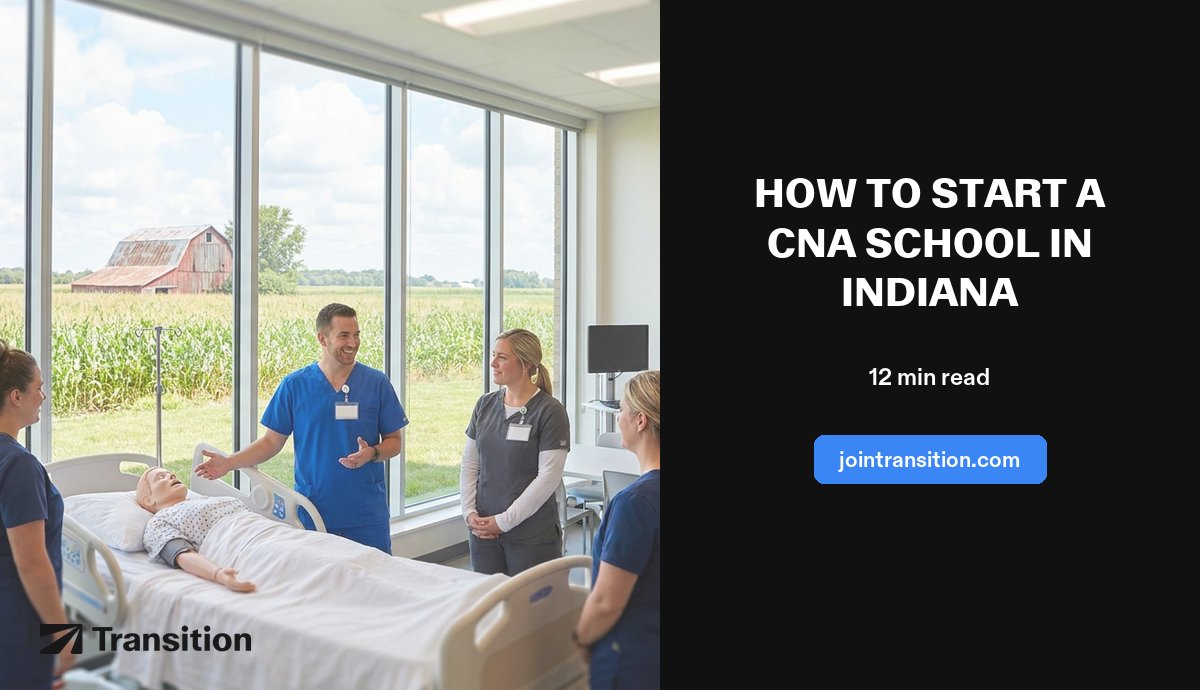
IDOH's application asks for photographs of your classroom and clinical lab, so your space needs to exist — and look credible — before you apply. Plan a classroom for the 30 theory hours and a lab outfitted like a resident room: hospital beds, mannequin, wheelchair, mechanical lift, vital-signs equipment, and supplies for bathing, feeding, and transfer practice.
Indiana gives labs unusual weight: under IDOH's 2023 flexibility rules, up to 43 of your 75 clinical hours can happen in a simulated lab setting (or an approved assisted living facility, capped at 20 hours there). A well-built lab isn't just a teaching aid in Indiana — it's clinical capacity that reduces your dependence on facility scheduling.
Step 4 — Apply for state program approval
All nurse aide training programs must be approved by IDOH before any training happens. The vehicle is State Form 629 — "Application for Approval to Operate a Nurse Aide or a Qualified Medication Aide Training Program" — submitted by email to aidetraining@health.in.gov.
The supporting package is specific: classroom and clinical lab photos, signed clinical agreements with a licensed nursing facility, time-record forms, your student file documentation list, final exams, supply lists, lesson plans, and student pre-admission assessments. Your curriculum must use the state's Indiana Nurse Aide Curriculum (30 lessons) as the minimum standard and comply with IDOH's NATCEP Administrative Standards plus the federal rules at 42 CFR 483.151–.154.
We found no application fee published — IDOH approval appears to be free — and no official review timeline, so email the aide training unit for current processing expectations. After approval, IDOH conducts on-site program reviews, and your results become public: program review reports post to the state's QAMIS system, and your students' pass rates are visible. Treat every cohort like the audit it eventually becomes.
Here's a genuine piece of good news that surprises founders from other states: Indiana's Board for Proprietary Education only covers degree-granting institutions, and the statute behind DWD's Office for Career and Technical Schools (IC 22-4.1-21-9) exempts schools "approved or regulated by any other state regulatory board, agency, or commission" — which your IDOH-approved program is. If CNA training is all you offer, you shouldn't need a second license, though the clean move is filing OCTS's Determination of Status Questionnaire to get that exemption in writing. Add non-IDOH programs later (phlebotomy, medical assistant), and OCTS authorization kicks in for those.
Step 5 — Hire a qualified program director and instructors
Your program director must be an RN who meets IDOH's NATCEP Administrative Standard #1, including completion of an IDOH-approved Train-the-Trainer course. Delegated instructors can be RNs or LPNs — a flexibility many states don't offer — but they need Train-the-Trainer too. The federal floor beneath it all: training runs under the general supervision of an RN with at least 2 years of nursing experience, including 1 year in long-term care.
Plan around one real constraint: only three IDOH-approved Train-the-Trainer providers exist — the IU School of Nursing in Indianapolis, Healthcare Education Consultants, and Ivy Tech. Courses fill and don't run every week, so get your director enrolled the moment you commit to launching. A program waiting on a Train-the-Trainer seat is the most common self-inflicted delay we see in Indiana.
Step 6 — Build or buy a state-compliant curriculum
Indiana requires 105 total hours: a minimum of 30 classroom hours (traditional or online-equivalent) plus 75 clinical hours. The clinical block has structure: at least 32 hours must be in a licensed comprehensive care (nursing) facility, up to 43 hours can be in a simulated lab or IDOH-approved assisted living setting, with at most 20 in assisted living.
The Indiana Nurse Aide Curriculum's 30 lessons are your required floor — build your lesson plans, final exams, and skills checklists directly onto it, because those exact documents go into your State Form 629 package. The clinical-heavy split changes your economics compared to other states: instructor-supervised facility time is your biggest recurring cost, which is precisely why the 43-hour lab allowance matters.
Step 7 — Set up clinical site agreements
You need a signed agreement with at least one licensed nursing facility before you apply — it's in the required package. Facilities have every reason to cooperate: your graduates are their pipeline, and Indiana's 120-day rule (new hires can work as aides for up to 120 days while completing training and testing) means facilities actively recruit from training cohorts.
Common snags: corporate ownership groups slow-walking signatures, facilities capping students per rotation, and competing schools booked into the same building. Sign two sites if you can. And remember that only 32 clinical hours must happen in the nursing facility — your lab absorbs much of the rest, which keeps you resilient when a facility reschedules.
Step 8 — Understand testing and the Indiana Nurse Aide Registry
Indiana is one of the few states with no national exam vendor. The competency evaluation is administered by Ivy Tech Community College under contract with IDOH, scheduled statewide through Ivy Tech's CNA/QMA Central Testing Office in Indianapolis. Students apply through Ivy Tech's online portal; as of January 2025 the fee is $100 for written plus skills ($90 to retake a single part). The written exam is 100 multiple-choice questions with an 80% pass bar; skills testing covers hand hygiene plus four randomly selected skills; candidates get up to four attempts per part within two years.
Because one central office schedules the whole state, build exam lead time into your cohort calendar — graduating a class with no test dates booked is a support headache you can avoid. Passing students are listed on the Indiana Nurse Aide Registry, maintained by IDOH and searchable through MyLicenseOne. Renewal is free every two years but requires at least 8 hours of paid nursing-related work — worth telling graduates on day one. A "finding" on the registry (abuse, neglect, misappropriation) is a permanent employment bar.
Step 9 — Set up enrollment, payments, and student records
Look back at the State Form 629 package: time-record forms, student file documentation, pre-admission assessments, lesson-by-lesson records. IDOH's on-site reviews check whether you actually keep all of it, cohort after cohort. This is the operational layer where Transition earns its keep for the schools we work with: branded online enrollment, payment plans, attendance and grade tracking mapped to your 105 hours, e-signed enrollment and clinical documents, automated onboarding emails and SMS, and exam-tracking so nobody misses the Ivy Tech scheduling window — one system replacing the spreadsheet-Jotform-Square-paper stack. When QAMIS makes your program review public, you want the file cabinet to be the boring part.
Step 10 — Launch with a local marketing plan
Start with the basics that compound: a Google Business Profile with steady graduate reviews, a one-page site with schedule, price, and online application, and inquiry follow-up measured in minutes, not days.
Then take Indiana's workforce money seriously, because it's unusually good. The Department of Workforce Development runs WorkOne centers statewide, and the Next Level Jobs Workforce Ready Grant covers CNA training as a Health & Life Sciences program — Ivy Tech's own CNA course is fully covered for eligible Hoosiers. Private providers can qualify too: get listed on INTraining (Indiana's eligible training provider list), then submit the Workforce Ready Grant provider application; grants run up to $5,500 per student for qualifying high-demand programs. A private school approved for WRG funding is effectively free to eligible students — that's a marketing message that writes itself. Round it out with nursing facility partnerships built on the 120-day rule: facilities hire first, train second.
What it really costs
Realistic estimated startup ranges for a small Indiana CNA school:
| Item | Estimated range |
|---|---|
| LLC formation + biennial report | $95 – $300 |
| Insurance (liability + professional) | $1,500 – $4,000/yr |
| Rent deposit + first months | $3,500 – $10,000 |
| Skills lab equipment (beds, mannequin, lift, supplies) | $6,000 – $16,000 |
| Curriculum + materials | $1,000 – $3,500 |
| Train-the-Trainer courses (director + instructors) | $500 – $2,000 |
| Instructor payroll (pre-revenue + first cohorts) | $8,000 – $20,000 |
| Marketing (site, Google profile, launch ads) | $1,000 – $4,000 |
| Bottom line | $21,000 – $58,000 |
These are estimates. Indiana's lab-heavy clinical allowance argues for spending up on the lab — it directly substitutes for facility hours you'd otherwise have to schedule and staff.
How long it takes
Most founders should plan 4–8 months from LLC filing to first class. IDOH publishes no review timeline, so your speed depends on submitting a complete State Form 629 package the first time — photos, agreements, lesson plans, exams, all of it. The two variance drivers specific to Indiana: Train-the-Trainer seat availability (three providers, limited dates) and clinical agreement signatures from facility corporate offices. Founders who enroll their RN director in Train-the-Trainer and open facility conversations in month one launch near the front of the range.
Common mistakes to avoid
- Waiting on Train-the-Trainer. With only three approved providers, course availability — not IDOH — often sets your launch date. Enroll your director immediately.
- Submitting a thin Form 629 package. IDOH's checklist is long and literal: missing lab photos or an unsigned clinical agreement means the application bounces.
- Ignoring the clinical math. 75 clinical hours with ≥32 in a nursing facility is the inverse of most states. Price your instructor payroll around supervised facility time, and use the 43-hour lab allowance deliberately.
- Forgetting exam scheduling is centralized. One Ivy Tech office books the whole state. Graduating cohorts without booked test dates strands students and tanks your reviews.
- Assuming you need a second state license. Indiana's proprietary-education bodies exempt IDOH-regulated programs — but get OCTS's exemption determination in writing rather than guessing, especially if you'll add non-CNA programs later.
- Neglecting the public paper trail. Program reviews post to QAMIS and pass rates are visible. Sloppy records aren't just an audit risk; they're public marketing damage.
FAQ
How much does it cost to start a CNA school in Indiana? Plan on roughly $21,000–$58,000 all-in. State-side costs are minimal — $95 LLC filing and no published IDOH application fee — so the budget is really rent, lab equipment, insurance, and instructor payroll before your first tuition arrives.
Do I need to be a nurse to open a CNA school in Indiana? No. The owner needs no clinical license, but your program director must be an RN who has completed an IDOH-approved Train-the-Trainer course, and instructors must be RNs or LPNs with the same training. Non-nurse operator plus strong RN director is a proven model.
How many hours is CNA training in Indiana? 105 hours: at least 30 classroom hours and 75 clinical hours, with a minimum of 32 clinical hours in a licensed nursing facility. Up to 43 clinical hours may run in a simulated lab or approved assisted living setting.
Can CNA classes be online in Indiana? The 30 classroom hours may be delivered in an online-equivalent format under IDOH's rules, but the 75 clinical hours are hands-on by definition. Confirm your specific delivery model with aidetraining@health.in.gov before building it.
What exam do Indiana CNA students take? Indiana's state competency exam, administered by Ivy Tech Community College for IDOH — $100 for written plus skills, 80% to pass the written, up to four attempts per part in two years. Passers join the Indiana Nurse Aide Registry via MyLicenseOne.
Can students get their CNA training paid for in Indiana? Often, yes. The Workforce Ready Grant (Next Level Jobs) covers CNA training for eligible residents, WIOA funds flow through WorkOne centers, and nursing facilities frequently sponsor students they hire under the 120-day rule. Private schools can apply to join INTraining and the WRG provider list.
How long does IDOH approval take? IDOH doesn't publish a timeline. Complete applications move much faster than incomplete ones, so treat the Form 629 checklist as gospel and confirm current processing times with the aide training unit by email.
A quick disclaimer
This is information, not legal advice. Indiana's requirements shift — the clinical-hour flexibility rules came by IDOH notice in 2023, and exam fees changed in 2025 — so verify current details with IDOH (aidetraining@health.in.gov), DWD, and your own attorney before making commitments.
The paperwork gets you open. The systems keep you open.
After IDOH says yes, the job is clean execution: enrollment, payments, attendance, documents, exam scheduling, records that survive a QAMIS review. That's what Transition runs for CNA and allied-health schools every day. See how it works at jointransition.com.
Get CNA training paid for.
Tell us your county and we text you the route that fits, who to call, and what to bring.