
How to Start a CNA School in Iowa (2026 Guide)
July 27, 2026 · Iowa
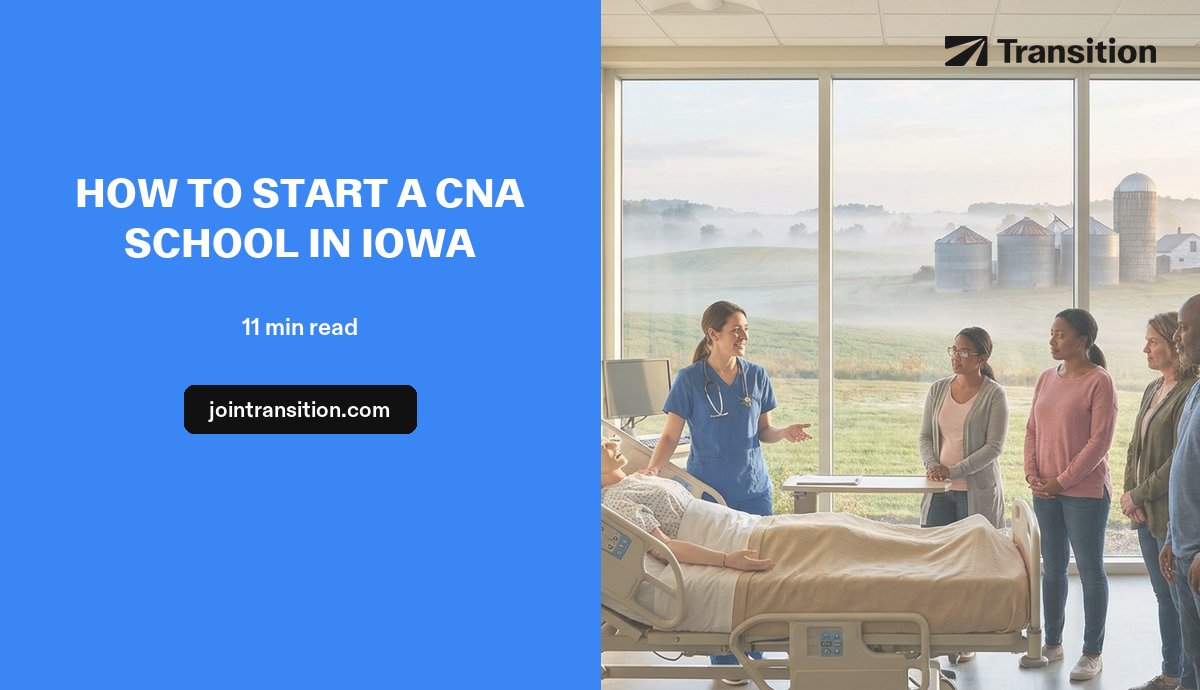
Iowa's long-term care sector runs on certified nursing assistants, and it can't find enough of them — the state has poured money into health careers apprenticeships and credentialing grants precisely because facilities from Des Moines to Sioux City can't fill aide positions. If you want to open a training school, Iowa needs you.
Iowa's rulebook also just changed, which makes 2026 an unusually good moment to understand it properly. As of July 1, 2025, nurse aide program approval runs under a rewritten rule — Iowa Admin. Code 441-81.13 — with the Department of Inspections, Appeals, and Licensing (DIAL) as the operational approver, a hard 90-day decision clock, and two brand-new online written-exam options through Headmaster and Credentia. Much of what you'll read elsewhere about Iowa's requirements describes the old rule. This guide describes the current one.
We work with CNA and allied-health schools every day, running enrollment, records, and compliance once they're open, so we've seen where Iowa founders stumble. Fair warning before we start: this is a researched operator's guide, not legal advice — verify the details with DIAL before you spend real money.
Quick Facts: CNA School Requirements in Iowa
| Item | Iowa requirement |
|---|---|
| Total training hours | 75 clock hours minimum |
| Classroom/clinical split | No longer fixed by rule (since 7/1/2025); in practice ~45 classroom/lab + 30 clinical, ≥16 hours supervised practical per federal rule |
| Credential | Certified Nurse Aide — Iowa Direct Care Worker (DCW) Registry |
| Approving agency | Iowa DIAL (designated by Iowa HHS), under Iowa Admin. Code 441-81.13 |
| Application | Form 427-0517 (75-Hour Nurse Aide Program Application), emailed to DIAL |
| Review timeline | DIAL must approve, deny, or request more info within 90 days |
| Exam | Written: Headmaster/TMU ($50) or Credentia ($70 remote); skills in person ($115–$135) |
| Registry | Iowa Direct Care Worker Registry (DIAL); scores auto-reported, listed in ~10–14 days |
| Typical time to launch | Roughly 4–7 months |
| Instructor requirement | RN, 2 yrs nursing incl. 1 yr long-term care, adult-teaching background |
Step 1 — Form your business entity
Iowa is one of the cheapest states in the country to form a company. File your LLC's Certificate of Organization through the Secretary of State's Fast Track Filing portal (filings.sos.iowa.gov) for $50. The biennial report — due between January 1 and April 1 of odd-numbered years — is $30 online.
Get your free EIN from the IRS the same day and open a dedicated business bank account. Iowa's consumer-protection rules for for-profit schools (more on those in Step 4) assume you can show organized finances, so start clean.
Step 2 — Register for state taxes
Register through GovConnectIowa, the Department of Revenue's portal — there's no fee for withholding or sales tax permits. On sales tax, Iowa taxes only specifically enumerated services, and educational instruction isn't on the list: your tuition is not subject to Iowa sales tax. (Oddly, dance schools and flight instruction are enumerated — CNA training is not.)
When you hire instructors, register as an employer with Iowa Workforce Development through myIowaUI for unemployment insurance. The 2026 numbers are friendly: a 1.0% new-employer rate on a taxable wage base that legislation cut to $20,400.
Step 3 — Secure your location, classroom, and skills lab
Iowa doesn't publish a square-footage formula, but your application package includes your course calendar, syllabus, and skills checklist, and DIAL must be told the sites for every class and clinical before each course runs. You'll want a classroom for the didactic hours and a lab set up like a resident room — hospital bed, mannequin, wheelchair, transfer and vital-signs equipment, handwashing access — sized so every student can practice the full skills checklist.
The federal rule beneath Iowa's (42 CFR 483.152) requires at least 16 hours of supervised practical training, and Iowa programs conventionally run 16 lab hours before clinicals, so a functional lab isn't optional even under the streamlined state rule.
Step 4 — Apply for state program approval
Here's the current structure, post-realignment: Iowa HHS is the nominal Medicaid agency, but it has formally designated DIAL — the Department of Inspections, Appeals, and Licensing — to approve nurse aide training programs. Private entities can absolutely apply; DIAL's own guidance lists community colleges, health care facilities, and private providers as program sponsors.
You apply before your program begins and every two years after, using Form 427-0517 (the "75-Hour Nurse Aide Program Application"), emailed to DIAL's health facilities division. The supporting packet includes your course calendar, chapter objectives, syllabus — Iowa programs build on the "How To Be A Nurse Assistant" curriculum — skills checklist, and your instructor's resume with active Iowa RN license verification. Two features founders should love: the rule gives DIAL a 90-day clock to approve, deny, or request more information, and we found no application fee anywhere (confirm with DIAL). Approval lasts a maximum of two years, and substantive program changes must be reported mid-cycle.
One more Iowa layer, easily missed: Iowa's postsecondary registration law (Iowa Code chapter 261B) is administered through the Department of Education's higher-ed division, and nondegree career schools don't just ignore it — they file a Nondegree/Technical application through the AccessGov portal claiming the 261B.11 exception, renewed every two years, with no fee. For-profit schools also carry consumer-protection duties under Iowa Code 714.23 (a required tuition refund policy) and 714.25 (student disclosures). None of this is a second licensure gauntlet like Illinois or Idaho — but the exception filing and refund-policy compliance are real, so put them on the checklist and confirm whether a financial-responsibility filing applies to your school.
Step 5 — Hire a qualified program director and instructors
Iowa's operative instructor standard, carried forward from the pre-2025 rule and DIAL's application review: a registered nurse with at least 2 years of nursing experience, including at least 1 year in long-term care facility services, who has either completed a course in teaching adults or has experience teaching adults or supervising nurse aides. There's no separate state train-the-trainer course — the adult-teaching requirement covers it.
The application requires the RN's resume and Iowa license verification, and clinical supervision runs at one RN (or an LPN assisting an RN) per 15 students. If you're not a nurse, this hire comes first: the program application is built around your instructor's credentials, and cohort scheduling is built around their availability.
Step 6 — Build or buy a state-compliant curriculum
This is where Iowa's 2025 rewrite matters most. The old rule fixed the split at 30 didactic + 16 lab + 30 clinical hours (minimums that summed to 76 — which is why some Iowa colleges literally brand their course "the 76-Hour Nurse Aide"). The current rule dropped the codified split: it requires the 75-clock-hour course and defers program standards to the federal rule, which mandates at least 16 hours of supervised practical training and 16 hours of core content before any resident contact.
In practice, DIAL and established providers still run the traditional shape — roughly 45 hours of classroom and lab plus 30 hours of supervised clinical — and your application's calendar and syllabus will be reviewed against the state's expected curriculum. Our advice: build to the traditional 30/16/30 structure anyway. It satisfies the federal floor, matches what DIAL is used to approving, and keeps your course competitive with the community colleges you'll be compared against.
Step 7 — Set up clinical site agreements
Your 30 clinical hours happen in a real facility under your RN's supervision, and DIAL must be notified of clinical dates and sites before each course. Nursing facilities are the natural partners, and Iowa hands you a genuinely unusual selling point for them — and for students: under rule 81.13, if a Medicare/Medicaid facility hires your graduate within 12 months of course completion, the facility must reimburse the aide's course, book, and testing costs pro rata over their first year.
Read that again as a marketing asset: a student who gets hired — and in this labor market they will — effectively gets their tuition back. Build it into your enrollment pitch and your facility partnerships. Watch the standard snags: corporate signature delays, per-rotation student caps, and DIAL's disqualification rules for facilities under recent enforcement (large CMPs, payment denials, temporary management), which can knock a partner site out of eligibility.
Step 8 — Understand testing and the Direct Care Worker Registry
Iowa modernized testing in 2025, and the current landscape has two vendors. For the written (knowledge) exam, students can test through Headmaster/TMU — $50, proctored at a community college or taken remotely (register at ia.tmutest.com) — or remotely through Credentia for $70. As of February 2026, Iowa's community colleges operate as proctor sites under the D&S Diversified Technologies (Headmaster/TMU) system, which hosts registration and records. The skills exam is in-person only: about $115 at community college test sites, or around $135 through DIAL's listed alternative testing organization (check dial.iowa.gov for current sites).
Passing is 70% on each part, with three attempts per part before the student must retake the 75-hour course — track attempts for your graduates, because a forced retake is a support crisis. Scores flow automatically from the testing entity to DIAL, and passing students are added to the Iowa Direct Care Worker Registry within roughly 10–14 days, receiving a six-digit registry ID. Registry listing is what nursing homes require to hire; note it's the "Direct Care Worker Registry," not a "nurse aide registry" — Iowa consolidated its direct-care credentials under DIAL.
Step 9 — Set up enrollment, payments, and student records
Iowa's streamlined rule doesn't mean streamlined operations: you're maintaining biennial approval files, per-course date-and-site notifications to DIAL, lesson plans per unit, faculty qualification lists available for inspection, completion evidence issued to every student within 30 days, a written refund policy under Iowa Code 714.23, and disclosure records under 714.25. This is the layer Transition was built for — branded online enrollment, payment plans, attendance and grade tracking, e-signed enrollment agreements and refund-policy acknowledgments, automated onboarding email and SMS, and surveys, in one system instead of spreadsheets plus Jotform plus Square plus paper. The schools we work with spend their time teaching, not reconstructing records before a DIAL review.
Step 10 — Launch with a local marketing plan
The fundamentals first: a Google Business Profile fed by graduate reviews, a one-page site with schedule, price, and online application, and follow-up within minutes of every inquiry — CNA students enroll with the school that answers first.
Then work Iowa's workforce infrastructure. Iowa Workforce Development runs IowaWORKS centers statewide, where WIOA-funded students get individual training accounts. IWD's Health Careers Registered Apprenticeship program has put grant money behind CNA pathways, and facilities themselves are motivated recruiters thanks to the reimbursement mandate — a nursing home that pre-hires your students knows the tuition math works out. (Iowa's GAP Tuition Assistance flows through community colleges only, so don't build your model on it — but do build it on facility partnerships, which private schools can win on speed and schedule flexibility.)
What it really costs
Realistic estimated startup ranges for a small Iowa CNA school:
| Item | Estimated range |
|---|---|
| LLC formation + biennial report | $50 – $200 |
| Insurance (liability + professional) | $1,500 – $4,000/yr |
| Rent deposit + first months | $3,000 – $8,000 |
| Skills lab equipment (beds, mannequin, lift, supplies) | $5,000 – $14,000 |
| Curriculum + materials | $1,000 – $3,000 |
| Instructor payroll (pre-revenue + first cohorts) | $7,000 – $16,000 |
| Marketing (site, Google profile, launch ads) | $1,000 – $4,000 |
| Bottom line | $18,000 – $49,000 |
Estimates, and Iowa sits at the affordable end of the national range: a shorter 75-hour course means lower per-cohort payroll, and there's no expensive second licensure. Des Moines metro rent pushes toward the top; small-town shared space pulls under the bottom.
How long it takes
Iowa is one of the faster states to launch in — plan on 4–7 months from LLC filing to first cohort. The 90-day decision clock on DIAL is the anchor; your variance comes from how complete your Form 427-0517 packet is (a request for more information restarts meaningful time), how quickly your clinical facility signs, and your RN's start date. Founders who submit a complete packet with signed agreements and a fully credentialed instructor routinely beat the middle of that range.
Common mistakes to avoid
- Building from the old rule. Pre-July-2025 guides describe rescinded rule 441-81.16 and its codified 30/16/30 split. Your application will be reviewed under 441-81.13 — cite and build to the current framework (while keeping the traditional structure as your template).
- Ignoring the reimbursement mandate. Facilities must reimburse hired graduates' training costs over 12 months. Schools that don't market this leave their single best enrollment argument on the table.
- Missing the 261B exception filing. "No fee, filed online" doesn't mean optional. File the nondegree exception through AccessGov and adopt a compliant 714.23 refund policy before enrolling anyone.
- Losing students at the skills exam. The written test went online, but skills testing is in-person with limited sites. Book skills dates as part of your cohort plan, not after graduation.
- Sloppy per-course notifications. DIAL expects class and clinical dates and sites before each course. Skipping the routine notice is an easy way to turn a two-year approval into a problem file.
- Forgetting the two-year renewal. Approval expires. Calendar the reapplication at month 20, not month 24.
FAQ
How much does it cost to start a CNA school in Iowa? Roughly $18,000–$49,000 all-in for most founders. Iowa's state-side costs are close to zero — a $50 LLC filing, no published DIAL application fee, no postsecondary exception fee — so the budget is rent, lab equipment, insurance, and instructor payroll.
Do I need to be a nurse to open a CNA school in Iowa? No. Owners need no clinical credential, but your instructor of record must be an Iowa-licensed RN with 2 years of nursing experience including 1 year in long-term care, plus adult-teaching background. Many strong schools pair a non-nurse operator with an experienced RN.
How many hours is CNA training in Iowa? At least 75 clock hours. Since July 1, 2025 the state rule no longer fixes the internal split; the federal floor requires at least 16 supervised practical hours, and Iowa programs conventionally run about 45 classroom/lab hours plus 30 clinical hours (the old 30/16/30 minimums).
Can CNA classes be online in Iowa? Didactic instruction can be delivered online — Iowa programs have run online theory for years — and the written exam itself can now be taken remotely via Headmaster or Credentia. Lab and clinical hours are in-person, as is the skills exam.
What exam do Iowa CNA students take, and what does it cost? A written knowledge exam ($50 via Headmaster/TMU at proctor sites or remote; $70 remote via Credentia) plus an in-person skills exam (about $115 at community college sites, ~$135 at the alternative testing organization). 70% passes; three attempts per part; passers join the Iowa Direct Care Worker Registry automatically within about two weeks.
How long does Iowa program approval take? DIAL must approve, deny, or request more information within 90 days. Complete applications move fastest; approval then runs up to two years before renewal.
Does Iowa require a separate private school license? Not a license in the Illinois/Idaho sense. Nondegree career schools file an exception claim under Iowa Code 261B.11 through the state's AccessGov portal (biennial, no fee) and must comply with Iowa's tuition-refund and disclosure statutes for proprietary schools. Confirm your specifics with the Department of Education's higher-ed division when you file.
A quick disclaimer
This guide is information, not legal advice. Iowa's framework changed materially on July 1, 2025, and details — fees, forms, testing vendors — keep moving. Verify everything with DIAL, the Iowa Department of Education's higher-ed division, and your own attorney before making commitments.
The paperwork gets you open. The systems keep you open.
Once DIAL approves you, the work becomes running clean cohorts on a two-year approval cycle — enrollment, payments, attendance, notifications, exam tracking. That's what Transition does for CNA and allied-health schools every day. See how it works at jointransition.com.
Get CNA training paid for.
Tell us your county and we text you the route that fits, who to call, and what to bring.