
How to Start a CNA School in Mississippi (2026 Guide)
July 27, 2026 · Mississippi
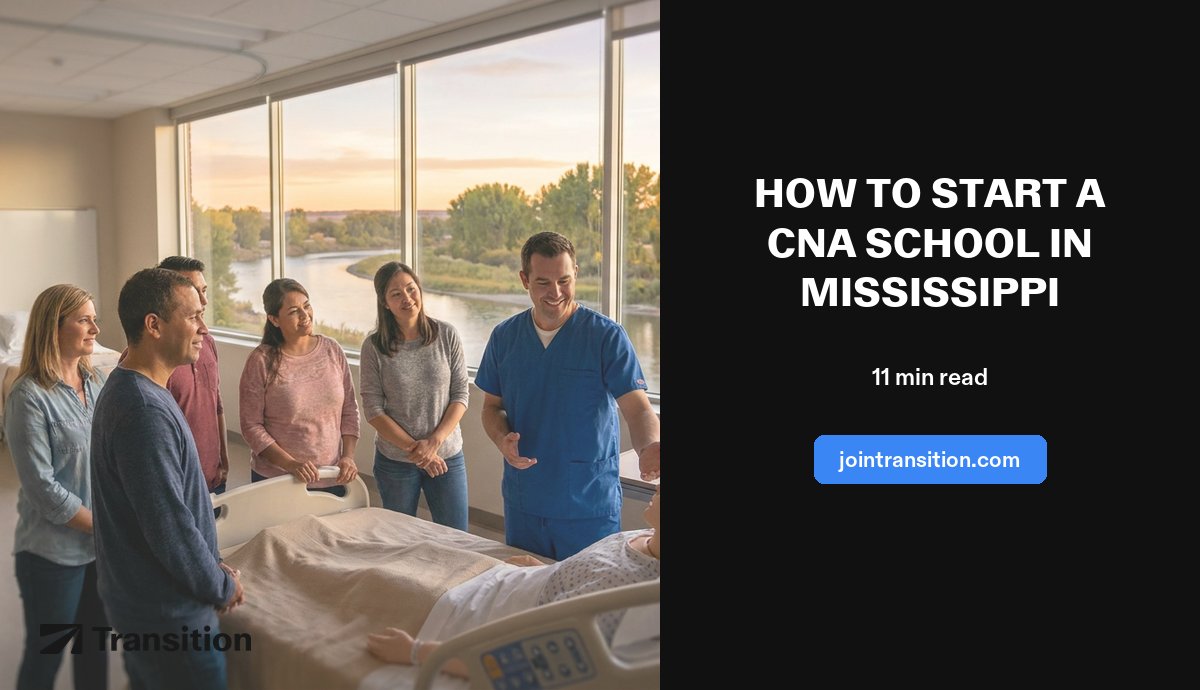
Mississippi's long-term care facilities and hospitals are competing for a workforce that isn't there. Nursing assistant consistently ranks among the most in-demand healthcare jobs in the country — Monster's 2025 healthcare report put CNA at #8 nationally — and the Mississippi Hospital Association's own workforce surveys document the turnover and vacancy pressure playing out in facilities across the state. Every county with a nursing home needs what a good CNA school produces.
Mississippi's process for opening one has a distinctly old-school flavor: the state keeps its training-program application offline. There's no portal and no downloadable packet — you request the NATCEP application directly from the Nurse Aide Office at the Mississippi State Department of Health (MSDH). Meanwhile, the testing side has quietly modernized, and most of the internet hasn't noticed: Mississippi's exam is now run by D&SDT-Headmaster on the TMU platform, not Credentia, no matter what older articles (and even one stale MSDH page) still say.
We work with CNA and allied-health schools across the country — including Core Medical Services next door in Alabama — handling their enrollment, records, and day-to-day compliance, so we know what this looks like on the ground. Here's the full Mississippi roadmap. One honest note before we start: this is operator research, not legal advice. The final word on fees and forms comes from the agencies named below.
Quick Facts: CNA School Requirements in Mississippi
| Item | Mississippi Requirement |
|---|---|
| Total training hours | 75 minimum (federal floor), including ≥16 supervised clinical hours; 16 core classroom hours before resident contact |
| Credential | Certified Nurse Aide (CNA) |
| Approving agency | MSDH, Bureau of Health Facilities Licensure and Certification |
| Application | By request from the Nurse Aide Office (601-364-2718; antanikah.robbins@msdh.ms.gov) — not published online |
| Exam vendor | D&SDT-Headmaster (TMU platform, ms.tmutest.com) — knowledge $35 + skills $100 |
| Registry | Mississippi Nurse Aide Registry (on the TMU platform for MSDH) |
| Typical time to approval | 2–5 months, driven by the by-request application cycle |
| Instructor requirement | RN with 2+ years nursing experience, at least 1 year in long-term care (federal NATCEP standard) |
Step 1: Form Your Business Entity
Mississippi keeps this simple and cheap. Business filings are online-only through the Secretary of State's portal at business.sos.ms.gov — an LLC Certificate of Formation costs $50 (expect a small processing surcharge online) and is typically processed within a couple of business days. Domestic LLCs file a free annual report each year; set the reminder now.
Then get your free EIN from the IRS and open a dedicated business bank account. Keep tuition money separate from personal funds from the first deposit — clean books make everything downstream easier, from insurance underwriting to the proprietary-school exemption filing we'll cover in Step 4.
Step 2: Register for State Taxes
Register with the Mississippi Department of Revenue through TAP (Taxpayer Access Point, tap.dor.ms.gov) for employer withholding. On sales tax, the news is good: Mississippi's 7% sales tax applies to tangible personal property and enumerated services, and tuition/educational services aren't on the list — so a pure training operation generally doesn't need a sales tax permit. If you plan to sell scrubs, supplies, or books to students at retail, confirm the treatment with DOR first.
For unemployment insurance, register with the Mississippi Department of Employment Security at mdes.ms.gov ("Register with Us") — the online registration issues your Employer Account Number and UI tax rate immediately, which is refreshingly fast.
Step 3: Secure Your Location, Classroom, and Skills Lab
Mississippi doesn't publish a detailed public equipment list the way some states do — the specific facility standards come with the application packet — but the practical requirements are what every NATCEP needs: a classroom that seats your cohort comfortably and a skills lab where students can demonstrate and return-demonstrate every skill on the curriculum and the state skills exam.
Build the standard kit: hospital bed, mannequin, wheelchair, gait belts, blood pressure cuffs and stethoscopes, thermometers, hygiene and transfer supplies, and a handwashing sink. Two planning notes from schools we work with: verify zoning for instructional use before signing a lease (small-town commercial landlords are flexible; their zoning boards sometimes aren't), and if you intend to pursue on-site testing later, equip the lab to exam-standard from day one — the same setup serves training and test events.
Step 4: Apply for State Program Approval
The approving agency is the Mississippi State Department of Health, Bureau of Health Facilities Licensure and Certification in Jackson. And here's the state's biggest quirk: the new-program application isn't published online. You request the NATCEP application packet directly from the Nurse Aide Office — call 601-364-2718 or 601-364-1100, or email antanikah.robbins@msdh.ms.gov — and the packet is where you'll find the current forms, instructor documentation requirements, any fees, and site-visit expectations. Don't treat the thin web presence as a sign the requirements are thin; it just means the details travel by email.
Expect the application to cover the standard NATCEP package: your curriculum and hour breakdown, instructor qualifications and licenses, facility and equipment documentation, clinical site arrangements, and policies for skills evaluation and record-keeping. Build in review time and a site visit before your first class, and get every commitment about timeline in writing from the office.
The second-agency question — with a Mississippi twist. Mississippi licenses private career schools through the Commission on Proprietary School and College Registration (CPSCR), administered by the Mississippi Community College Board — and full registration is genuinely expensive: a $2,500 application, $500 agent license, and a $50,000 surety bond, filed through the EDvera system. But here's the high-value detail: Miss. Code § 75-60-5 exempts courses that are required by law to be approved or licensed by another state agency — and an MSDH-approved NATCEP fits that category, as CPSCR's own regulations recognize. The exemption is not automatic: you file an electronic Exemption Application with a $100 fee, citing the exemption category and attaching your MSDH approval, and you renew it every 12 months (about $100/year). CPSCR can audit and revoke. So the practical path for a CNA-only school is: MSDH approval first, then the CPSCR exemption filing — roughly $100 a year instead of $3,000-plus and a $50,000 bond. Confirm your specific situation with CPSCR (601-432-6518, info@mccb.edu), especially if you'll add non-CNA programs later, because those can pull you into full registration.
Step 5: Hire a Qualified Program Director and Instructors
Mississippi applies the federal NATCEP standard from 42 CFR 483.152: your program's training must run under the general supervision of a qualified RN, and your primary instructor must be an RN with at least 2 years of nursing experience, including at least 1 year in long-term care. The application packet from the Nurse Aide Office contains the state's specific instructor documentation requirements — verify whether any Mississippi-specific instructor approval or workshop applies when you request it, and get your instructor's paperwork moving early, because instructor verification is a common source of application delay in every state we work in.
Beyond the primary instructor, plan your bench: LPNs and specialty professionals can typically support instruction under RN supervision, and you'll want an RN available for skills-exam observation. Under Headmaster's model, RNs can also apply separately (via hdmaster.com) to serve as skills-test evaluators/observers — useful if you pursue test-site status. Budget $28–$40/hour for RN instructor pay in most Mississippi markets. And the standing advice: your instructor is your single point of failure, so cultivate a second qualified RN before you need one.
Step 6: Build or Buy a State-Compliant Curriculum
Mississippi requires the federal minimum: 75 total hours, including at least 16 hours of supervised clinical training, with 16 hours of core classroom instruction — communication, infection control, safety, residents' rights, independence — completed before any direct resident contact. You may see claims floating around that Mississippi requires 100 or more hours; they're wrong. The state's curriculum standards track the federal requirements, and the balance of hours beyond the 16-hour clinical minimum is classroom and lab time structured by your program.
You can build your own curriculum mapped to the federal content requirements or license a published one (Hartman's and similar publishers are widely used); either way, document your hour-by-hour plan, because it goes in the application. On delivery: Mississippi has no fully-online approved programs. Some classroom hours may be delivered remotely, but clinical training is in person, full stop — confirm the current remote-hours policy with the Nurse Aide Office before designing a hybrid schedule around it.
Many programs sensibly run more than 75 hours — extra lab time raises first-attempt pass rates, and pass rates are your reputation. But that's a program design choice, not a state mandate.
Step 7: Set Up Clinical Site Agreements
Your 16+ supervised clinical hours need a real facility — typically a licensed nursing home, where students perform care on actual residents under qualified supervision. Get a written affiliation agreement covering schedules, supervision responsibility, student conduct and privacy policies, health screening requirements, and termination terms.
The pitch to facilities writes itself in this labor market: your cohort is their hiring pipeline, and facilities that host clinicals get first look at every graduate. The snags are familiar: a facility that hits survey trouble can become unusable as a training site with little notice, so maintain a relationship with a backup facility; and nail down in writing who supervises students on the floor, because "the facility will sort it out" is how clinical days get canceled.
Step 8: Understand Testing and the State Registry
Here's where you must ignore most of the internet. Mississippi's nurse aide exam is administered by D&SDT-Headmaster through the TMU (TestMaster Universe) platform at ms.tmutest.com — the state moved from Credentia, whose old Mississippi pages now dead-end. The current Mississippi Nurse Aide Candidate Handbook (June 2025) is a Headmaster document. Build every workflow around TMU.
The details you'll manage as a program:
- Fees: knowledge exam $35, skills exam $100 — $135 total ($45 for the audio/oral knowledge version). Retakes cost the same per component. Programs can prepay student fees through TMU, a nice enrollment perk to advertise.
- Eligibility flows through you: instructors enter training records and completions into TMU before students can pay and schedule. Budget real admin time for this — it's a recurring operational task, not a one-time setup.
- Attempt limits: three attempts within 24 months of training completion. Students who exhaust attempts must retrain in an approved program (a small but real re-enrollment market).
- Formats: the knowledge test can be taken in person or remotely proctored; the skills test is always in person with an RN observer — and under the Headmaster model, a school can pursue becoming a test site.
Graduates land on the Mississippi Nurse Aide Registry, maintained for MSDH on the same TMU platform, and must renew every 24 months with at least 8 hours of paid nurse aide work. Teach your students that renewal rule before they graduate — it generates goodwill and saves them from expired certifications.
Step 9: Set Up Enrollment, Payments, and Student Records
Mississippi's operational center of gravity is TMU: training records in, completions in, eligibility out — all sitting on top of your own attendance tracking against the 75-hour requirement, your annual CPSCR exemption renewal, and MSDH's record-keeping expectations.
This is the layer we built Transition for. Schools use it to run branded online enrollment, payments and payment plans, attendance and grade tracking, e-signed enrollment agreements and clinical affiliation documents, and automated email/SMS sequences that keep students moving from application to test day. One system instead of spreadsheets, Jotform, Square, and paper files — with completion data organized so TMU entry is transcription, not detective work.
Step 10: Launch with a Local Marketing Plan
- Google Business Profile first. In Mississippi's smaller markets, a well-reviewed profile can own the local search results for "CNA classes near me" almost by itself.
- Partner with MDES and the WIN Job Centers. The Mississippi Department of Employment Security runs WIN Job Centers statewide, and WIOA funding routinely covers CNA tuition for eligible job seekers — a direct pipeline of funded students.
- Work your clinical facility and the local hospital. Facilities will co-market, guarantee interviews, and sometimes sponsor tuition for new hires; the Mississippi Hospital Association's workforce data can even anchor your local pitch.
- Keep a simple site — dates, price, enroll now — and answer inquiries within minutes. In a market with fewer competing schools than most states, responsiveness plus reviews is a durable moat.
What It Really Costs
Realistic estimated startup ranges for a single-location Mississippi school:
| Item | Estimated Range |
|---|---|
| LLC formation | $50–$75 |
| MSDH application costs | Request current fees from the Nurse Aide Office |
| CPSCR exemption filing (annual) | ~$100/yr |
| Insurance (liability + professional) | $1,500–$4,000/yr |
| Rent + deposit (first 3–6 months) | $4,000–$12,000 |
| Skills lab equipment | $7,000–$18,000 |
| Curriculum (build or license) | $500–$4,000 |
| Instructor payroll (pre-revenue + first cohort) | $6,000–$15,000 |
| Student test fees (if you prepay, per student) | $135 |
| Marketing (first 6 months) | $1,500–$5,000 |
| Software, records, enrollment systems | $1,000–$3,000/yr |
| Bottom line (cash outlay) | ~$22,000–$60,000 |
Mississippi is one of the most affordable states in the country to open a CNA school — low formation costs, low rents, and (via the CPSCR exemption) an escape from the $50,000 proprietary-school bond that a full registration would require. The trade-off is lower tuition ceilings than coastal states; volume and pass rates are the business model.
How Long It Takes
Plan on 2–5 months from LLC filing to first class. The variance is concentrated in one place: the by-request application cycle with the Nurse Aide Office — request the packet on day one, because you can't work on what you don't have. While you wait, run everything else in parallel: entity and tax registrations, lease and lab build-out, instructor recruitment and documentation, curriculum selection, and the clinical facility agreement. Founders who treat the phone call to 601-364-2718 as step one — not step five — launch a season earlier.
Common Mistakes to Avoid
- Building around Credentia. Mississippi's exam runs on Headmaster's TMU platform now. Old articles — and even a stale state webpage — still say NNAAP/Credentia. Following them costs your first cohort weeks.
- Waiting to request the application packet. It's offline and by-request. The day you decide to do this is the day you email the Nurse Aide Office.
- Skipping the CPSCR exemption filing. The exemption is real but not automatic — file it, pay the ~$100, and renew every 12 months. Operating unregistered and unexempted is how schools get shut down.
- Forgetting the exemption renewal. It's annual. Calendar it with your LLC annual report.
- Underestimating TMU admin time. Every student's eligibility flows through data your instructor enters. Sloppy entry equals delayed test dates equals angry graduates.
- Ignoring the 24-month/3-attempt window. Track your graduates' testing status — students who drift past their attempts become retraining obligations and reputation risks.
FAQ
How much does it cost to start a CNA school in Mississippi? Typically $22,000–$60,000 all-in — among the lowest in the country. The big variables are lab equipment and rent; the CPSCR exemption path (~$100/year) spares you the $2,500+ registration and $50,000 bond a full proprietary-school license would require.
Do I need to be a nurse to open a CNA school in Mississippi? No. The owner needs no clinical license, but your primary instructor must be an RN with at least 2 years of nursing experience including 1 year in long-term care, and training must run under qualified RN supervision per the federal NATCEP standard.
How many hours is CNA training in Mississippi? 75 hours minimum — the federal floor — including at least 16 hours of supervised clinical training, with 16 core classroom hours before any resident contact. Claims that Mississippi requires 100+ hours are incorrect, though many programs voluntarily run longer.
Can CNA classes be online in Mississippi? Not fully. Some classroom hours may be delivered remotely and the knowledge exam offers remote proctoring, but there are no fully-online approved programs and clinical hours are always in person. Confirm current remote-hours policy with the MSDH Nurse Aide Office.
Who approves CNA schools in Mississippi? The Mississippi State Department of Health's Bureau of Health Facilities Licensure and Certification. Request the application packet from the Nurse Aide Office (601-364-2718). Private schools should also file the annual CPSCR exemption with the Mississippi Community College Board.
What exam do Mississippi CNA students take, and what does it cost? The Mississippi Nurse Aide Competency Exam, administered by D&SDT-Headmaster via TMU (ms.tmutest.com): a knowledge test ($35) and a skills test ($100). Candidates get three attempts within 24 months of completing training.
How do graduates stay certified? The Mississippi Nurse Aide Registry requires renewal every 24 months, with at least 8 hours of paid nurse aide work in the period. Employers verify status on the registry, which runs on the same TMU platform.
Disclaimer
This guide is general information, not legal advice. Mississippi keeps key program-approval details in a by-request application packet, and its testing vendor changed recently — so verify everything current with the MSDH Nurse Aide Office (601-364-2718, antanikah.robbins@msdh.ms.gov), CPSCR at the Mississippi Community College Board (601-432-6518), and your own attorney and accountant before committing.
The Paperwork Gets You Open. The Systems Keep You Open.
In a state where every student's test date depends on your data entry, operations are the product. See how Transition runs enrollment, payments, student records, e-signatures, and automated messaging for CNA schools like yours at jointransition.com.
Get CNA training paid for.
Tell us your county and we text you the route that fits, who to call, and what to bring.