
How to Start a CNA School in Missouri (2026 Guide)
July 27, 2026 · Missouri
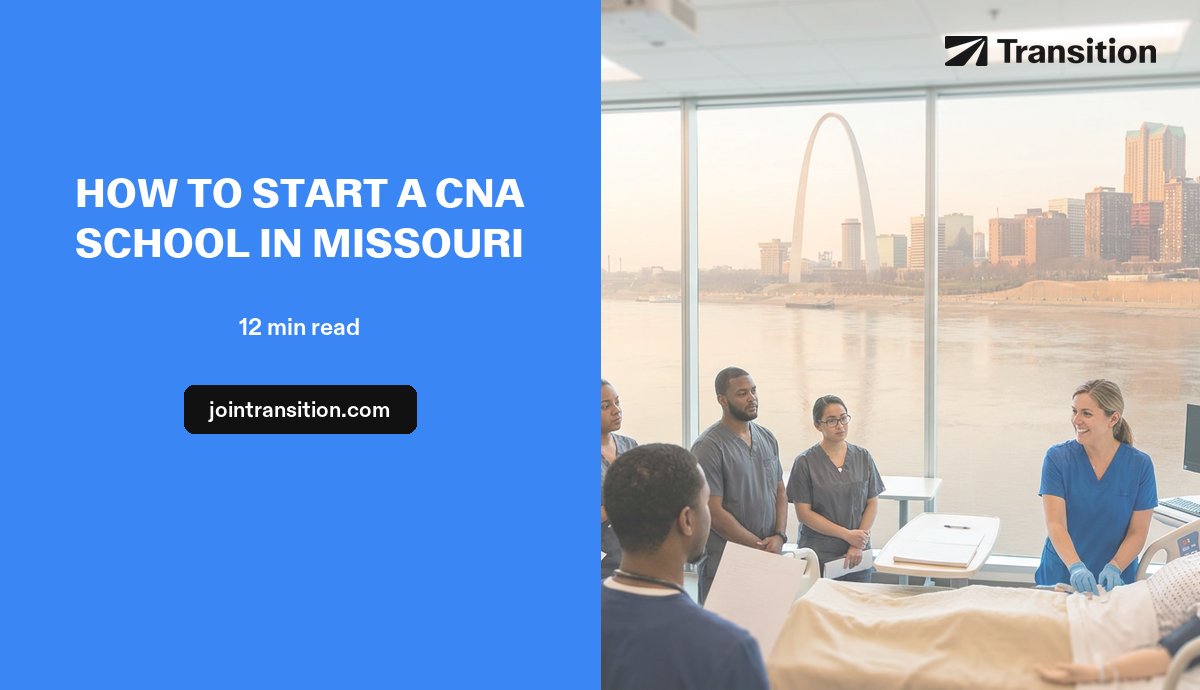
Missouri needs nursing assistants at a pace its schools aren't matching. MERIC — the state's labor-market research arm — has consistently ranked nursing assistants among the top middle-skill occupations for projected openings, with more than 16,000 openings expected over a ten-year window. Long-term care facilities across the state are effectively replacing their entire CNA staff every few years. Someone has to train the replacements.
Here's what makes Missouri different: it's one of the most demanding CNA training states in the country. The federal minimum is 75 hours. Missouri requires 175 — 75 in the classroom and 100 of supervised on-the-job clinical training in a licensed facility. And if you're opening a private school, you'll clear two separate state agencies before you enroll a single student: the Department of Higher Education & Workforce Development (MDHEWD) for proprietary school certification, then the Department of Health and Senior Services (DHSS) for program approval.
We work with CNA and allied-health schools every day — running their enrollment, student records, and compliance paperwork — so we've seen what this process looks like from the inside. This guide walks you through the whole thing, step by step. One note before we start: we're operators, not lawyers. Treat this as a well-researched map, and verify the details with the agencies we name before you spend money.
Quick Facts: CNA School Requirements in Missouri
| Item | Missouri Requirement |
|---|---|
| Total training hours | 175 (75 classroom + 100 on-the-job clinical) |
| Credential | Certified Nurse Assistant (CNA) |
| Approving agency | Missouri DHSS, Health Education Unit |
| Application | Training Agency Application via cnaregistry@health.mo.gov; private schools also apply through MDHEWD's EDvera system |
| Exam vendor | D&SDT-Headmaster (TMU platform, mo.tmutest.com) |
| Registry | Missouri CNA Registry (DHSS) |
| Typical time to approval | 4–9 months for a private school (MDHEWD certification is the long pole) |
| Instructor requirement | Missouri-licensed RN, 2+ years nursing experience incl. 1 year LTC in the last 10, plus an approved instructor workshop |
Step 1: Form Your Business Entity
Start with the Missouri Secretary of State. Most independent school owners form an LLC through the Missouri Online Business Filing portal — Articles of Organization cost $50 filed online (about one business day) versus $105 on paper. Missouri is also one of the few states with no annual report requirement for LLCs, which is a small ongoing win.
Once the LLC is filed, get a free EIN from the IRS (takes minutes online) and open a dedicated business bank account. Keep tuition revenue completely separate from personal funds from day one — you'll need clean financials later, because MDHEWD's certification process asks about your expected tuition revenue and requires a security deposit based on it.
If you plan to seek investors or eventually operate in multiple states, talk to an accountant about whether an LLC taxed as an S-corp fits better. For most single-location schools, a plain LLC is the right call.
Step 2: Register for State Taxes
Register with the Missouri Department of Revenue using Form 2643 or the MyTax Missouri portal. The good news: tuition and educational services are not subject to Missouri sales tax, so most CNA schools only need employer withholding registration, not a sales tax license. (If you sell tangible goods — scrubs, gait belts, printed manuals — ask your accountant whether those sales are taxable.)
When you hire your first instructor, register with the Division of Employment Security via UInteract (uinteract.labor.mo.gov) for unemployment insurance. You become liable once you pay $1,500 in wages in a calendar quarter. The 2026 taxable wage base is $9,000 with a new-employer rate around 2.4% — budget for it, but it won't break you.
Step 3: Secure Your Location, Classroom, and Skills Lab
DHSS expects real training space, and its Training Agency Application asks for proof of it. Missouri's standards contemplate a classroom with a minimum capacity of 15 students, plus the equipment to teach and demonstrate every skill on the curriculum: hospital bed, mannequin, wheelchair, gait belt, blood pressure equipment, hygiene supplies, and the rest of the standard skills-lab kit.
A few practical notes from schools we work with:
- Lease 1,200–2,000 square feet if you can — one classroom, one lab area, a small office. Verify zoning allows instructional use before you sign.
- Because Missouri's 100 clinical hours happen inside a licensed facility (more on that in Step 7), your lab is for teaching and practice, not for logging clinical time. Don't over-build it.
- Your site will be looked at: DHSS approval runs on two-year cycles with an on-site evaluation each approval period, so keep the space audit-ready permanently, not just for opening day.
Step 4: Apply for State Program Approval
This is the heart of the process, and in Missouri it's a two-agency gauntlet for private schools. Get the order right or you'll lose months.
First: MDHEWD Proprietary School Certification. Missouri requires private career schools to hold a Certificate to Operate from the Department of Higher Education & Workforce Development before DHSS will approve them as a CNA training agency. MDHEWD even maintains a dedicated page for CNA programs. You apply through MDHEWD's EDvera online system. Expect:
- A $660 initial certification fee (plus $100 if you're applying for an exemption instead)
- A security deposit — surety bond, CD, or letter of credit — equal to 10% of your expected first-year tuition revenue (minimum $5,000, maximum $100,000)
- A review that MDHEWD itself says "may take several months"
There are statutory exemptions (RSMo 173.616) — for example, a nursing home training only its own employees at no charge — but there is no blanket exemption for CNA schools. If you charge tuition to the public, plan on full certification. One more wrinkle: MDHEWD-certified schools cannot offer CMT (Certified Medication Technician) or Level I Medication Aide programs — those routes run exclusively through DHSS-approved sponsors.
Second: DHSS Training Agency approval. With your Certificate to Operate in hand, submit the Training Agency Application to the DHSS Health Education Unit at cnaregistry@health.mo.gov. Your package needs:
- Your MDHEWD certificate and signed agreement documents
- A signed contract or MOU with a licensed long-term care facility for the clinical portion
- Proof of adequate classroom space and equipment
- Proof your instructor is approved and listed on the TMU instructor registry
DHSS doesn't publish an application fee, which softens the MDHEWD costs a bit. Approval lasts two years with an on-site evaluation each cycle, and renewals are due 30 days before expiration. Critically: you cannot advertise, enroll students, or start classes until both approvals are complete. We've seen eager founders print flyers early — in Missouri, that's a compliance problem, not just a gamble.
Step 5: Hire a Qualified Program Director and Instructors
Missouri sets clear bars here, and DHSS verifies every person by name:
- Instructor: a Missouri-licensed RN (or temporary permit holder) with at least 2 years of nursing experience, including at least 1 year in long-term care within the last 10 years, who has completed a state-approved Nursing Assistant Instructor Workshop — the train-the-trainer courses run through long-term care associations like the Missouri Health Care Association. Instructors apply to the Health Education Unit with a resume, license, and IDs; verification typically takes 7–10 working days, and approved instructors are listed on the TMU instructor registry.
- Clinical supervisor: an RN or LPN with at least 1 year of licensed experience who has completed the clinical supervisor workshop. Missouri requires the instructor to personally teach all 75 classroom hours and at least 16 of the 100 clinical hours; the clinical supervisor covers the remaining 84 and must be physically on the facility premises while students train.
- Examiner (for testing): an RN who did not teach the students being examined and isn't employed by the facility operator — an independence rule that surprises new owners.
Budget $30–$45/hour for instructor pay in most Missouri markets, more in Kansas City and St. Louis. Your instructor is your bottleneck: if they leave mid-cohort, class stops. Line up a second approved instructor as early as you can afford to.
Step 6: Build or Buy a State-Compliant Curriculum
Missouri's curriculum requirement lives in regulation 19 CSR 30-84.010: 75 classroom hours covering the state's required units, 100 hours of supervised on-the-job training, and a final examination. The rule was last amended effective December 30, 2021, and it prescribes the classroom methods you'd expect — lecture, video, demonstration and return-demonstration.
Two things to know:
- The split is fixed. You can't shift hours between classroom and clinical the way you can in 75-hour states. Build your schedule around 75 + 100 from the start. Most schools run this as a 4–8 week full-time program or 10–14 weeks part-time.
- Online delivery is a gray area. The regulation doesn't explicitly authorize distance learning for the classroom portion. If a hybrid model matters to your business plan, get written guidance from the Health Education Unit before you build it. Don't assume.
You can write your own curriculum mapped to the state's units or license one from a publisher — either way, keep the hour-by-hour breakdown documented, because it's part of what site evaluators check.
Step 7: Set Up Clinical Site Agreements
Missouri's clinical portion isn't a field trip — it's 100 hours of genuine on-the-job training inside a licensed skilled nursing facility, intermediate care facility, hospital, hospital-based nursing facility, or Missouri Veterans Home. A standalone school must have a signed contract or MOU with a licensed facility before DHSS will approve it, and many students are actually employed by the facility while they train.
Common snags we see:
- Facilities want students who'll stay and work for them. Lead with that: your school is a hiring pipeline, and the OJT model makes it natural for facilities to hire trainees.
- The clinical supervisor must be on the premises for all supervised hours — nail down in the agreement who provides that supervisor and who pays them.
- Facility survey trouble can knock out your clinical site. Have a backup facility relationship before you need one.
Step 8: Understand Testing and the State Registry
Missouri's competency exam is run by D&SDT-Headmaster on the TestMaster Universe (TMU) platform at mo.tmutest.com — the same system that hosts the instructor and clinical supervisor registries and every candidate's account. The exam is a 75-question written test plus a skills demonstration.
As a training agency, you'll live in TMU: entering students, tracking their eligibility, and scheduling testing. Schools with approved space and an approved examiner can host test events on-site, which is a real enrollment selling point — students strongly prefer testing in the room where they trained. Remember the examiner independence rules from Step 5 when you plan this.
Students who pass land on the Missouri CNA Registry, maintained by DHSS. Employers verify certification there, so walk your graduates through checking their own listing — it's a small service that generates goodwill and reviews.
Step 9: Set Up Enrollment, Payments, and Student Records
Here's the part the state doesn't test but your survival depends on. Between MDHEWD's tuition-revenue reporting, DHSS's two-year evaluations, TMU data entry, and 175 hours of attendance per student, a Missouri CNA school generates more paperwork per graduate than almost any other state's.
This is what we built Transition for. Schools use it to run branded online enrollment, take payments and payment plans, track attendance and grades against the 75/100 hour requirements, e-sign enrollment agreements and clinical MOUs, and automate the onboarding emails and texts that keep students showing up. One system instead of spreadsheets, Jotform, Square, and a filing cabinet — and when the site evaluator asks for records, you export them instead of excavating them.
Step 10: Launch with a Local Marketing Plan
You can't advertise until both approvals land — but the day they do:
- Google Business Profile first. "CNA classes near me" is how most students find you. Ask every graduating cohort for reviews; ten 5-star reviews will out-market a billboard.
- Partner with Missouri Job Centers. The Office of Workforce Development (under MDHEWD, jobs.mo.gov) funds training for eligible job seekers — getting on their radar can fill seats with funded students.
- Work your clinical facility. Facilities that sponsor or hire your students are your best referral engine; some will fund tuition for new hires.
- Keep a simple one-page website with dates, price, and an enroll-now button — then respond to inquiries within minutes, not days. Speed of follow-up wins more enrollments in this market than any ad spend.
What It Really Costs
Realistic estimated startup ranges for a single-location Missouri school:
| Item | Estimated Range |
|---|---|
| LLC formation + EIN | $50–$200 |
| MDHEWD certification fee | $660 |
| MDHEWD security deposit (bond/CD) | $5,000–$100,000 held (bond premium often $500–$2,000/yr) |
| Insurance (liability + professional) | $2,000–$5,000/yr |
| Rent + deposit (first 3–6 months) | $6,000–$20,000 |
| Skills lab equipment | $8,000–$20,000 |
| Curriculum (build or license) | $1,000–$5,000 |
| Instructor payroll (pre-revenue + first cohort) | $8,000–$20,000 |
| Marketing (first 6 months) | $2,000–$6,000 |
| Software, records, enrollment systems | $1,000–$3,000/yr |
| Bottom line (cash outlay) | ~$30,000–$80,000 |
The bond is the Missouri-specific line item people miss: it's 10% of expected first-year tuition revenue, so a school projecting $200,000 in tuition posts a $20,000 security instrument. A surety bond premium keeps the cash cost manageable, but it's underwritten — clean personal credit helps.
How Long It Takes
Plan on 4–9 months from LLC filing to first class in session. The variance is almost entirely MDHEWD: proprietary school certification "may take several months" by the agency's own description, and it must finish before DHSS review starts. DHSS approval itself — with a complete application, an approved instructor, and a signed clinical MOU — is comparatively quick. Founders who assemble the instructor approval and facility MOU while MDHEWD reviews their certification compress the timeline dramatically. Founders who do everything sequentially don't.
Common Mistakes to Avoid
- Applying to DHSS before MDHEWD. Private schools need the Certificate to Operate first. Doing it backwards costs you a full resubmission cycle.
- Advertising or enrolling before both approvals are final. Missouri explicitly prohibits it — and MDHEWD checks.
- Underestimating the 175 hours. Pricing and scheduling copied from a 75-hour state's playbook will sink your margins. Your cost per graduate is roughly double.
- One instructor, no backup. The instructor must teach all 75 classroom hours personally. If they quit mid-cohort, you're stuck.
- A handshake clinical arrangement. DHSS wants a signed contract/MOU with a licensed facility in the application package — get it in writing early.
- Ignoring the two-year re-approval clock. The on-site evaluation comes every cycle. Schools that keep attendance, skills checklists, and records continuously ready pass without drama.
FAQ
How much does it cost to start a CNA school in Missouri? Most founders should budget $30,000–$80,000 in cash, plus a security deposit (bond, CD, or letter of credit) equal to 10% of expected first-year tuition revenue — minimum $5,000. The MDHEWD certification fee is $660; DHSS publishes no separate application fee.
Do I need to be a nurse to open a CNA school in Missouri? No. The owner doesn't need a clinical license, but your program must have a Missouri-licensed RN instructor with 2+ years of experience (including a year of long-term care in the last 10) who has completed the state instructor workshop, plus an RN or LPN clinical supervisor.
How many training hours does Missouri require for CNAs? 175 total — 75 classroom hours plus 100 hours of supervised on-the-job clinical training in a licensed facility, per 19 CSR 30-84.010. That's more than double the 75-hour federal minimum.
Can CNA classes be online in Missouri? The regulation doesn't expressly authorize online delivery for the 75 classroom hours, and the 100 clinical hours must happen in person at a licensed facility regardless. If you want a hybrid model, get written guidance from the DHSS Health Education Unit before building it.
Who approves CNA schools in Missouri? Two agencies for private schools: MDHEWD (proprietary school Certificate to Operate, via the EDvera system) and then DHSS's Health Education Unit (training agency approval). Facility-based programs training their own employees may qualify for an MDHEWD exemption and deal mainly with DHSS.
What exam do Missouri CNA students take? The Missouri CNA exam is administered by D&SDT-Headmaster through the TMU platform (mo.tmutest.com): a 75-question written exam plus a skills test. Passing students are listed on the Missouri CNA Registry maintained by DHSS.
Can my school become a test site? Yes — schools with suitable space and an approved independent examiner (an RN who didn't teach the candidates) can host Headmaster test events. It's a meaningful competitive advantage when recruiting students.
Disclaimer
This guide is for general information, not legal advice. Missouri's rules, fees, and forms change — 19 CSR 30-84.010 was itself amended in 2021, and agency processes move online and shift. Verify current requirements with the DHSS Health Education Unit (cnaregistry@health.mo.gov), MDHEWD (PropCompliance@dhewd.mo.gov), and your own attorney and accountant before making commitments.
The Paperwork Gets You Open. The Systems Keep You Open.
Two agencies, 175 hours, two-year evaluations — Missouri rewards schools that run tight operations. See how Transition handles enrollment, payments, student records, e-signatures, and automated messaging for CNA schools like yours at jointransition.com.
Get CNA training paid for.
Tell us your county and we text you the route that fits, who to call, and what to bring.