
How to Start a CNA School in Montana (2026 Guide)
July 27, 2026 · Montana
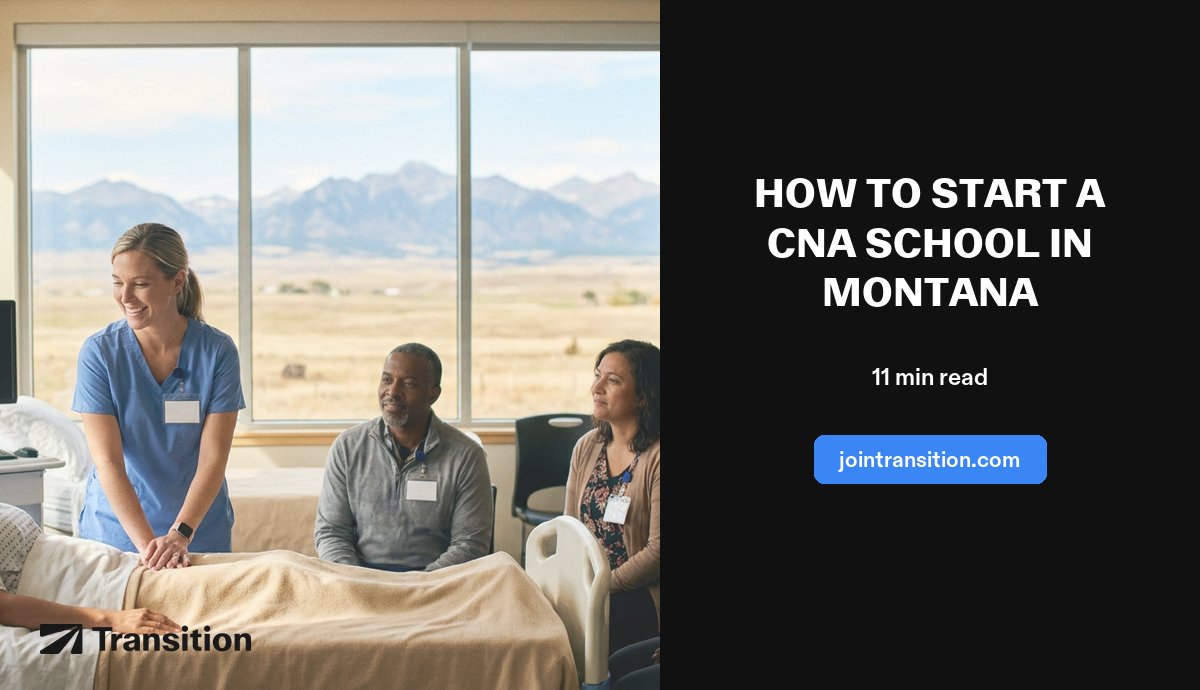
Montana's long-term care facilities are competing for a workforce that keeps shrinking. Rural counties from Glendive to Libby have nursing homes running short-staffed, hospitals in Billings and Missoula are hiring aides as fast as they can certify them, and the state's home health sector — which Montana folds into the very same training curriculum — needs even more. If you've been thinking about opening a nurse aide training program here, the demand side of the equation is not your problem.
Here's the good news about Montana specifically: it's one of the more straightforward states to get approved in. There's no application fee, no separate private career school license to chase, and a single agency — the Department of Public Health and Human Services (DPHHS) Certification Bureau — reviews your whole package. The catch is that it's a paper process (PDF applications, mail or email, no slick portal), and the Bureau gives itself up to 90 days to respond. Planning around that window is half the game.
We help CNA and allied-health schools around the country run their day-to-day operations — enrollment, records, payments, messaging — so we've seen what tends to trip new founders up. This guide walks the whole path. One note before we start: we're operators and software people, not lawyers. Verify everything below with DPHHS and your own counsel before you spend real money.
Montana CNA School Quick Facts
| Item | Detail |
|---|---|
| Total training hours | 75 (federal minimum; Montana adds no state hour rule) |
| Classroom / clinical split | Not fixed by regulation — you propose it; ≥16 hours supervised clinical, and 16 classroom hours required before any resident contact |
| Credential | Certified Nurse Aide (CNA) |
| Approving agency | Montana DPHHS, Certification Bureau / Nurse Aide Registry (Quality Assurance Division) |
| Application | Nurse Aide Training Program Application (PDF) — mailed or emailed to cna@mt.gov; no fee |
| Exam vendor | D&S Diversified Technologies / Headmaster (TMU platform) |
| Registry | Montana Nurse Aide Registry |
| Typical time to approval | Bureau has up to 90 days to respond; plan 2–4 months |
| Instructor rule (short version) | Program Coordinator: RN with 2 years nursing experience, 1 in long-term care. Clinical instructors: RN or LPN, same experience floor |
Step 1 — Form your business entity
Montana business filings run entirely online through the Secretary of State's SOS Online Business Services portal at biz.sosmt.gov — there's no paper option. Most school founders form an LLC; the filing fee for Articles of Organization is $35, one of the cheapest in the country. Montana even waives the annual report fee if you file by April 15 each year.
While you're at it: get a free EIN from the IRS (takes ten minutes online), then open a dedicated business bank account. Keep tuition revenue separate from personal funds from day one — it makes taxes, refunds, and any future audit dramatically simpler.
Step 2 — Register for state taxes
Montana has no general sales tax, so you won't be collecting sales tax on tuition — a small mercy compared to some states. You will still need to register with the Montana Department of Revenue (via its TransAction Portal, TAP) for income tax withholding once you hire instructors, and with the Montana Department of Labor & Industry for unemployment insurance. If you pay any instructor as a 1099 contractor, talk to an accountant first; misclassification is a common and expensive early mistake.
Step 3 — Secure your location, classroom, and skills lab
Montana's application doesn't publish square-footage minimums, but your curriculum package has to show where and how you'll teach every mandatory unit — personal care skills, safety and emergency procedures, transfers, infection control — which in practice means a functioning skills lab. Plan on at least one hospital bed, a mannequin, a wheelchair, a mechanical lift or transfer equipment, a working sink for handwashing instruction, vitals equipment, and standard supplies (briefs, linens, gait belts, PPE).
Zoning matters: confirm with your city or county that your space is approved for instructional use before signing a lease. A modest 1,200–2,000 square foot space with one classroom and one lab area is a typical starting footprint for a first cohort of 8–12 students.
Step 4 — Apply for DPHHS program approval
This is the heart of the process. Montana calls these programs Nurse Aide Training Programs (NATPs), and approval runs through the DPHHS Certification Bureau / Nurse Aide Registry in Helena. There is no online portal for program approval — you download the Nurse Aide Training Program Application PDF from the DPHHS site and submit by mail (PO Box 202953, Helena, MT 59620) or email curriculum materials to cna@mt.gov.
Your package needs to include, per the application's own checklist:
- The NATP/HHA Training Program Application itself
- A Program Coordinator Application (with license copy and resume)
- Clinical Instructor Application(s) for every instructor
- Supplemental Instructor applications, if you're using guest experts
- A copy of your curriculum and textbook
- Your class schedule
- The Core Curriculum Requirements Checklist — this is the piece people underestimate. You must map each of Montana's 12 mandatory topic units (residents' rights, communication, personal care, safety, death and dying, nutrition, infection control, and so on) to the week it's taught and the textbook chapter that covers it.
Two Montana-specific curriculum details worth flagging: your rights unit must cover Montana residents' rights and the Montana Elder Abuse Act specifically, not just generic federal content. And CPR is recommended but not mandatory in the state's core curriculum.
There is no application fee, and the application states the Bureau has 90 days to respond. Approval appears to be primarily a curriculum/paper review rather than a pre-approval site inspection, but be responsive if the Bureau asks for revisions — the 90-day clock is a ceiling, and clean applications move faster.
One more thing that makes Montana distinctive: the state uses a single combined CNA/HHA core curriculum, so the same application can cover a Home Health Aide program if you add the five extra HHA topic units (home ambulation equipment, home transfers, home safety, contaminated-supply disposal, and home management). If home health training is on your roadmap, it's efficient to apply for both at once.
Step 5 — Hire a qualified program coordinator and instructors
Montana's instructor rules come straight off the state's Coordinator/Instructor application:
- Program Coordinator: must be an RN with at least 2 years of nursing experience, including at least 1 year in long-term care services.
- Clinical instructors: may be RN or LPN, with the same 2-years / 1-year-LTC experience floor.
- All instructors must have completed a course in teaching adults or have experience teaching adults or supervising aides — Montana does not require a formal train-the-trainer certificate.
- Supplemental instructors (guest speakers on nutrition, activities, social services, etc.) need at least 1 year of experience in their field.
- One quirk: a facility's Director of Nursing may serve as Program Coordinator but may not be an instructor.
Each instructor's packet needs a copy of their current Montana license and a resume documenting both clinical and teaching experience. Line these people up before you apply — the program can't be approved without them.
Step 6 — Build or buy a state-compliant curriculum
Montana doesn't impose hour requirements beyond the federal floor: 75 total hours, at least 16 hours of supervised clinical, and 16 hours of classroom instruction before any student touches a resident (covering communication, independence, residents' rights, safety, and basic infection control). The classroom/clinical split beyond that is yours to propose — the application literally has blank fields for "Classroom Hours" and "Clinical Hours."
In practice, many Montana programs run something like 50 classroom/lab hours and 25 clinical hours — but the ~25-hour clinical figure is convention, not regulation, so design what actually prepares students for the Headmaster skills exam. Whether you write your own curriculum or license a published one, you must complete the state's Core Curriculum Requirements Checklist mapping every mandatory topic to your schedule and textbook. A licensed curriculum ($400–$3,000) plus your own checklist mapping is the fastest route for most founders.
Step 7 — Set up clinical site agreements
Your students' supervised clinical hours need to happen with real residents under your instructor's supervision — typically in a licensed skilled nursing facility or long-term care setting. You'll need a written affiliation agreement with each facility naming the site in your application.
Montana's rural geography is the snag here. Outside Billings, Missoula, Great Falls, and Bozeman, you may have exactly one nursing home within reasonable driving distance — and it may already host another program or be wary of the liability. Approach facilities as a workforce partner, not a favor-asker: your graduates are their future hires. Offer to prioritize their hiring pipeline, schedule clinicals around their survey windows, and carry your own liability insurance. Get the agreement signed before you submit to DPHHS.
Step 8 — Understand testing and the Montana Nurse Aide Registry
Montana's competency exam is run by D&S Diversified Technologies / Headmaster — a company actually headquartered in Helena — on its TMU (TestMaster Universe) platform. Students take a written knowledge test and a hands-on skills demonstration. Your program will register candidates through TMU, and passing students land on the Montana Nurse Aide Registry, maintained by the DPHHS Certification Bureau (public verification runs through the state's BOUNDS portal).
Established training programs can often serve as in-facility test sites with an approved proctor/observer setup, which is a real competitive advantage — students strongly prefer testing in the room where they trained. Ask Headmaster's Montana office about test-site requirements once you're approved. Track your pass rates from cohort one; they're your best marketing asset and your early-warning system.
Step 9 — Set up enrollment, payments, and student records
Approval gets you open; operations keep you open. From day one you'll be juggling enrollment applications, tuition payments and payment plans, signed enrollment agreements, attendance logs DPHHS-ready documentation of those 75 hours, skills checklists, and exam registrations — per student, per cohort.
Most new schools cobble this together from spreadsheets, Jotform, Square, and a filing cabinet, and it works until the first time a student disputes a payment or an auditor asks for attendance records. This is what we built Transition for: branded online enrollment, payment plans, attendance and grade tracking, document e-signature, automated onboarding emails and texts, and end-of-course surveys in one system. Schools we work with typically get their enrollment-to-first-class pipeline fully automated before their second cohort.
Step 10 — Launch with a local marketing plan
In Montana's small markets, reputation compounds fast. The launch checklist:
- Google Business Profile first — most students find CNA classes by searching "CNA classes near me." Ask every graduate for a review.
- Connect with Job Service Montana — the state's workforce arm under the Department of Labor & Industry, with 18 offices statewide and the MontanaWorks.gov platform. Workforce counselors refer training-ready jobseekers, and some students may qualify for WIOA funding once you're an eligible provider.
- A simple one-page website with your schedule, price, and an online application that takes five minutes. Speed-to-contact wins: the school that calls back first usually gets the student.
- Partner with the facilities hosting your clinicals — many will sponsor employees through your program.
What it really costs
Realistic startup ranges for a modest first location (estimates — your market will vary):
| Item | Estimated range |
|---|---|
| LLC formation (MT SOS) | $35 |
| Liability insurance (annual) | $1,500 – $4,000 |
| Rent deposit + first months | $3,000 – $10,000 |
| Skills lab equipment (bed, mannequin, lift, supplies) | $5,000 – $15,000 |
| Curriculum (licensed) + textbooks | $500 – $3,500 |
| Instructor payroll (pre-revenue + first cohort) | $5,000 – $15,000 |
| DPHHS application fee | $0 |
| Marketing (site, GBP, launch ads) | $1,000 – $5,000 |
| Total to first cohort | $16,000 – $52,000 |
The zero-dollar application fee is real, but don't let it fool you into under-budgeting the lab and payroll lines — those are where the money actually goes.
How long it takes
Plan on 4 to 7 months from "decision" to "first class." Entity formation takes days; finding a lease and a qualified RN coordinator usually takes 1–3 months; assembling the curriculum checklist and application takes 2–6 weeks; and DPHHS has up to 90 days to respond. The biggest variance drivers in Montana are the clinical site agreement (especially rural) and how clean your curriculum checklist is on first submission — a bounce-back for revisions can restart much of the review clock.
Common mistakes to avoid
- Submitting a generic curriculum without the Montana checklist mapping. The Core Curriculum Requirements Checklist must tie every mandatory unit to a week and a textbook chapter — including Montana residents' rights and the Montana Elder Abuse Act.
- Assuming 25 clinical hours is required. Only the 16-hour federal clinical floor is regulatory in Montana; design your split deliberately rather than copying a number off a third-party site.
- Applying before instructors are secured. The coordinator and instructor applications are part of the program package — no staff, no approval.
- Ignoring the 90-day clock in your lease negotiations. Don't start paying full rent in month one of a review that can run three months.
- Skipping the DON rule. If your clinical site's Director of Nursing was going to teach, she can't — she can only coordinate.
- No system for documenting hours. DPHHS-certified completion depends on documented attendance; reconstructing hours from memory after the fact is how programs get into trouble.
FAQ
How much does it cost to start a CNA school in Montana? Most founders should budget roughly $16,000–$52,000 to reach their first cohort, depending mainly on lease and lab decisions. Montana keeps regulatory costs unusually low: $35 to form an LLC and no DPHHS application fee.
Do I need to be a nurse to open a CNA school in Montana? No — the owner doesn't need a clinical license. But your Program Coordinator must be an RN with 2 years of nursing experience including 1 year in long-term care, and every clinical instructor must be an RN or LPN meeting the same experience floor.
How many training hours does Montana require? 75 total hours — the federal minimum. At least 16 must be supervised clinical, and students need 16 hours of classroom instruction before any resident contact. Montana doesn't fix the rest of the split; you propose it in your application.
How long does DPHHS approval take? The Certification Bureau gives itself up to 90 days to respond to a program application. Clean, complete applications often move faster; incomplete ones bounce and effectively restart the process.
Can CNA classes be online in Montana? Montana's application materials don't address delivery format, so hybrid/online theory isn't explicitly authorized or prohibited. Clinical hours must always be in person. Ask the Certification Bureau (cna@mt.gov) directly before building an online-heavy model.
What exam do my graduates take? The Montana CNA knowledge and skills exams run through D&S Diversified Technologies/Headmaster on the TMU platform. Passing candidates are placed on the Montana Nurse Aide Registry.
Can I also train Home Health Aides? Yes — Montana uses a combined CNA/HHA core curriculum, and the same DPHHS application covers HHA programs if you add the five additional home-care topic units. It's the cheapest program expansion you'll ever do.
Disclaimer
This guide is for general information, not legal advice. Montana's requirements can change, and DPHHS policy documents are updated periodically — verify current rules with the DPHHS Certification Bureau (cna@mt.gov), the Montana Secretary of State, and your own attorney or accountant before making commitments.
The paperwork gets you open. The systems keep you open.
Once DPHHS says yes, the real work is enrollment, records, payments, and follow-up — every day, for every student. See how Transition runs enrollment, student records, messaging, and compliance for CNA schools like yours at jointransition.com.
Get CNA training paid for.
Tell us your county and we text you the route that fits, who to call, and what to bring.