
How to Start a CNA School in Nevada (2026 Guide)
July 27, 2026 · Nevada
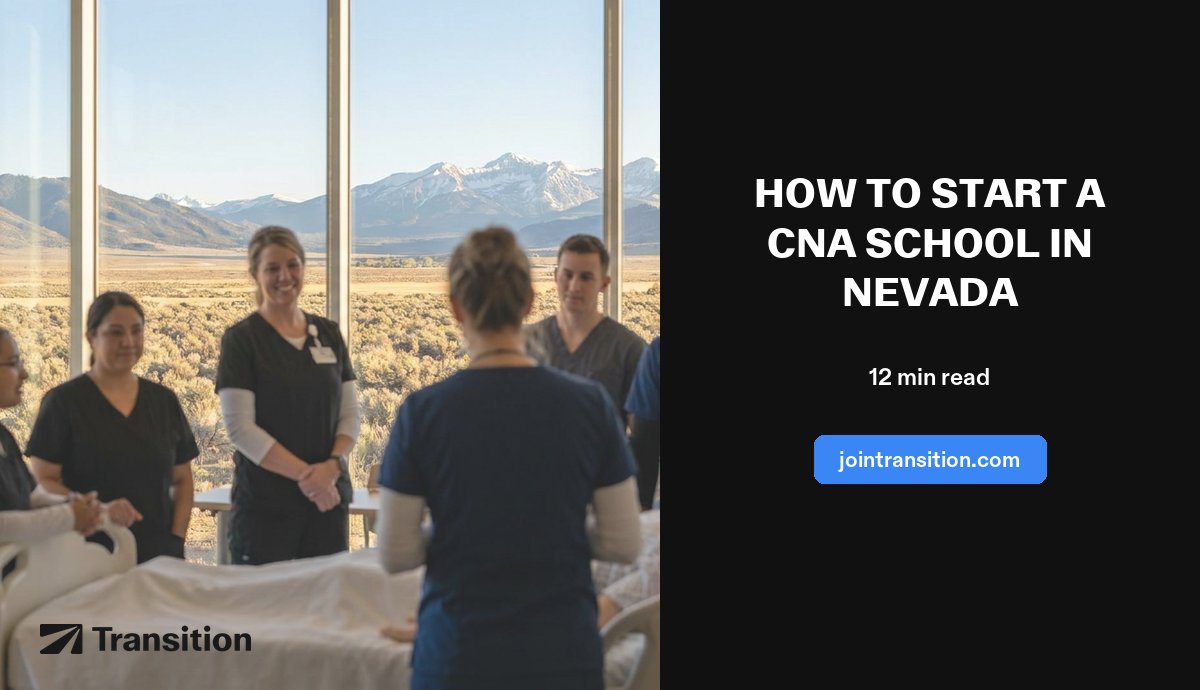
Las Vegas and Reno are two of the fastest-growing healthcare markets in the West, and Nevada's skilled nursing facilities, hospitals, and home care agencies are all pulling from the same undersized pool of certified nursing assistants. Demand isn't the question here. The question is whether you're prepared for Nevada's approval gauntlet — because this state has two structural requirements most founders have never heard of until they're deep in the application.
First: every nursing assistant training program in Nevada must be administered through an "academic administrator" — by statute, that means the Nevada System of Higher Education, an approved career-and-technical-education program, a Nevada public school, or a nationally recognized accrediting body. A private school has to contract with one. Second: a private, tuition-charging school also needs a license from the Commission on Postsecondary Education (CPE) on top of Board of Nursing program approval. Neither is a dealbreaker — schools clear both every year — but they change your timeline and your budget, and it's far better to know now.
We work with CNA and allied-health schools every day on the operational side — enrollment, records, payments, messaging — and this guide walks Nevada's full path in order. Standard caveat, meant genuinely: we're operators, not attorneys. Verify everything with the Board of Nursing and CPE before spending real money.
Nevada CNA School Quick Facts
| Item | Detail |
|---|---|
| Total training hours | 75 minimum (≥60 theory + lab by statute); plan 76+ so clinical meets the federal 16-hour supervised-practical floor |
| Classroom / clinical split | ≥60 theory/lab; ~15–16 clinical; 16 classroom hours required before any direct patient contact |
| Credential | Certified Nursing Assistant (CNA) — certified by the Board of Nursing |
| Approving agency | Nevada State Board of Nursing (NSBN); NRS 632.2856 and NAC 632.721–632.805 |
| Also required (private schools) | Commission on Postsecondary Education (CPE) license + academic administrator agreement |
| Application | NATP Initial Application for Approval, emailed to NSBN; $250 fee; on-site visit before approval |
| Exam vendor | Credentia (NNAAP written/oral + skills) |
| Registry | NSBN itself — CNA certification via the Nevada Nurse Portal (no separately named registry) |
| Typical time to approval | 4–9 months all-in (CPE licensing and the academic administrator contract drive variance) |
| Instructor rule (short version) | NV RN, 3 years experience incl. 1 year with elderly/chronically ill and 1 year LTC, plus a Board-approved train-the-trainer course (iCNA approval) |
Step 1 — Form your business entity
Nevada business formation runs through SilverFlume (nvsilverflume.gov), the Secretary of State's business portal. Nevada's costs stack up in a way that surprises people used to cheaper states: Articles of Organization $75, plus the Initial List of Managers/Members $150, plus the State Business License $200 — $425 total to stand up an LLC, and about $350 per year after that (annual list + license renewal). The trade-off is no state income tax.
Get your EIN free from the IRS, open a dedicated business bank account, and keep tuition revenue cleanly separated — you'll need a program budget and per-student cost breakdown in your NSBN application, and CPE will look at your finances too.
Step 2 — Register for state taxes
No state income tax in Nevada, but you're not off the hook: register with the Nevada Department of Taxation for the Modified Business Tax (a payroll-based tax) once you have employees, and with the Employment Security Division for unemployment insurance. Nevada's Commerce Tax only kicks in above $4 million in gross revenue — not a year-one problem. Tuition for instructional services isn't subject to sales tax, but taxable sales of books or supplies may be; confirm specifics with your accountant.
Step 3 — Secure your location, classroom, and skills lab
Nevada inspects before it approves: new programs get an on-site visit to verify classroom and clinical-facility standards under NAC 632.780 before approval issues, and the Board inspects at least once every 24 months after. Your application must also list the physical sites used to teach theory and the enrollment caps per class.
Equip a real skills lab — beds, mannequins, wheelchair, mechanical lift or transfer aids, working handwashing sink, vitals equipment, supplies keyed to the NSBN CNA Skills Guidelines — because your skills checklist is a required application attachment. Size the room to your instructor plan: Nevada caps skills/lab/clinical instruction at 15 trainees per instructor.
Step 4 — Apply for program approval (NSBN + CPE + the academic administrator)
This is the heart of the Nevada process, and it has three interlocking parts.
Part 1 — The academic administrator. Under NRS 632.2856(6), your program must be administered through the Nevada System of Higher Education, a State Board of Education–approved CTE program, a Nevada public school, or another nationally recognized accrediting/approving body. Private schools satisfy this by contract — the signed Academic Administrator Agreement is literally an attachment in the NSBN application. Start this conversation first; it's the piece with no standard price list and the longest negotiation.
Part 2 — CPE licensure. NSBN states plainly that private programs charging student fees must also be licensed by the Commission on Postsecondary Education (cpe.nv.gov). CPE is the sole licensing authority for private postsecondary institutions under NRS 394, and a tuition-charging CNA school squarely fits the definition. Expect a uniform application with Nevada supplemental forms, a surety bond, notarized documents, annual year-end reports, and a new-license fee reported around $2,000 — confirm the current amount with CPE directly.
Part 3 — The NSBN application itself. The Nursing Assistant Training Program Initial Application for Approval is submitted by email to the Board's CNA Training Program Specialist with a $250 non-refundable fee. The required attachments run sixteen items deep, including: the Academic Administrator Agreement, your CPE license copy, your Nevada business license, an instructor list with RN and iCNA license numbers and resumes, all policies and procedures, a program budget, a blank certificate of completion, your skills checklist, course outline, a syllabus showing hours per unit across lecture/lab/clinical with behavioral objectives, signed clinical contracts (at least one Board-approved clinical site), a student course evaluation form, enrollment caps, and a per-student cost breakdown.
After paper review comes the pre-approval site visit. Once approved, know the maintenance rules: approval runs one year, all programs renew annually by August 1 with a $100 review fee, any revision — hours, content, sites, staff — needs prior Board approval, and approval can be withdrawn if 20% or more of your trainees fail the competency exam or you go 12 months without holding a class. That 20% rule should shape your admissions and exam-prep strategy from day one.
Step 5 — Hire a qualified primary instructor (iCNA)
Nevada layers statute, regulation, and Board practice, and the Board currently enforces the union of all three. To be approved as a CNA instructor (iCNA), your nurse needs:
- A current, unencumbered Nevada RN license (the license to teach is Nevada-specific)
- 3 years of nursing experience including direct patient care, staff supervision, and staff education
- 1 year caring for the elderly or chronically ill, and 1 year in a long-term care facility
- Completion of a Board-approved train-the-trainer course
- iCNA approval via the Nevada Nurse Portal, renewed annually (~$100/year, with a requirement of paid teaching within the past two years to renew)
An LPN may substitute only where the RN requirement creates hardship. Non-nurse specialty instructors (e.g., a dietitian teaching nutrition) are allowed with a year of relevant elderly/chronic-care experience, but can't serve as primary instructor or test manual skills. And in facility-based programs, the Director of Nursing cannot be the primary instructor. Budget both the train-the-trainer course and the annual iCNA fee into your staffing costs — and start recruiting early, because RNs meeting the full stack are scarce.
Step 6 — Build a state-compliant curriculum
Nevada's statute fixes the shape: at least 75 total hours, of which at least 60 must be theory and laboratory skills. Regulation adds that at least 16 classroom hours — communication, infection control, safety and emergencies (including the Heimlich maneuver), promoting independence, residents' rights — must come before any direct patient contact. Orientation time doesn't count toward the 75.
Here's the design nuance that trips up bare-minimum planners: at exactly 75 hours with 60 theory/lab, clinical is only ~15 hours — but the federal NATCEP floor requires at least 16 hours of supervised practical training, and Nevada adopts the federal standard for facility-based programs. The clean solution: build 76+ hours (60 theory/lab + 16 clinical) and satisfy both rulebooks. Your syllabus must map hours per unit into lecture, lab, and clinical columns with behavioral objectives — do this properly the first time, because every later change requires prior Board approval. Nevada also requires program exit tests before students sit the state exam: a theory exam passed at 80% and an RN-administered pass/fail skills test.
Step 7 — Set up clinical site agreements
Every clinical site must be Board-approved with a signed clinical agreement, and you need at least one to apply. Skilled nursing facilities are the standard partners. In Las Vegas and Reno, the challenge is competition — multiple programs court the same facilities — while in rural Nevada it's scarcity.
Pitch facilities on the pipeline: your graduates are their hires, and Nevada's CNA renewal rule (which requires 40 hours of paid CNA work every two years to keep certification) means facilities benefit from a steady local training partner. Get agreements signed before you submit, and remember that adding a site later means another Board approval cycle — line up a second site early if you can.
Step 8 — Understand testing and Nevada CNA certification
Nevada's competency exam is run by Credentia (the NNAAP exam): a 70-question written test (oral option available) plus a skills evaluation, with one year from program completion to pass. Unlike most states, there's no separately named registry — certification is issued and maintained by the Board of Nursing itself, with candidates applying through the Nevada Nurse Portal, paying a $50 application fee, and completing a fingerprint-based background check (employment fingerprints can't be reused — it's a separate submission).
Watch your numbers obsessively here, because of the 20%-failure withdrawal rule: your pass rate isn't just marketing in Nevada, it's your license to operate. Track first-attempt results by skill and by written domain from cohort one, and remediate before students test, not after they fail.
Step 9 — Set up enrollment, payments, and student records
Nevada's record demands are explicit: permanent trainee records including grades and completion certificates (NAC 632.790), the Board-approved certificate of completion, documented exit-test results, Board inspections every 24 months — plus CPE's annual reporting on top.
Doing that with spreadsheets, Jotform, Square, and a filing cabinet works until the first inspection or payment dispute. This is what we built Transition to handle: branded online enrollment, payment plans, attendance and grade tracking, e-signed enrollment agreements, automated email/SMS onboarding (fingerprint appointments, exam registration, class reminders), and surveys — one system with a clean audit trail for when the Board shows up.
Step 10 — Launch with a local marketing plan
- Google Business Profile first; reviews from every cohort. In Las Vegas's crowded training market, review volume plus a published pass rate is the differentiator.
- Get on Nevada's WIOA Eligible Training Provider List through DETR (the Department of Employment, Training and Rehabilitation) and your local board — Workforce Connections in southern Nevada, Nevadaworks in the north. ETPL status unlocks funded students via EmployNV, and Nevada's list even has reciprocity with Arizona, California, and Utah.
- Partner with your clinical facilities on employer-sponsored cohorts.
- Fast follow-up wins: a one-page site, five-minute online application, same-day response. The Board's requirement that you hold at least one class every 12 months is a floor you'll clear easily if your funnel works.
What it really costs
Realistic startup ranges for a private school (estimates — Nevada runs mid-to-high because of the dual licensure):
| Item | Estimated range |
|---|---|
| LLC formation (SilverFlume, all-in) | $425 |
| CPE license + surety bond premium | $2,200 – $4,000 |
| Academic administrator agreement | varies — budget $1,000 – $5,000+/yr |
| NSBN application + site visit + iCNA fees | $400 – $700 |
| Train-the-trainer course for your RN | $300 – $800 |
| Liability insurance (annual) | $2,000 – $5,000 |
| Rent deposit + build-out + first months | $6,000 – $20,000 |
| Skills lab equipment | $6,000 – $18,000 |
| Instructor payroll (pre-revenue + first cohort) | $8,000 – $20,000 |
| Marketing (site, GBP, launch ads) | $2,000 – $6,000 |
| Total to first cohort | $28,000 – $80,000 |
How long it takes
Plan on 4 to 9 months. Entity formation is a week; the long poles are the academic administrator contract (no standard timeline — start immediately), CPE licensure (application, bond, review), assembling the sixteen-attachment NSBN package, and scheduling the pre-approval site visit. The August 1 annual renewal cycle is worth planning around too — approval close to summer means your first renewal comes fast. Founders who run the CPE and academic-administrator tracks in parallel with the NSBN paperwork land at the short end of the range.
Common mistakes to avoid
- Discovering the academic administrator rule late. NRS 632.2856(6) requires it and the signed agreement goes in your application. It's the single most Nevada-specific hurdle — start there.
- Skipping CPE licensure. Board program approval is not institutional licensure. A private tuition-charging school needs both, and operating unlicensed puts the whole business at risk.
- Building a bare 75-hour program. At 60 theory/lab hours, that leaves ~15 clinical — below the federal 16-hour supervised-practical floor. Build 76+ and stop worrying.
- Treating the syllabus as a draft. Every revision to hours, content, sites, or staff needs prior Board approval. Submit the program you actually intend to run.
- Ignoring the 20% failure rule. In Nevada a bad cohort isn't just embarrassing — a ≥20% competency-exam failure rate is grounds for withdrawal of approval.
- Underestimating instructor lead time. Your RN needs three years of qualifying experience, a train-the-trainer course, and iCNA approval before you can even apply. Recruit first, lease later.
FAQ
How much does it cost to start a CNA school in Nevada? Realistically $28,000–$80,000 to first cohort for a private school, including the $425 LLC stack, CPE licensing and bond, the academic administrator agreement, the $250 NSBN application, lab build-out, and payroll.
Do I need to be a nurse to open a CNA school in Nevada? No — but your primary instructor must be a Nevada-licensed RN with 3 years of experience (including a year with the elderly or chronically ill and a year in long-term care) plus a Board-approved train-the-trainer course and annual iCNA approval.
How many training hours does Nevada require? A minimum of 75 hours, with at least 60 in theory and lab and 16 classroom hours before any patient contact. Practical programs run 76+ hours so clinical meets the federal 16-hour minimum.
What is the "academic administrator" requirement? Nevada statute requires every nursing assistant training program to be administered through NSHE, an approved CTE program, a public school, or a nationally recognized accrediting body. Private schools meet it by contracting with a qualifying entity — and the agreement is a required application attachment.
Can CNA classes be online in Nevada? There's no published NSBN rule authorizing online theory, and the application requires listing physical sites where theory is taught. Treat it as an ask-the-Board question before designing a hybrid program; clinical is in-person regardless.
What exam do graduates take? The Credentia NNAAP exam — a 70-question written (or oral) test plus a skills evaluation — after passing your program's own exit tests (80% theory plus an RN-administered skills check). Certification is issued by the Board of Nursing via the Nevada Nurse Portal, with a fingerprint background check.
How do programs stay approved? Annual renewal by August 1 ($100), at least one class every 12 months, Board inspection at least every 24 months, prior approval for any program change — and a competency-exam failure rate under 20%.
Disclaimer
This guide is general information, not legal advice. Nevada's fees and rules change, and several figures here (notably CPE's licensing fee) should be confirmed directly with the agency. Verify current requirements with the Nevada State Board of Nursing, the Commission on Postsecondary Education, and your own attorney before committing funds.
The paperwork gets you open. The systems keep you open.
In a state that inspects regularly and revokes approval over pass rates, organized operations are the moat. See how Transition runs enrollment, student records, messaging, and compliance for CNA schools like yours at jointransition.com.
Get CNA training paid for.
Tell us your county and we text you the route that fits, who to call, and what to bring.