
How to Start a CNA School in New York (2026 Guide)
July 27, 2026 · New York
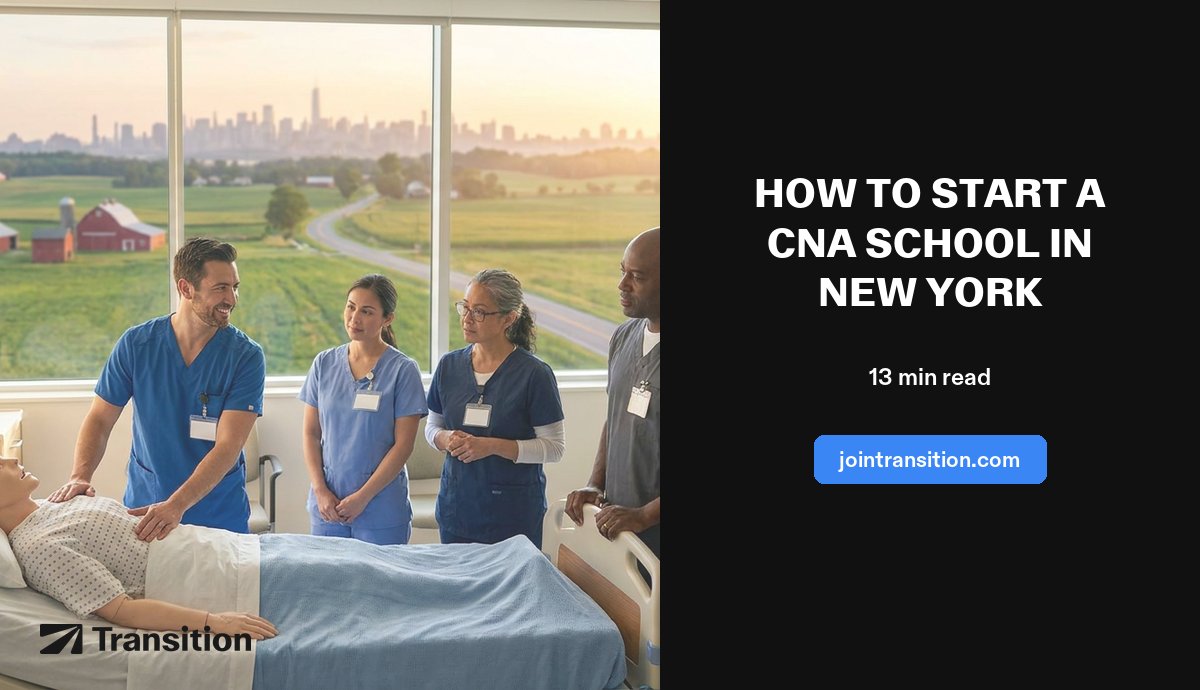
New York's nursing homes and hospitals need certified nurse aides at a scale most states can't imagine — and downstate especially, private career schools carry a huge share of the training load. If you can get a school open in New York, you will not lack students or employers who want your graduates.
But understand what you're signing up for, because New York is the most bureaucratically layered state we cover. Nearly everywhere else, one health agency approves your program and you're done. In New York, a private school needs two approvals from two agencies: the NYS Education Department (NYSED) — through its Bureau of Proprietary School Supervision (BPSS) — must license you as a private career school, and your nurse aide training program (NATP) must be approved by NYSED in conjunction with the NYS Department of Health (NYSDOH), which owns the curriculum standards, the Prometric exam, and the registry. And while the state's nursing-home regulation sets a 100-hour floor, the school-based route NYSED actually approves requires 120 hours minimum — 90 classroom and 30 supervised clinical — and many programs build to 125 or more.
We work with CNA and allied-health schools every day on the operations side — enrollment, records, contracts, messaging — and we've seen what the New York gauntlet does to unprepared founders. This guide is the map. It's not legal advice; New York of all states is one where you verify everything with the agencies and probably hire a consultant or attorney who has been through BPSS licensure before.
Quick Facts: CNA School Requirements in New York
| Item | Requirement |
|---|---|
| Total training hours (school-based NATP) | 120 minimum: 90 classroom/lab + 30 supervised clinical (state reg floor for facility programs is 100 hrs; many schools run 125+) |
| Clinical setting | Long-term care facility (RHCF/nursing home), under your RN instructor — no simulation substitutes |
| Credential earned | Certified Nurse Aide (CNA), NYS Nurse Aide Registry |
| Approving agencies | NYSED (BPSS school license + NATP operation) in conjunction with NYSDOH (curriculum/testing) |
| Application | BPSS new-school application ($5,000 fee) + NATP application package (Forms 1–7) |
| Exam vendor | Prometric (NYS Nurse Aide Competency Exam) |
| Registry | New York State Nurse Aide Registry |
| Typical time to open | 9–18 months for a new private career school |
| Instructor baseline | RN (associate degree or higher), 2+ years nursing-home experience, plus documented teaching qualification |
Step 1 — Form your business entity
New York entities are filed with the NYS Department of State, Division of Corporations (not a "Secretary of State" office — New York routes business filings through DOS). An LLC's Articles of Organization cost $200 to file, and then New York hits you with its infamous publication requirement: you must publish notice of formation in two newspapers for six weeks in your county and file a Certificate of Publication ($50). In upstate counties that's a few hundred dollars; in New York City it can run $1,000–$2,000. Budget for it — skipping it suspends your authority to do business.
Get your EIN from the IRS and open a dedicated business account. BPSS will scrutinize your finances (bank statements, operating budget, balance sheet) as part of licensure, so clean books from day one are not optional here.
Step 2 — Register for state taxes
Register with the NYS Department of Taxation and Finance. Vocational instruction is generally not subject to NY sales tax, but confirm your specific situation with a New York CPA — especially if you'll sell supplies, uniforms, or test-prep materials, which can be taxable. When you hire staff, file Form NYS-100 to register as an employer with the NYS Department of Labor for unemployment insurance, and set up withholding. New York also requires employers to carry workers' compensation and disability/paid family leave coverage from the first employee — this trips up small schools constantly.
Step 3 — Secure your location, classroom, and skills lab
BPSS physically inspects your space before licensure: certificate of occupancy appropriate for instructional use, fire safety compliance, adequate room size, lighting, and ventilation. NYSED's NATP guidance requires the training area to have equipment "as would be found in a residential health care facility," sufficient outlets, storage for supplies and records, and — explicitly — a sink with running water for skills instruction.
Practically, that means a classroom plus a lab with hospital bed(s), mannequin, wheelchair, transfer equipment, vitals equipment, and personal-care supplies. In NYC real estate, this is your biggest cost driver; a code-compliant space that passes both the fire inspection and the educational-suitability review is worth paying for. Class-size ratios matter too: NY caps at 24:1 in classroom, 8:1 in skills lab, and 8:1 in clinical.
Step 4 — Apply for approval: BPSS license + NATP approval
This is the long pole, and it's two workstreams.
Workstream A — BPSS private career school license. Any private, non-degree school charging tuition in New York must be licensed by NYSED's Bureau of Proprietary School Supervision. The new-school application fee is $5,000, non-refundable ($2,500 for an additional location), and the package covers ownership disclosure, financial viability (budgets, bank statements, audits), facility inspection, your enrollment agreement, advertising review, and personnel — your school director and teachers need BPSS-issued personnel licenses too. Curriculum applications carry their own fees ($100 for courses under 100 hours, $250 over 100 hours — your NATP will be the latter). BPSS also requires nurse aide programs to attach DOH-mandated addenda to every student's enrollment agreement.
Workstream B — NATP approval. Your nurse aide program itself is approved via NYSED's Nurse Assisting program office in conjunction with NYSDOH, using the application package in the Guidelines for Approval and Operation of a Nurse Aide Training Program: Form 1 (Program Cover Sheet), Form 2 (Program Coordinator Verification), Form 3 (Nurse Aide Instructor Verification), a curriculum identification checklist against the NYSDOH-required content, your clinical affiliation documentation, and the NATP skills performance checklist. The 16-hour federal introductory content (communication, infection control, safety, residents' rights, independence) must be delivered before any resident contact.
Run the workstreams in parallel, respond to deficiency letters fast, and expect the combined process to take the better part of a year. When anything changes later — coordinator, instructor, curriculum — you must notify NYSED in writing.
Step 5 — Hire a qualified program coordinator and instructors
New York formally defines two roles, and both must be RNs with real long-term-care backgrounds:
- Program Coordinator — administrative owner of the program. Must be a registered professional nurse (associate degree or higher) with at least 2 years of experience in a nursing home caring for the elderly and/or chronically ill.
- Primary Instructor (Nurse Aide Instructor) — develops lesson plans, teaches, and personally supervises clinicals. Same RN + 2 years nursing-home experience baseline.
Both must also document at least one teaching qualification: certification to teach nurse aides or practical nursing, a trade-school teacher license, 3 years teaching nursing to adults in an approved academic setting, 3 years teaching nurse aides in a residential facility, or completion of a recognized course in teaching adult learners. One person can hold both roles in a small school, but burnout is real — most growing schools split them by cohort two or three. Remember these individuals also need BPSS personnel licensure at a licensed private school.
Step 6 — Build or buy a state-compliant curriculum
Your adult NATP curriculum must total at least 120 hours: minimum 90 hours of classroom/lab instruction (built on the NYSDOH-required nurse aide curriculum content) and 30 hours of supervised clinical in a long-term care facility. Orientation, observation-only time, and "shadowing" don't count toward the 30 clinical hours, and federal/NYSDOH policy does not accept simulation in place of hands-on clinical. You can exceed the minimums — many schools market a 125–130 hour program — but you cannot go under.
Theory may be delivered remotely when in-person isn't available (a COVID-era allowance that has persisted in NYSED guidance), but skills lab evaluation and clinicals are in-person under your approved RN instructor, full stop. Sequence the 16 introductory hours first, align skills teaching to the Prometric skills checklist, and document hour-by-hour lesson plans — NYSED reviews them.
Step 7 — Set up clinical site agreements
Your 30 clinical hours must run in a residential health care facility (nursing home) under the direct supervision of your approved RN instructor, at 8 students per instructor maximum. You'll need a written affiliation agreement, and your program must document scheduled dates/times with the facility.
Two New York-specific snags: first, one more rule with teeth — if a student is employed by a facility, their work hours cannot count as training hours. Second, downstate nursing homes are heavily courted by competing schools, so expect to offer something in return: first interview rights with graduates, flexible clinical scheduling, or instructor support. Sign a backup site if you possibly can; losing your only clinical site mid-cohort is an emergency.
Step 8 — Understand testing and the registry
New York's nurse aide competency exam — written (or oral) plus a clinical skills evaluation — is administered by Prometric for NYSDOH. Here's an obligation many founders miss: the NATP is responsible for scheduling the certification exam for successful students within ten business days of the last day of the program. Build that into your end-of-course workflow.
Students must be at least 16 to enroll and can test at 17. Passing places the graduate on the New York State Nurse Aide Registry. Established schools can pursue becoming Prometric in-facility test sites — worth doing once you have volume, since students perform better on home turf and "test on-site" is a real enrollment differentiator.
Step 9 — Set up enrollment, payments, and student records
New York schools carry a heavier records burden than almost anywhere: BPSS-compliant enrollment agreements with DOH addenda, tuition and refund records BPSS can audit, attendance, skills checklists, instructor files, exam scheduling within the ten-day window, and quarterly obligations that come with the license. Doing this on paper and spreadsheets is how schools end up with deficiency findings.
This is where the schools we work with lean on Transition: branded online enrollment, e-signed enrollment agreements (with the required addenda attached every time, automatically), payment plans, attendance and grade tracking, automated email/SMS for onboarding and exam-day reminders, and surveys — one system of record when a BPSS reviewer asks for a student file. Whatever tooling you pick, stand it up before your first cohort.
Step 10 — Launch with a local marketing plan
In New York's competitive metro markets, differentiation beats volume advertising. Claim your Google Business Profile immediately and turn every graduating class into reviews — the school with 100+ reviews owns "CNA classes Brooklyn." Publish your price, schedule, and an online application on a simple fast site; respond to inquiries in minutes by text, because in NYC a lead that waits an hour is enrolled elsewhere.
Then work funded pipelines: the New York State Department of Labor Career Centers refer WIOA-funded students to schools on the Eligible Training Provider List, ACCES-VR refers vocational-rehab students, and nursing homes will sponsor students they intend to hire — your clinical partners are your best B2B channel.
What it really costs
New York is the expensive one. Realistic estimates for a single-location private school:
| Item | Estimated range |
|---|---|
| LLC formation + publication | $500 – $2,500 |
| BPSS application + curriculum + personnel fees | $5,500 – $7,500 |
| Insurance (liability, workers' comp, DBL) | $3,000 – $8,000 |
| Rent + deposit (first 3 months, metro) | $9,000 – $30,000 |
| Skills lab equipment | $8,000 – $20,000 |
| Curriculum development/licensing | $1,000 – $6,000 |
| Instructor/coordinator payroll (first cohort) | $8,000 – $18,000 |
| Marketing (site, GBP, launch ads) | $2,000 – $8,000 |
| Total to first cohort | $37,000 – $100,000 |
Treat these as planning estimates. Upstate can come in well below these ranges; NYC rarely does.
How long it takes
Plan on 9–18 months from entity formation to first graduating class. The variance is almost entirely in the dual approval: BPSS licensure (financial review, facility inspection, personnel licensing) and NATP approval each take months, and every incomplete submission adds a cycle. Founders who show up with clean financials, a code-compliant space, and a qualified RN coordinator already signed move through fastest.
Common mistakes to avoid
- Assuming DOH approval alone is enough. Private schools need the BPSS license and the NYSED/DOH-approved NATP. One without the other means you cannot legally enroll students.
- Budgeting 100 hours because the state reg says 100. The school-based NATP minimum NYSED enforces is 120 (90 + 30). Build your tuition and schedule on the real number.
- Ignoring the LLC publication requirement and losing good standing right when BPSS reviews your entity documents.
- Counting employment hours or observation as clinical time. New York explicitly forbids both.
- Missing the ten-business-day exam scheduling duty after each cohort ends.
- Hiring an RN without the documented teaching qualification. Two years in a nursing home isn't enough by itself — verify the teaching criterion before you extend an offer.
FAQ
How much does it cost to start a CNA school in New York? For a private career school, plan on roughly $37,000–$100,000 through your first cohort — the $5,000 BPSS application fee, metro rent, and payroll drive the total. Upstate, lean setups can come in lower.
Do I need to be a nurse to open a CNA school in New York? No, the owner doesn't need to be a nurse, but your Program Coordinator and Primary Instructor must be RNs with 2+ years of nursing-home experience plus a documented teaching qualification, and school personnel need BPSS licenses.
How many hours is a CNA program in New York? School-based programs must be at least 120 hours — 90 classroom/lab and 30 supervised clinical in a nursing home. Many run 125–130. (The 100-hour figure you'll see quoted comes from the nursing-home regulation floor.)
Who approves CNA schools in New York? Two agencies together: NYSED — which licenses the school via BPSS and approves NATP operation — in conjunction with the NYS Department of Health, which sets curriculum and testing standards.
Can CNA classes be online in New York? Theory can be delivered remotely under current NYSED guidance when in-person delivery isn't available, but skills labs and the 30 clinical hours must be in-person; simulation is not accepted for clinical.
What exam do New York students take, and who runs the registry? The NYS nurse aide competency exam through Prometric; passing graduates are listed on the New York State Nurse Aide Registry maintained for NYSDOH.
How long does approval take in New York? Longer than almost any other state — most new private schools should expect 9–18 months across BPSS licensure and NATP approval combined.
Disclaimer
This guide is general information, not legal advice. New York's requirements, fees, and forms change, and BPSS guidance is updated regularly. Verify current rules with NYSED/BPSS, the NYS Department of Health, the Department of State, and the Department of Taxation and Finance — and consider professional help for the BPSS application specifically.
Ready to build the school, not just the paperwork?
The paperwork gets you open. The systems keep you open. See how Transition runs enrollment, e-signed agreements, records, and messaging for schools navigating exactly this kind of compliance load at jointransition.com.
Get CNA training paid for.
Tell us your county and we text you the route that fits, who to call, and what to bring.