
How to Start a CNA School in Oklahoma (2026 Guide)
July 27, 2026 · Oklahoma
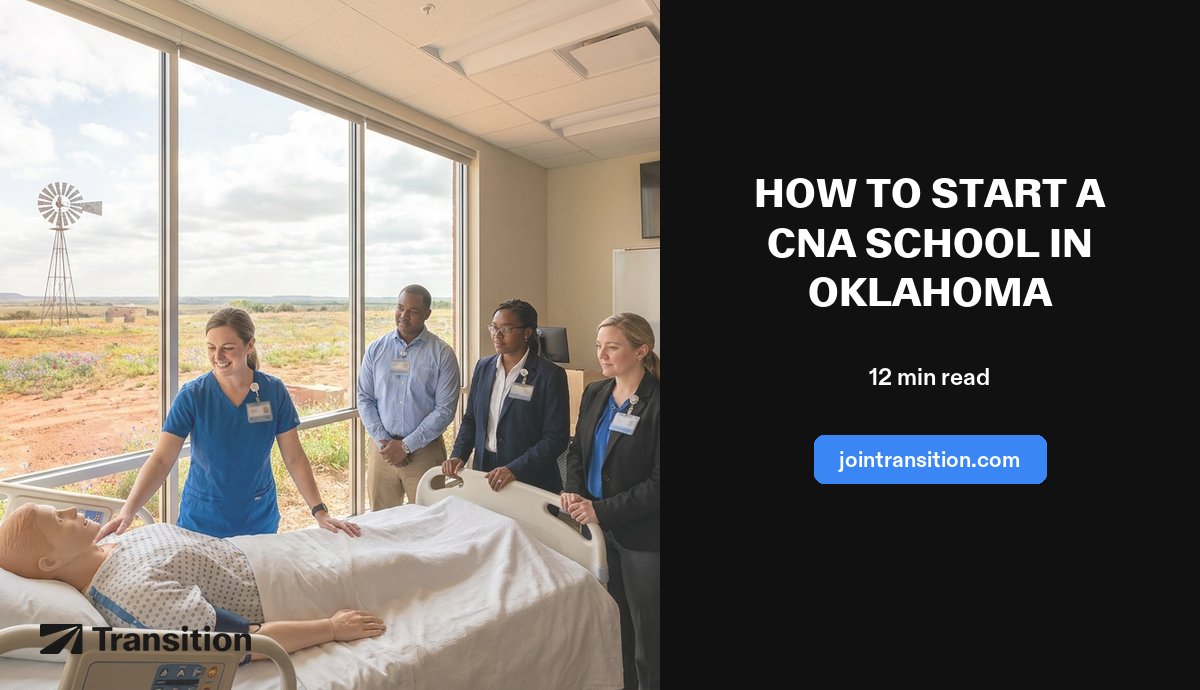
Oklahoma doesn't actually certify "CNAs" the way most states do. The credential here is the Long-Term Care Aide (LTCA), one of several aide certifications the Oklahoma State Department of Health (OSDH) tracks on its Nurse Aide and Nontechnical Services Worker Registry. If you want to open a training school, you'll be applying to OSDH to run a Nurse Aide Training and Competency Evaluation Program (NATCEP) — and, in most cases, you'll also need a license from the Oklahoma Board of Private Vocational Schools. Two agencies, two applications. Miss the second one and you can be fully OSDH-approved and still operating illegally.
The demand side is real: Oklahoma's long-term care facilities, home health agencies, and hospitals are chronically short on aides, and employers across the state hire LTCA graduates as fast as schools can produce them. We work with CNA and allied-health schools every day — helping them run enrollment, records, and student communication — and Oklahoma operators tell us the bottleneck isn't students. It's getting through the paperwork correctly the first time.
This guide walks through the whole process. One note before we start: we're a software company that lives in this world, not a law firm. Treat this as a well-researched map, and verify the current rules with OSDH and the other agencies named below before you spend money.
Quick Facts: CNA School Requirements in Oklahoma
| Item | Requirement |
|---|---|
| Total training hours | 75 minimum |
| Classroom/clinical split | ≥16 classroom hours before any resident contact; ≥16 supervised clinical hours; ≥10 hours on Alzheimer's/dementia care; exact split not fixed by rule |
| Credential name | Long-Term Care Aide (LTCA) |
| Approving agency | Oklahoma State Department of Health (OSDH), Nurse Aide Registry / Long Term Care Service |
| Application | ODH Form 743A (LTCA training program application) + curriculum and clinical site documentation, submitted to OSDH in Oklahoma City |
| Also required | Oklahoma Board of Private Vocational Schools (OBPVS) license for most private schools |
| Exam vendor | OSDH-approved vendors — Prometric and Headmaster (D&S Diversified Technologies) both administer the Oklahoma exam |
| Registry | Oklahoma Nurse Aide and Nontechnical Services Worker Registry |
| Typical time to approval | OSDH responds in writing within about 30 days of a complete application; approval granted for up to 2 years |
| Instructor requirement | Licensed nurse instructors; an RN must supervise the program if an LPN teaches (federal rule: RN supervisor with 2+ years nursing experience, 1+ in long-term care) |
Step 1 — Form your business entity
Start with the Oklahoma Secretary of State. You can file Articles of Organization for an LLC through the Secretary of State's online business filing system for $100 (about $104 with the card processing fee), with approval typically in 2–3 business days. There's a modest $25 Annual Certificate due each year on your anniversary date. An LLC is the structure most small training schools choose — it separates your personal assets from the business and keeps taxes simple.
Once the LLC is approved, get a free EIN from the IRS (irs.gov, takes minutes online) and open a dedicated business bank account. Regulators, clinical partners, and eventually accreditors will all want to see clean separation between you and the school.
Step 2 — Register for state taxes
Register with the Oklahoma Tax Commission through its OkTAP online portal. Tuition for instructional services is generally not subject to Oklahoma sales tax, but if you sell taxable goods — textbooks, scrub sets, supply kits — you may need a sales tax permit, so ask the OTC directly about your mix. Once you hire employees, you'll also register for employer withholding with the OTC and for unemployment insurance with the Oklahoma Employment Security Commission (OESC).
Step 3 — Secure your location, classroom, and skills lab
OSDH will want to see that you have adequate classroom space and a skills lab that mirrors a long-term care environment. Plan for at minimum: a hospital bed (two is better), a mannequin for personal care skills, a wheelchair, a mechanical lift or transfer equipment, a scale, blood pressure cuffs and stethoscopes, handwashing access, and the supplies for the skills your students will be tested on. Your lab is also where the state exam's clinical skills test may eventually be run if you pursue becoming a test site, so build it to that standard from day one.
Check local zoning and fire occupancy before signing a lease. A 1,000–1,500 square foot space with one classroom and one lab area is a common starting footprint for the schools we work with.
Step 4 — Apply for state program approval
This is the heart of the process. In Oklahoma, nurse aide training programs are approved by the Oklahoma State Department of Health under OAC Title 310, Chapter 677. The Long-Term Care Aide program application is ODH Form 743A, available on the OSDH Nurse Aide Registry pages, submitted by mail or hand delivery to the Department in Oklahoma City.
Your application package will need to demonstrate compliance with the state curriculum standards and typically includes:
- The completed ODH 743A application
- Your full curriculum with hour breakdowns (75 hours minimum — see Step 6)
- Instructor credentials and licenses
- Your clinical site agreement/verification for supervised clinical training
- Skills lab and classroom details
- Policies on attendance, records, and competency evaluation
OSDH responds in writing within about 30 days of receiving a complete application. Approval is granted for a period of up to two years, after which you'll renew; renewal cycles include on-site visits. Keep meticulous records from your first cohort — attendance, skills checklists, evaluations — because those records are exactly what surveyors ask for.
One more Oklahoma quirk worth knowing: OSDH approves separate programs for each aide category — Long-Term Care Aide (ODH 743A), Home Health Aide (ODH 743), Certified Medication Aide (ODH 743C), Residential Care Aide, Adult Day Care Aide, and ICF/IID Aide each have their own application. Many schools start with LTCA and add HHA or CMA programs later, since the incremental paperwork is manageable once your first program is approved.
Don't skip the second license: OBPVS
Here's the trap that catches new Oklahoma school owners: if you're a private school offering nurse aide training to the general public (anyone other than your own employees), you generally also need a license from the Oklahoma Board of Private Vocational Schools (OBPVS). Facility-based programs training their own staff are treated differently, but a standalone private career school is squarely in OBPVS territory. OBPVS licensure involves its own application, fees, surety bond, and standards. If you believe you qualify for an exemption, OBPVS has a formal exemption-determination process — get the ruling in writing. Start this application in parallel with your OSDH application, not after.
Step 5 — Hire a qualified program director and instructors
Oklahoma follows the federal NATCEP framework: training must be performed by or under the general supervision of a registered nurse with at least two years of nursing experience, at least one of which is in a long-term care setting. Under OSDH rules, licensed practical nurses can serve as instructors, but the program must then designate an RN as the training program supervisor. Instructors are expected to have experience in the subject matter they teach — plan on at least a year of relevant experience for anyone on your roster.
Practical advice from the schools we work with: hire your RN before you submit the OSDH application (their credentials go in the package), and have a bench of at least one backup instructor. A single-instructor school that loses its RN mid-cohort has a compliance emergency on its hands.
Step 6 — Build or buy a state-compliant curriculum
Oklahoma requires a minimum of 75 total hours for the Long-Term Care Aide program, with specific component minimums rather than one fixed split:
- At least 16 hours of classroom instruction before any resident contact (communication, infection control, safety, residents' rights, and related basics)
- At least 16 hours of supervised clinical training
- At least 10 hours on Alzheimer's disease and dementia care — an Oklahoma-specific requirement that generic national curricula often shortchange
The rest of the 75 hours is yours to allocate across classroom, lab, and clinical. Most Oklahoma programs run more than the minimum. Whether you write your own curriculum or license a published one, map every lesson to the required content areas in OAC 310:677 and show the hour math explicitly in your application — reviewers should never have to guess where your 75 hours live.
Step 7 — Set up clinical site agreements
Your students' supervised clinical hours need to happen in an appropriate care setting — for LTCA training, that means a licensed long-term care facility (nursing home). You'll need a written affiliation agreement with the facility, and OSDH's application package asks for clinical site verification.
Common snags: facilities that agree verbally but stall on signing; corporate chains that require their legal department to approve agreements (budget 4–8 weeks); and facilities that limit how many students can be on the floor per instructor. Line up two clinical sites if you can — losing your only site between cohorts is one of the most common reasons Oklahoma schools go dark for a semester.
Step 8 — Understand testing and the state registry
After training, your graduates take Oklahoma's competency exam — a written (knowledge) test plus a skills demonstration. OSDH approves multiple testing vendors; Prometric and Headmaster (D&S Diversified Technologies) both currently administer the Oklahoma nurse aide exam, and candidates test at approved sites around the state. Check OSDH's current testing vendor and testing site list when you launch, since vendor lineups change.
Passing candidates are placed on the Oklahoma Nurse Aide and Nontechnical Services Worker Registry, which employers check before hiring. Students must pass both exam portions within two years of completing training. Once established, schools can pursue becoming approved test sites — a real competitive advantage, since students strongly prefer testing in the room where they trained.
Step 9 — Set up enrollment, payments, and student records
The operational side is where new schools quietly bleed time. Between OSDH's record-keeping expectations, OBPVS's student-file standards, enrollment agreements, payment plans, attendance, skills checklists, and exam coordination, a two-person school can drown in spreadsheets fast.
This is the problem we built Transition to solve: branded online enrollment, payment plans, attendance and grade tracking, e-signed enrollment agreements and contracts, automated onboarding emails and texts, and student surveys — one system instead of Jotform plus Square plus a filing cabinet. The schools we work with typically get their evenings back within the first cohort.
Step 10 — Launch with a local marketing plan
You don't need a big budget; you need to be findable and fast.
- Google Business Profile — claim it, categorize it correctly, and ask every graduate for a review. Reviews are the #1 driver of organic enrollment for small schools.
- Workforce partnerships — connect with Oklahoma Works (the state's workforce system) and your local OESC/Oklahoma Works American Job Center. Aide training is a workforce-funding favorite, and WIOA-funded students can become a steady pipeline once you're on the eligible training provider list.
- Employer relationships — nursing homes that host your clinicals will often hire your graduates and refer future students. Some will even sponsor tuition.
- A simple website with online enrollment — and answer every inquiry within minutes, not days. Speed-to-lead wins students in this market.
What it really costs
Realistic startup estimates for a small Oklahoma CNA/LTCA school (label: estimates — your market will vary):
| Item | Estimated range |
|---|---|
| LLC formation + misc. filings | $150–$400 |
| Liability insurance (annual) | $1,500–$4,000 |
| Lease deposit + first months' rent | $3,000–$10,000 |
| Skills lab equipment & supplies | $5,000–$15,000 |
| Curriculum (purchased or developed) | $500–$5,000 |
| Instructor payroll (first cohort) | $4,000–$10,000 |
| OSDH application + OBPVS licensure, bond, fees | $500–$3,000 |
| Marketing (first 6 months) | $1,000–$5,000 |
| Bottom line | $15,000–$50,000 |
You can land at the low end by starting lean — subleased classroom space, used lab equipment, a licensed curriculum — and many Oklahoma schools do.
How long it takes
Plan on 4–9 months from entity formation to first cohort. The variance in Oklahoma comes from three places: how fast you secure a signed clinical site agreement (often the long pole), whether your OSDH application is complete on first submission (the 30-day clock runs from a complete application), and the OBPVS licensure timeline, which runs on its own board-meeting calendar. Starting both agency applications in parallel is the single biggest schedule saver.
Common mistakes to avoid
- Skipping OBPVS. OSDH approval alone doesn't make a private school legal in Oklahoma. If you're training the public, assume you need the OBPVS license until you have a written exemption ruling.
- Shortchanging the 10 Alzheimer's/dementia hours. It's an Oklahoma-specific requirement; national off-the-shelf curricula don't always meet it out of the box.
- Submitting an incomplete OSDH package. Missing clinical verification or instructor credentials restarts your clock.
- One instructor, one clinical site. Either one leaving mid-cohort can shut you down for months.
- Ignoring the other aide categories. HHA, CMA, and RCA approvals are natural add-ons that grow revenue from students you already have.
- Paper records. Two years in, your renewal survey will ask for attendance and skills documentation you filed (or didn't). Build the record system before cohort one.
FAQ
How much does it cost to start a CNA school in Oklahoma? Most small schools spend roughly $15,000–$50,000 to get open, depending on lease, lab equipment, and how much curriculum they build versus buy. The state filings themselves are a small fraction of that; facilities and payroll are the real costs.
Do I need to be a nurse to open a CNA school in Oklahoma? No. The owner doesn't have to be a nurse, but your training program must be run by or under the general supervision of an RN with at least two years of nursing experience (including a year in long-term care), and any LPN instructors must work under a designated RN program supervisor.
How many hours is CNA (Long-Term Care Aide) training in Oklahoma? At least 75 hours, including a minimum of 16 classroom hours before any resident contact, at least 16 supervised clinical hours, and at least 10 hours on Alzheimer's and dementia care.
Who approves CNA schools in Oklahoma? The Oklahoma State Department of Health (Nurse Aide Registry / Long Term Care Service) approves nurse aide training programs. Most private schools also need a license from the Oklahoma Board of Private Vocational Schools.
Can CNA classes be online in Oklahoma? Portions of classroom theory can potentially be delivered online with OSDH's blessing, but the 16 supervised clinical hours must be hands-on in a facility, and skills practice needs a physical lab. Describe any online delivery explicitly in your OSDH application rather than assuming it's allowed.
What exam do Oklahoma students take, and who runs it? A two-part competency exam (written + skills) administered by OSDH-approved vendors — currently Prometric and Headmaster (D&S Diversified Technologies). Passing candidates go on the Oklahoma Nurse Aide and Nontechnical Services Worker Registry.
How long is an Oklahoma training program approval good for? Up to two years. Renewals include on-site survey visits, so keep clean training records from day one.
Disclaimer
This guide is for general information, not legal advice. Rules, fees, and forms change — sometimes quietly. Before spending money, verify current requirements with the Oklahoma State Department of Health, the Oklahoma Board of Private Vocational Schools, the Oklahoma Secretary of State, and the Oklahoma Tax Commission.
The paperwork gets you open. The systems keep you open.
Once OSDH says yes, the real work is enrollment, records, payments, and staying survey-ready — every day. See how Transition runs enrollment, student records, messaging, e-sign, and compliance for CNA schools like yours at jointransition.com.
Get CNA training paid for.
Tell us your county and we text you the route that fits, who to call, and what to bring.