
How to Start a CNA School in Pennsylvania (2026 Guide)
July 27, 2026 · Pennsylvania
Pennsylvania hands nurse aide training to an agency most people wouldn't guess: the Department of Education. PDE approves and monitors every Nurse Aide Training and Competency Evaluation Program (NATCEP) in the Commonwealth, publishes a model curriculum through Penn State, and — since July 2022 — requires every program to staff three defined roles: a PDE-approved program administrator, a coordinator, and a qualified nurse instructor. And if you're a private, tuition-charging school, there's a second gate: licensure by the State Board of Private Licensed Schools. Two approvals, one school.
The market makes the effort worthwhile. Pennsylvania has one of the oldest populations in the country, its nursing homes and home-care agencies are perpetually short-staffed, and employers hire certified aides as fast as programs graduate them. We work with CNA and allied-health schools every day on the operations side, and Pennsylvania operators consistently tell us the same thing: the state's process is navigable — if you know both doors you have to walk through.
Standard caveat, offered sincerely: we're operators and software people, not lawyers. Verify everything below with PDE and the other named agencies before you commit money.
Quick Facts: CNA School Requirements in Pennsylvania
| Item | Requirement |
|---|---|
| Total training hours | 80 minimum (many PA programs run 120–128+) |
| Classroom/clinical split | ≥37.5 hours supervised clinical; remaining split program-determined |
| Credential name | Certified Nurse Aide (CNA), listed on the Pennsylvania Nurse Aide Registry |
| Approving agency | Pennsylvania Department of Education (PDE), NATCEP office (ra-natcep@pa.gov) |
| Also required | State Board of Private Licensed Schools licensure for most private career schools |
| Application | PDE NATCEP application package (request via the NATCEP office); model curriculum published via Penn State |
| Exam vendor | Credentia — registration, scheduling, and scores through the CNA365 portal |
| Registry | Pennsylvania Nurse Aide Registry (registry services via Credentia) |
| Typical time to approval | Plan several months; PDE assigns NATCEP advisors and holds office hours for new programs |
| Instructor requirement | RN with 2+ years nursing experience (1+ in long-term care) as instructor or supervisor of an LPN instructor; PDE instructor training required |
Step 1 — Form your business entity
Pennsylvania business filings run through the Department of State's Bureau of Corporations and Charitable Organizations, and the front door is the PA Business One-Stop Hub (business.pa.gov). Filing a Certificate of Organization for an LLC costs about $125. Note that Pennsylvania now requires a small annual report filing (around $7 for LLCs) — a new obligation as of 2025 that's easy to miss.
Then grab your free EIN from the IRS and open a dedicated business bank account. Both PDE and the Private Licensed Schools board will expect your school to look like a real, financially separate institution.
Step 2 — Register for state taxes
Register with the Pennsylvania Department of Revenue through the myPATH portal. Tuition for instruction is generally not subject to PA sales tax, but if you sell books, kits, or scrubs, ask Revenue whether you need a sales tax license for those items. When you hire staff, you'll register for employer withholding (myPATH) and for unemployment compensation with the Department of Labor & Industry (UCMS). Don't forget local wage taxes — Pennsylvania's local earned income tax system means your payroll setup needs your municipality's rates.
Step 3 — Secure your location, classroom, and skills lab
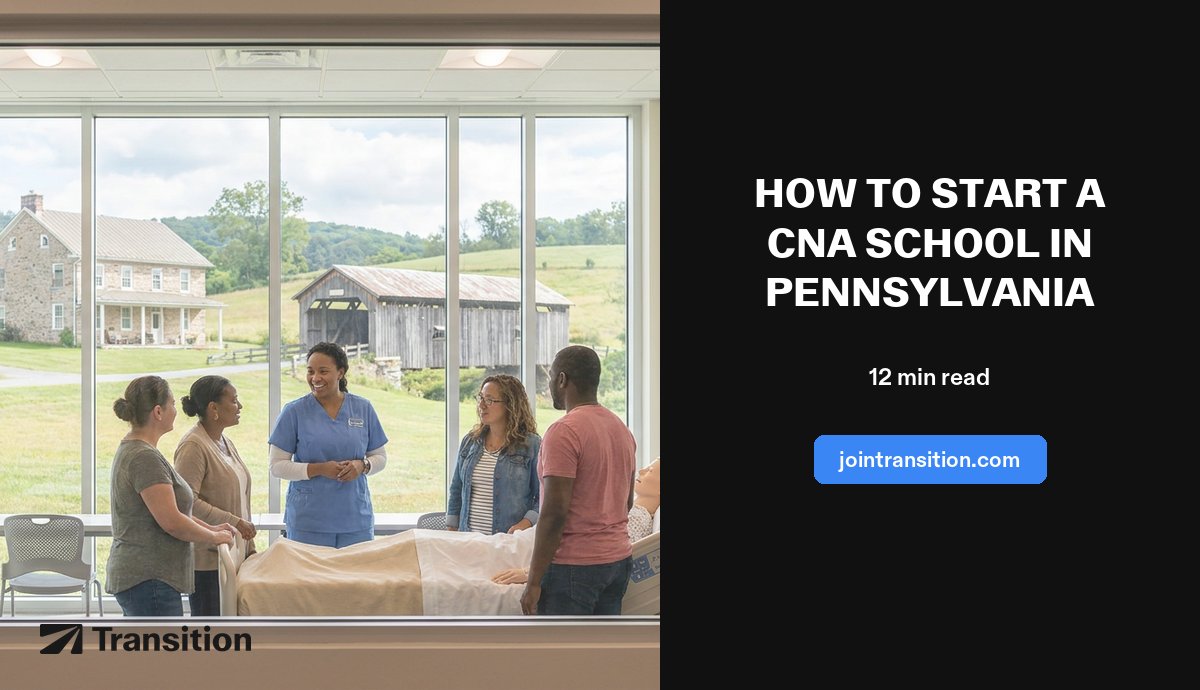
Your NATCEP application will describe your training site, so lock down a space with a classroom and a skills lab that simulates a resident care environment: hospital bed(s), mannequin, wheelchair, transfer equipment, vitals equipment, and handwashing access. The Private Licensed Schools board will separately evaluate your facility as part of licensure, including whether it's adequate for the enrollment you propose.
Check zoning and occupancy with your municipality early — Pennsylvania boroughs and townships vary widely, and a certificate-of-occupancy surprise can cost you a start date.
Step 4 — Apply for state program approval
Two approvals, ideally pursued in parallel:
1) PDE NATCEP approval. The Pennsylvania Department of Education approves nurse aide training programs under the federal NATCEP framework and Act 14 of 1997. Start by contacting the NATCEP office at ra-natcep@pa.gov to request the current application package. Expect the application to cover:
- Your curriculum, mapped to the required content and hour minimums (80 hours, ≥37.5 clinical)
- Your three required roles: program administrator, coordinator, and instructor (see Step 5)
- Clinical site information and agreements
- Policies for screening students — Pennsylvania requires criminal history record checks for nurse aide trainees under Act 14, so your admissions process must address CHRI review
- Record-keeping and evaluation procedures
PDE is unusually supportive of new programs: it assigns NATCEP advisors and hosts virtual open office hours where you can ask about curriculum, record keeping, monitoring, and policy development before you submit. Use them — schools that engage an advisor early report far fewer revision cycles. Approvals run on two-year cycles with ongoing monitoring, consistent with the federal rules.
2) Private Licensed Schools licensure. If you're a private entity charging tuition to prepare people for an occupation — which is exactly what a CNA school is — Pennsylvania's State Board of Private Licensed Schools requires you to be licensed before advertising, enrolling students, or teaching. The licensure application covers your finances, facility, enrollment agreement, refund policy, advertising, and staff, and carries its own fees and a surety bond requirement. Contact Board staff at RA-PLS@pa.gov to confirm how the requirement and any exemptions apply to your model. Do not skip this: operating an unlicensed private school in PA is the kind of mistake that ends businesses.
Step 5 — Hire a qualified program director and instructors
Pennsylvania formalized its staffing model in July 2022. Every NATCEP needs:
- A program administrator (PDE-approved)
- A coordinator
- An instructor: either an RN, or an LPN instructor working under an RN supervisor
The anchor qualification comes from the federal rule: training must be performed by or under the general supervision of an RN with at least two years of nursing experience, at least one year of it in long-term care. Every PDE-approved program must employ at least one RN meeting that standard — either doing the teaching or supervising an LPN who does.
Pennsylvania also requires instructors to complete the state's instructor training (train-the-trainer) requirements. Nurses who already hold a PDE teaching certificate or can document experience instructing in a practical nursing or professional nursing program may only need the abbreviated portion covering Pennsylvania's nurse aide rules; everyone else should plan on the full course. Build this into your hiring timeline — a great RN who hasn't completed instructor training can't start teaching the day you sign them.
Step 6 — Build or buy a state-compliant curriculum
Pennsylvania's floor is 80 hours with at least 37.5 hours of supervised clinical experience — the split of the remaining hours is yours to design. In practice, most successful PA programs run 120–128 hours or more, because employers notice the difference and because the state's content expectations are hard to do well in 80 hours.
You don't have to start from scratch: PDE points new programs to the model curriculum published on the Penn State website. Licensing it (or mapping your own materials against it) is the fastest route through review. Whatever you use, present the hour math clearly — content area by content area — and make sure your clinical hours are genuinely supervised, hands-on time with residents, which is what the 37.5-hour minimum requires.
Step 7 — Set up clinical site agreements
Your students' clinical hours happen in a licensed long-term care setting under your instructor's supervision, and PDE will want documentation of the arrangement. Get a written affiliation agreement signed by the facility administrator — not a verbal yes from a director of nursing who may change jobs next quarter.
Pennsylvania-specific snags we hear about: facilities requiring students to have completed criminal background checks before setting foot on the floor (align your Act 14 CHRI screening timeline accordingly), and large regional chains routing agreements through corporate legal, which can take 6–8 weeks. Court two sites so one signature delay doesn't idle a cohort.
Step 8 — Understand testing and the state registry
Pennsylvania's nurse aide exam is run by Credentia. Students create accounts, register, schedule, and get scores through the CNA365 portal, and Credentia also provides the registry services behind the Pennsylvania Nurse Aide Registry. A quirk worth knowing: PDE itself has no authority over the exam — testing policy questions route to the Department of Human Services, and operational questions go to Credentia.
The exam is the standard two-part format: a written (knowledge) test and a skills demonstration. As your program matures, talk to Credentia about becoming an approved test site — in-house testing measurably improves student completion and is a real enrollment selling point in a state where test-site access varies by region.
Step 9 — Set up enrollment, payments, and student records
Pennsylvania doubles your paperwork surface: PDE monitors your training records, attendance, and CHRI screening documentation, while the Private Licensed Schools board regulates your enrollment agreements, refund policy, and student financial records. Two agencies, two audits, one set of systems that had better agree with itself.
That's the job Transition was built for: branded online enrollment, e-signed enrollment agreements and disclosures, payment plans, attendance and grade tracking, automated email/SMS onboarding, and surveys — one student record instead of spreadsheets, Jotform, Square, and a filing cabinet. When a monitor asks for a file, you export it instead of reconstructing it.
Step 10 — Launch with a local marketing plan
- Google Business Profile — claim it, categorize as a training school, collect a review from every graduate. This is the highest-ROI marketing a local school can do.
- PA CareerLink — Pennsylvania's workforce system, run with the Department of Labor & Industry. Getting on the WIOA eligible training provider list turns your county's CareerLink office into a referral source with funding attached.
- Employer partnerships — long-term care operators in PA sponsor tuition and recruit directly from programs. Your clinical site is your first hiring partner.
- Simple website, instant follow-up — publish your schedule and price, take enrollment online, and answer inquiries in minutes. Speed wins students.
What it really costs
Realistic startup estimates for a small Pennsylvania CNA school (estimates — Philadelphia and Pittsburgh metro costs trend higher):
| Item | Estimated range |
|---|---|
| LLC formation + filings | $150–$400 |
| Liability insurance (annual) | $1,500–$4,000 |
| Lease deposit + first months' rent | $3,500–$12,000 |
| Skills lab equipment & supplies | $5,000–$15,000 |
| Curriculum (model-curriculum based or purchased) | $500–$4,000 |
| Instructor payroll (first cohort) | $5,000–$12,000 |
| PDE application + Private Licensed Schools licensure, bond, fees | $1,000–$4,000 |
| Marketing (first 6 months) | $1,000–$5,000 |
| Bottom line | $18,000–$55,000 |
How long it takes
Plan on 5–10 months from entity formation to first cohort. The variance in Pennsylvania comes from running two approval tracks: PDE NATCEP review (faster when you've worked with a NATCEP advisor and used the model curriculum) and Private Licensed Schools licensure, which runs on the Board's own meeting and review calendar. Schools that start both applications the same month — and line up their RN and instructor training early — compress the timeline the most.
Common mistakes to avoid
- Skipping the Private Licensed Schools license. PDE approval alone doesn't authorize a private school to advertise or enroll in Pennsylvania. Confirm your licensure status in writing before you market anything.
- Ignoring Act 14 CHRI screening. Criminal history review isn't optional in PA nurse aide training — bake it into admissions or watch enrollments unwind late.
- Hiring an RN who hasn't done instructor training. The train-the-trainer requirement adds weeks; schedule it before your program start date.
- Building to the 80-hour floor. Most competitive PA programs run 120+ hours. A bare-minimum program is harder to place graduates from and harder to market.
- Not using PDE's NATCEP advisors. Free expert review before submission — schools that skip office hours pay for it in revision cycles.
- One clinical site, verbal agreement. Get two signed affiliation agreements before you enroll a single student.
FAQ
How much does it cost to start a CNA school in Pennsylvania? Most small schools land between $18,000 and $55,000 all-in, driven by rent, lab equipment, and instructor payroll. The two state approvals (PDE and Private Licensed Schools) add fees and a bond but are a minority of the total.
Do I need to be a nurse to open a CNA school in Pennsylvania? No. Owners don't need a license, but your program must employ at least one RN with two years of nursing experience (including one in long-term care) as the instructor or as supervisor of an LPN instructor, and instructors must meet PDE's instructor-training requirements.
How many hours is CNA training in Pennsylvania? The state minimum is 80 hours, at least 37.5 of them supervised clinical. Many Pennsylvania programs voluntarily run 120–128+ hours, and employers know the difference.
Who approves CNA schools in Pennsylvania? The Pennsylvania Department of Education approves nurse aide training programs (NATCEPs). Private, tuition-charging schools generally also need licensure from the State Board of Private Licensed Schools before advertising or enrolling students.
What exam do Pennsylvania CNA students take? The Credentia nurse aide exam, managed through the CNA365 portal — a written knowledge test plus a skills demonstration. Passing candidates are listed on the Pennsylvania Nurse Aide Registry.
Can CNA classes be online in Pennsylvania? Some theory content may be deliverable in hybrid form depending on how PDE approves your program design, but the 37.5 supervised clinical hours are hands-on in a facility, and skills instruction needs a physical lab. Describe any online components explicitly in your application.
How long does PDE approval take? There's no published fixed timeline; plan several months and engage a NATCEP advisor early. Complete applications using the Penn State model curriculum move fastest.
Disclaimer
This guide is general information, not legal advice. Pennsylvania's rules, fees, and forms change. Verify current requirements with the Pennsylvania Department of Education's NATCEP office, the State Board of Private Licensed Schools, the Department of State, and the Department of Revenue before making commitments.
The paperwork gets you open. The systems keep you open.
Two approvals get you to launch; enrollment, records, and monitoring keep you there. See how Transition runs online enrollment, e-sign, student records, messaging, and compliance for CNA schools like yours at jointransition.com.
Get CNA training paid for.
Tell us your county and we text you the route that fits, who to call, and what to bring.