
How to Start a CNA School in Texas (2026 Guide)
July 27, 2026 · Texas
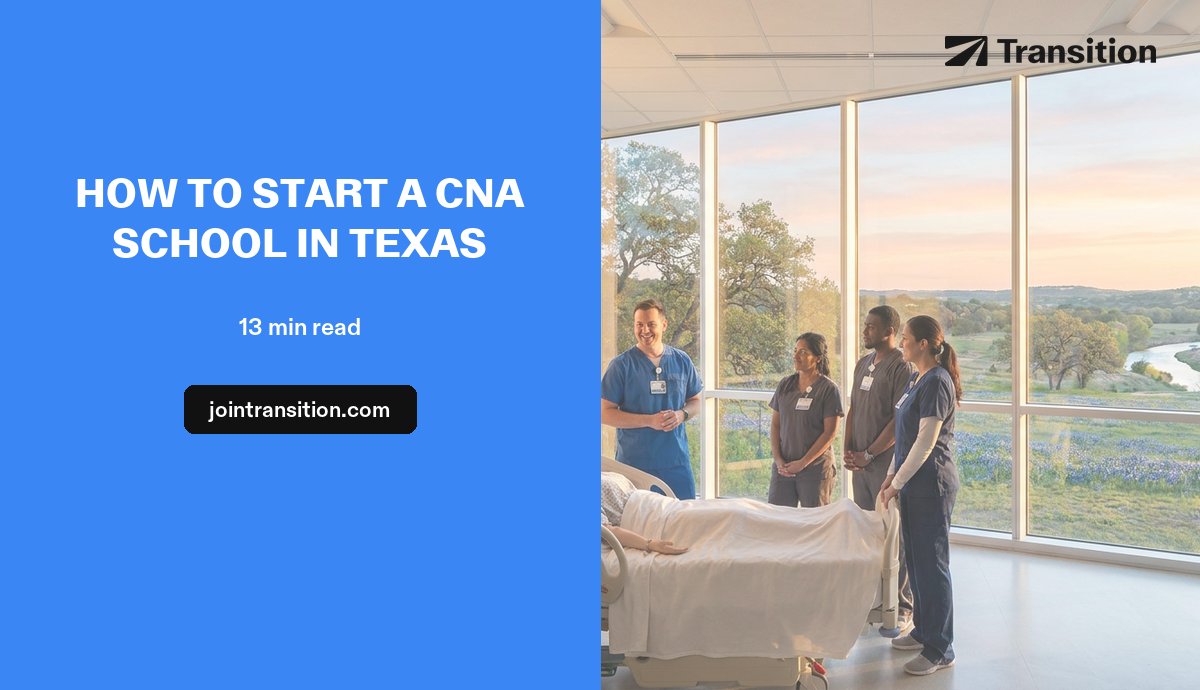
Texas calls CNA training programs NATCEPs — Nurse Aide Training and Competency Evaluation Programs — and routes everything through a single online portal called TULIP. That part of the process is cleaner than most states. What blindsides new founders is the second license: Texas HHSC itself tells standalone schools that "all non-facility based NATCEPs are required to obtain additional approval through the Texas Workforce Commission." Two agencies, two applications, one school. Most guides to starting a CNA school in Texas never mention the second one.
The market justifies the effort. Texas employed 88,293 nursing assistants in 2024, is projected to need 97,442 by 2034, and churns through roughly 13,707 openings a year. Meanwhile the state's own Long-Term Care Facilities Council reported to the Legislature that facility closures are being driven primarily by the inability to recruit and retain staff. Every one of those openings requires 100 hours of state-approved training first.
This is our home turf — we work with Texas CNA schools like Texana Training Solutions every day on enrollment, records, payments, and messaging, so we've watched this process from application to full classrooms. Here's the complete path. One graceful disclaimer up front: we're operators, not attorneys, and Texas rules move. Verify everything with HHSC, TWC, and your own counsel before you spend real money.
Quick Facts: CNA School Requirements in Texas
| Item | Requirement |
|---|---|
| Total training hours | 100 (60 classroom/lab + 40 clinical, fixed by 26 TAC §556.3) |
| Pre-clinical requirement | 16 introductory classroom hours before any resident contact (8 must be infection control incl. PPE) |
| Credential earned | Certified Nurse Aide (CNA), Texas Nurse Aide Registry |
| Approving agency | Texas HHSC (Health and Human Services Commission), Long-Term Care Regulation |
| Application portal | TULIP (Texas Unified Licensure Information Portal) — no application fee identified |
| Second license | TWC Career Schools and Colleges Certificate of Approval or written TWC exemption (standalone schools) |
| Exam vendor | Prometric (written $31 / oral $41 / skills $89) |
| Registry | Texas Nurse Aide Registry, searchable via TULIP Public Search |
| Time to approval | HHSC: up to 90 days on a complete application; TWC adds its own ~90-day track |
| Instructor requirement | Program director: Texas RN, 2 years experience + adult-teaching course/experience; 1 year LTC on staff |
Step 1 — Form your business entity
Texas filings go through the Secretary of State's SOSDirect system (or the newer SOSUpload). An LLC files a Certificate of Formation (Form 205) for $300 — expect about $308 with the statutorily authorized 2.7% card convenience fee. Most school founders choose an LLC for liability separation; talk to your CPA about whether an S-corp election makes sense once revenue is real.
Then the standard moves: free EIN from the IRS, dedicated business bank account, clean books from day one. The TWC career school application involves financial documentation, and commingled personal funds are the kind of mess that stalls it.
Step 2 — Register for state taxes
Texas has no personal income tax, but your LLC is automatically subject to the franchise tax administered by the Texas Comptroller. The no-tax-due threshold for 2026 reports is $2.65 million in annualized revenue, so a new school almost certainly owes nothing — but you must still file the annual Public Information Report. Set the reminder now.
Sales tax is genuinely good news here: standalone charges for instructional services — including vocational courses leading to certification — are not taxable in Texas. Separately sold textbooks, scrubs, and supply kits are; register for a sales tax permit if you'll sell them. Hiring employees adds unemployment tax registration with the Texas Workforce Commission.
Step 3 — Secure your location, classroom, and skills lab
HHSC's rules don't set a square-footage formula, but two constraints shape your build-out: the clinical ratio (at least one instructor per 10 trainees), and the fact that both HHSC (a NATCEP surveyor visits in person within two years of initial approval) and TWC (a pre-approval site visit) will inspect what you described on paper.
Build a skills lab that mirrors a nursing facility room: hospital beds, mannequin, wheelchair, gait belts, transfer equipment, vitals kit, a working handwashing sink, and privacy curtains. TULIP asks specifically about your classroom location, so lock the lease before you apply — but read Step 4 first so you don't pay rent for six months before you can legally enroll anyone.
Step 4a — Apply for HHSC NATCEP approval through TULIP
The heart of the process. Everything happens online in TULIP (the Texas Unified Licensure Information Portal): create an account, then navigate to the NA/MA/NFA section and start a Nurse Aide Training Program New Program Application. There's no numbered paper form for this — if you see references to a "Form 5507" application, that's actually an individual waiver form for aides trained before 1989, not a program application.
The TULIP application walks through six information steps — addresses, classroom location and program questions, your administrative authority and program director, clinical site(s), program instructors, and in-service education — plus a Documents tab where you upload:
- Your program director's resume
- Resumes for each program instructor
- A clinical agreement letter for every clinical site you list
Clinical sites must be one of Texas's allowed facility types: a licensed nursing facility, an ICF/IID, a Type B assisted living facility, a hospital, or a hospice inpatient unit (added in the 2024 rule amendments). We found no HHSC application fee anywhere in the rule or on HHSC's pages — the NATCEP application appears to be free.
Under 26 TAC §556.4, HHSC must notify you of approval or proposed denial within 90 days of receiving a complete application. Deficiencies show up in TULIP as "Response Required" with 10 days to correct — so watch the portal like a hawk after submitting. Approval arrives by email, you can start training immediately, and the approval runs on a two-year cycle: HHSC sends a renewal notice at least 60 days before expiration, and your renewal application is due at least 30 days before.
Step 4b — Get TWC Career School approval (the double-licensure trap)
Here's the part that separates this guide from the rest. Texas Education Code Chapter 132 requires proprietary career schools to hold a Certificate of Approval from the Texas Workforce Commission's Career Schools and Colleges program. There's an exemption at TEC 132.002(a)(7) for schools "otherwise regulated and approved" by another state agency — and an HHSC-approved NATCEP reads like a perfect fit.
The trap: the exemption is not automatic. Under TEC 132.002(d), you're exempt only if you apply to TWC for the exemption, submit supporting evidence, and TWC formally declares you exempt. Mechanically, that means filing TWC Form CSC-017 (Request for Exemption), checking the 132.002(a)(7) box, and attaching your HHSC NATCEP approval letter; TWC's stated response time is about 45–60 days. And HHSC's own NATCEP FAQ removes any doubt about whether you can skip this: all non-facility-based NATCEPs are directed to obtain additional approval through TWC.
So a standalone school engages TWC one of two ways:
- Written exemption via CSC-017 — viable if you teach only the HHSC-approved 100-hour NATCEP, nothing more. Note that TWC can still inspect exempt schools, and hours you add beyond the state-approved minimum — or any additional program (phlebotomy, PCT, medication aide prep marketed outside HHSC approval) — fall back under TWC jurisdiction and trigger full licensure.
- Full Certificate of Approval — the path most multi-program schools take. Initial fees: $3,000, or $1,001 for a small school (annual gross tuition and fees of $100,000 or less), plus $225 per additional program, $20 per director and instructor application, and an annual renewal fee of 0.12% of gross tuition (minimum $500). The application is Form CSC-001 with its checklist, TWC targets issuing approval within 90 days, and a site visit is part of the process.
Our honest advice from watching Texas schools navigate this: decide your five-year shape first. CNA-only forever? Pursue the exemption. Ever adding a second program — as most growing schools do? Start the TWC licensure clock early, because you need both agencies resolved before you enroll students legally.
Step 5 — Hire a qualified program director and instructors
Texas's requirements live in 26 TAC §556.5 (amended March 2024):
- Program director: a Texas-licensed RN with at least 2 years of nursing experience, plus a course in teaching adults or experience teaching adults or supervising nurse aides.
- Program instructors: Texas RN or LVN with at least 2 years of nursing experience and the same adult-teaching element. (You may see "one year" on an old HHSC FAQ — the rule says two; follow the rule.)
- The long-term care linkage: either the director or an instructor must have at least 1 year providing long-term care services in a nursing facility — and if your instructor is an LVN, the director or an RN instructor must be the one carrying that year.
- Supplemental trainers: licensed health professionals teaching within their scope, with a year of experience in their subject.
- Skills examiner: an RN with a year of experience caring for the elderly or chronically ill, plus completion of an HHSC skills training seminar.
There's no separate "train-the-trainer" certificate in Texas — the adult-education course/experience element serves that function. If you're an RN with two years including nursing facility time, you can be your own director and instructor at launch. If not, this hire gates your TULIP application, because the resumes upload with it.
Step 6 — Build or buy a state-compliant curriculum
Texas fixes the structure by rule (26 TAC §556.3): 100 total hours — 60 classroom/lab and 40 clinical. Within the 60, the first 16 introductory classroom hours must be completed before a trainee has any direct contact with a resident, and 8 of those 16 must cover infection control, including PPE. Your content must follow the state-approved Texas Curriculum for Nurse Aides in Long-Term Care Facilities.
Now the twist that changes Texas business models: since May 2024, HHSC has offered a free, state-run computer-based training (CBT) covering the entire 60-hour classroom portion. Approved NATCEPs must accept a trainee's CBT completion (within the preceding 12 months) in lieu of classroom hours — the student then completes the 40 clinical hours with you. Don't fight this; design for it. Smart Texas schools run two tracks: the full 100-hour program for students who want structure and support (most do), and a clinical-completion track that converts CBT finishers into paying students for the 40 hours they can't do alone.
One federal rule that shapes pricing: trainees employed by a nursing facility may not be charged for training or materials — the facility bears the cost. That's not a burden; it's a B2B sales channel (Step 7).
Step 7 — Set up clinical site agreements
Your 40 clinical hours need a signed agreement with one of the allowed facility types — and TULIP requires the agreement letter at application, so this comes before approval, not after. The 1:10 instructor-to-trainee clinical ratio also has to work within whatever student cap the facility gives you.
The pitch to administrators writes itself in this market: staffing shortages are closing Texas facilities, and you're offering first access to a recurring pipeline of trained graduates. Sweeten it with the employer-pays model — facilities that sponsor employees through your program satisfy the federal no-charge rule and lock in the hire. Then protect yourself: get at least two sites under agreement, because a single change in facility ownership or corporate policy can otherwise strand a cohort mid-program.
Step 8 — Understand testing and the Texas Nurse Aide Registry
Let's settle a point the internet gets wrong constantly: Texas nurse aide testing is run by Prometric, under contract with HHSC — not Credentia, not Pearson VUE. Current fees from Prometric's Texas Candidate Information Bulletin: written exam $31 (60 questions, 90 minutes), oral exam $41, clinical skills exam $89 (five skills from a bank of about 34, plus handwashing). Candidates get three attempts at each part within 24 months of completing training before retraining is required.
Texas gives schools real leverage here: Prometric administers exams at regional testing sites, computer-based testing centers, via live remote proctoring — and at In-Facility Testing (IFT) sites, which your school or clinical partner can become by applying through Prometric. Program directors manage candidate approvals, buy and assign exam vouchers, and pull results through the Texas Nurse Aide Portal. A school that tests on-site removes the last logistical barrier between graduation and certification, and your pass-rate data becomes a marketing asset.
Passing candidates land on the Texas Nurse Aide Registry, maintained by HHSC and publicly searchable through TULIP. Certification renews every two years, requiring qualifying work plus 24 hours of in-service education per cycle — and employers must also clear hires against the separate Employee Misconduct Registry. Build both lookups into your placement support.
Step 9 — Set up enrollment, payments, and student records
Count what Texas just handed you: TULIP data you must keep current, per-student documentation of the 16 introductory hours, attendance across a fixed 60/40 split, CBT-completion verification, clinical agreements and ratios, Prometric voucher management, two-year renewals — and an HHSC surveyor arriving in person within your first two years.
This is the layer where schools actually break, and it's the layer Transition runs: branded online enrollment, e-signed agreements, payment plans, attendance and skills tracking, survey-ready document storage, and automated email/SMS that moves every student from inquiry to enrolled to tested — one system instead of spreadsheets plus Jotform plus Square plus a filing cabinet. The Texas schools we work with spend their energy on teaching and partnerships, not reconciling three portals by hand.
Step 10 — Launch with a local marketing plan
- Google Business Profile first: "CNA classes Houston / Dallas / San Antonio" searches are where students start, and reviews from your first cohorts decide who they call. Ask every graduate, every time.
- Workforce Solutions: Texas runs 28 Local Workforce Development Boards operating 170+ Workforce Solutions offices, and the boards control WIOA training dollars through Eligible Training Provider lists. Getting listed makes your tuition free to funded students.
- Facility partnerships: every clinical site is also an employer-sponsored-student channel and a hiring-event venue. Texas's 1,183 nursing facilities, 2,008 assisted living facilities, and 733 ICF/IIDs are all short-staffed somewhere.
- The CBT-finisher audience: thousands of Texans complete HHSC's free online course and then need 40 clinical hours. "Finished the state's online course? Finish your clinicals with us" is a campaign nobody was running five years ago.
- Fast follow-up: the school that answers in five minutes beats the college that answers in five days.
What it really costs
Estimated startup ranges for a standalone Texas CNA school (estimates — verify current fees):
| Item | Estimated range |
|---|---|
| LLC formation + filings | $300–$650 |
| HHSC NATCEP application | $0 (no fee identified) |
| TWC exemption or Certificate of Approval | $0 (exemption) / $1,001–$3,000 (license) |
| Liability insurance (year 1) | $2,000–$5,000 |
| Rent + deposit (first 3 months) | $6,000–$15,000 |
| Skills lab equipment | $6,000–$18,000 |
| Curriculum + materials | $1,000–$5,000 |
| Instructor payroll (first cohorts) | $8,000–$18,000 |
| Marketing (first 6 months) | $2,500–$7,500 |
| Software + operations | $1,000–$3,000 |
| Total | $27,000–$75,000 |
The spread mostly reflects metro rents and whether you take the TWC license now or later. Texas's agency fees themselves are modest; payroll and space are the real budget.
How long it takes
Plan on 5 to 10 months from decision to first class. HHSC's 90-day clock only starts on a complete TULIP application — clinical agreement letters are the usual holdup, since facility corporate offices sign slowly. TWC runs its own roughly 90-day track (or 45–60 days for an exemption determination), and the two can run in parallel. Founders who assemble director, instructors, lease, and clinical agreements before touching TULIP routinely land near the five-month end.
Common mistakes to avoid
- Treating HHSC approval as the whole license. HHSC itself points non-facility NATCEPs to TWC. Skipping the exemption filing or the Certificate of Approval leaves you operating an unlicensed career school — with refund liability attached.
- Assuming the TWC exemption is automatic. TEC 132.002(d) requires you to apply and be declared exempt in writing. File the CSC-017; keep the letter.
- Submitting TULIP before clinical agreements are signed. The portal requires an agreement letter per site, deficiencies give you only 10 days to respond, and the 90-day clock rewards complete first submissions.
- Ignoring the free HHSC CBT. It's not going away, and it must be accepted for classroom hours. Schools that build a clinical-completion offer monetize it; schools that pretend it doesn't exist compete against free.
- Getting the LVN staffing math wrong. An LVN can instruct, but then your director or an RN instructor must carry the 1-year nursing facility experience. Check the combination before you hire.
- Missing the two-year rhythm. NATCEP renewal, registry renewals, and the initial-approval survey all run on two-year cycles. Calendar them the day your approval email lands.
FAQ
How much does it cost to start a CNA school in Texas? Realistically $27,000–$75,000 all-in. State fees are small — $300 for the LLC, no identified HHSC application fee, and $1,001–$3,000 for TWC licensure if you need it — so the budget is really rent, lab equipment, payroll, and marketing.
Do I need to be a nurse to open a CNA school in Texas? No, but your program director must be a Texas RN with two years of experience plus adult-teaching background, and someone on staff needs a year of nursing facility experience. Non-nurse founders hire the director first — the TULIP application requires that resume.
How many hours is CNA training in Texas? 100 hours, fixed by rule: 60 classroom/lab and 40 clinical, with the first 16 classroom hours (including 8 hours of infection control) completed before any resident contact.
Can CNA classes be online in Texas? The 60 classroom hours can be satisfied online — HHSC's own free CBT proves the model, and approved programs must accept its completion. The 40 clinical hours are in-person in a licensed facility, always.
Who runs the CNA exam in Texas? Prometric, under contract with HHSC — written $31, oral $41, skills $89. Schools and facilities can become in-facility test sites through Prometric, and directors manage vouchers and results through the Texas Nurse Aide Portal.
Do I need a TWC career school license if HHSC already approved my program? You need TWC to say so, either way. A CNA-only school can request a written exemption under TEC 132.002(a)(7) using Form CSC-017; a school adding any other program needs the full Certificate of Approval. HHSC explicitly directs non-facility programs to TWC.
How long does HHSC NATCEP approval take? Up to 90 days from a complete TULIP application, with 10-day windows to cure any flagged deficiencies. Complete, well-documented applications tend to move faster; missing clinical agreements are the most common delay.
Disclaimer
This guide is general information, not legal advice. Texas rules, fees, and vendors change — 26 TAC Chapter 556 was amended as recently as 2024, franchise tax thresholds move, and TWC fee schedules update. Verify current requirements directly with HHSC Long-Term Care Regulation, the Texas Workforce Commission Career Schools and Colleges program, the Comptroller, and your own counsel before making commitments.
Ready to build it?
The paperwork gets you open. The systems keep you open. When you're ready to run enrollment, payments, student records, e-signatures, and automated follow-up the way growing Texas CNA schools do, see how Transition works at jointransition.com.
Get CNA training paid for.
Tell us your county and we text you the route that fits, who to call, and what to bring.