
How to Start a CNA School in Virginia (2026 Guide)
July 27, 2026 · Virginia
Virginia's long-term care facilities, home health agencies, and hospitals have been short on certified nurse aides for years, and the state's aging population is not slowing down. From Hampton Roads to Richmond to Northern Virginia, employers compete for every graduate a training program can produce. Demand is on your side.
Here is the part that trips people up: in Virginia, nurse aide education programs are approved by the Virginia Board of Nursing, part of the Department of Health Professions, under regulation 18VAC90-26. Not the health department, not the education department. Virginia also raised its minimum to 140 hours in May 2023, so any advice still quoting 120 hours is out of date.
We help CNA and allied-health schools run their day-to-day operations, so we see this process from the inside. One note before we start: we are a software company, not a law firm. Treat this as a well-researched map, not legal advice, and verify current requirements with the agencies we name.
Quick Facts: CNA School Requirements in Virginia
| Item | Virginia Requirement |
|---|---|
| Total training hours | At least 140 clock hours (effective May 2023) |
| Hour minimums | At least 40 hours of direct client care clinical, at least 20 hours of skills lab, at least 24 hours of instruction before any client contact |
| Credential issued | Certified Nurse Aide (CNA) |
| Approving agency | Virginia Board of Nursing (Department of Health Professions) |
| Application | Application to Establish a Nurse Aide Education Program, submitted electronically at least 90 days before your expected opening date |
| Governing regulation | 18VAC90-26 |
| Exam vendor | Credentia (CNA365 portal) |
| Registry | Virginia Nurse Aide Registry, maintained by the Board of Nursing |
| Typical time to approval | Roughly 4 to 8 months from entity formation to first class |
| Instructor requirement | RN with a current, unrestricted Virginia or multistate license, 2 years of RN experience, and 1 year of direct client care or supervisory experience in long-term care |
Step 1: Form Your Business Entity
Start with the Virginia State Corporation Commission (SCC). You will file through the SCC's Clerk's Information System at cis.scc.virginia.gov, which handles formation, annual registration, and name searches in one portal.
Most school owners form an LLC. In Virginia that means filing Articles of Organization (Form LLC-1011) with a $100 filing fee, plus a $50 annual registration fee due by the last day of your anniversary month each year. Check name availability in the Clerk's Information System first, and avoid names that imply you are a college or an RN nursing school.
Once the SCC approves your entity, get a free EIN from the IRS online and open a dedicated business bank account. The Board of Nursing's application asks about financial resources, and clean books help.
Step 2: Register for State Taxes
Virginia Tax is the state's revenue agency. Register through its online business registration before you hire anyone or collect tuition.
Good news on sales tax: Virginia's retail sales and use tax applies to tangible goods, and tuition for instructional services is generally not subject to it. Confirm your situation with Virginia Tax or your accountant, especially if you sell textbooks or scrub packages separately, since selling goods can create a sales tax obligation even when tuition does not.
If you will have employees, register for employer income tax withholding with Virginia Tax and for unemployment insurance tax with the Virginia Employment Commission (VEC); Virginia's combined business registration handles both in one pass. Payroll registration is required even for part-time RN instructors.
Step 3: Secure Your Location, Classroom, and Skills Lab
Regulation 18VAC90-26-50 sets out what your facility must provide: comfortable temperatures, clean and safe conditions, adequate lighting, enough space for the cohort, current instructional technology, and equipment and supplies for simulating client care sufficient for your student group.
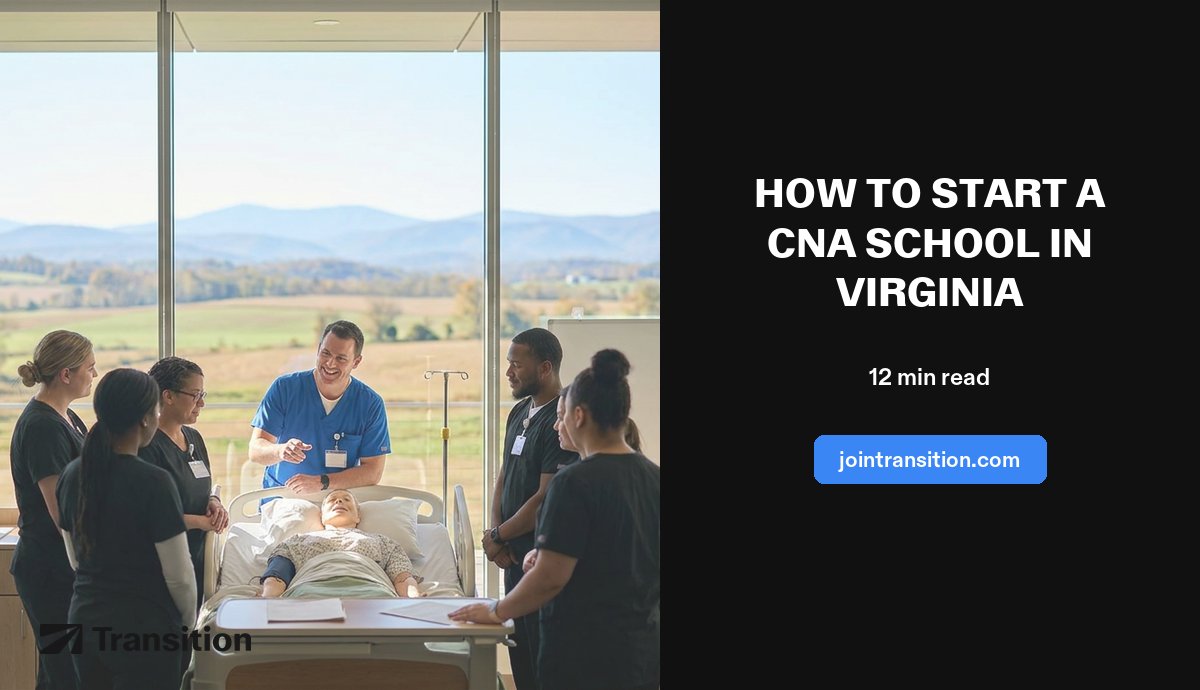
In practice, plan a classroom that seats your cohort and a skills lab set up like a resident room: hospital beds, a working sink for handwashing practice, mannequins, a mechanical lift, wheelchairs, vital signs equipment, privacy screens, and everyday personal care supplies. Remember the ratio rule: no more than 10 students per instructor in the skills lab and every clinical area.
Zoning is on you, not the Board. Before signing a lease, confirm with your city or county that the space is zoned for instructional use. A 1,200 to 2,000 square foot space is a common starting footprint for a single-cohort school.
Step 4: Apply for State Program Approval
This is the heart of the process. The Virginia Board of Nursing approves nurse aide education programs under 18VAC90-26. The form is the Application to Establish a Nurse Aide Education Program, on the Board's Nurse Aide Education Programs page at dhp.virginia.gov, and the application plus all supporting documentation must be submitted electronically at least 90 days before your expected opening date.
Your package must demonstrate what 18VAC90-26-20 requires: qualified instructional personnel, a compliant curriculum (see Step 6), facilities meeting the standards above, a record-keeping system, clinical training arrangements, and adequate financial resources.
Two Virginia specifics are worth flagging. First, approval comes only after your documentation is accepted and a site visit has been conducted, and you may not advertise until Board approval is granted. Second, the Board runs periodic virtual seminars on the application process for new nurse aide programs. Attend one; it is the fastest way to hear what reviewers look for. The Board's nurse aide education contact is reachable at 804-367-4473.
The Board does not publish a big application fee schedule for nurse aide programs, but confirm current fees when you apply rather than assuming zero. After approval, expect annual review by survey visit or written evaluation, a survey visit at least every two years, and possible unannounced visits.
One provision to know before writing your tuition policy: under 18VAC90-26-50, a program may not charge any fee, including textbooks and materials, to a student who on day one is employed by or has an employment offer from a facility. That is Virginia's implementation of the federal rule on facility-sponsored students, so price accordingly.
Step 5: Hire a Qualified Program Coordinator and Instructors
Virginia's instructor rules live in 18VAC90-26-30, and they are specific.
Your program coordinator and primary instructor must each hold a current, unrestricted Virginia RN license or multistate licensure privilege, with two years of RN experience and at least one year of direct client care or supervisory experience in long-term care. The coordinator carries administrative responsibility; the primary instructor delivers the majority of instruction and may not take on other duties while teaching or supervising students. In a facility-based program, the director of nursing may serve as coordinator but cannot do the teaching.
Supplemental personnel have their own lanes: health professionals with a year of experience in their field can teach classroom topics in their specialty, and RNs or LPNs with unrestricted Virginia licenses and a year of direct client care experience can provide clinical instruction under the primary instructor's supervision.
Virginia also has a teach-the-teacher requirement: before their first assignment, instructors must show competence in teaching adults, via at least 12 hours of coursework (adult learning, teaching methods, evaluation, the regulations, the curriculum, the exam skills) or equivalent teaching experience. Everyone teaching the curriculum completes a refresher course every three years, and the 1:10 clinical ratio caps how many students one instructor can supervise.
Step 6: Build or Buy a State-Compliant Curriculum
Here Virginia does new schools a real favor: the Board publishes a Board-approved nurse aide curriculum, downloadable from the Nurse Aide Education Programs page, along with a Program Administration Reference Guide, sample skills performance checklists, and a Virginia skills listing. You do not have to buy a curriculum, though many schools add textbooks and supplemental materials.
Whatever you use must deliver at least 140 clock hours under 18VAC90-26-50, built around three minimums: at least 24 hours of instruction before a student has any direct client contact, at least 20 hours designated for skills acquisition in the lab, and at least 40 hours of clinical time providing direct client care. Note the phrasing on the last one: observation hours do not count toward the 40.
Virginia does not fix a single classroom-hour number; it sets the 140-hour total plus those minimums and leaves the design to you. A common build is roughly 80 hours of classroom and lab combined, 40 to 50 hours of clinical, and buffer hours for review and exam prep.
Step 7: Set Up Clinical Site Agreements
Your 40-plus clinical hours must happen in a real care setting, and 18VAC90-26 requires that your clinical site not be a facility subject to certain federal penalties. Nursing facilities are the classic partner, but check a facility's survey history before you sign.
Get a written affiliation agreement with each site covering access, scheduling, supervision, liability insurance, and immunization and background check expectations. The common snags: facilities that verbally agree and then stall on signing (start these conversations months early), shift windows that do not fit your students, and corporate owners who require sign-off above the building administrator. Have a backup site identified before your Board site visit; reviewers want clinical access that is real, not aspirational.
Step 8: Understand Testing and the Virginia Nurse Aide Registry
Virginia's nurse aide competency exam is administered by Credentia. Students use Credentia's CNA365 portal to apply, schedule, and get results. The exam has two parts taken the same day: a written (or oral) knowledge test of 70 multiple-choice questions, ten of them unscored pilot items, and a hands-on skills evaluation. Candidates get three attempts at each part; failing out means retraining.
When students pass both parts, they are placed on the Virginia Nurse Aide Registry, maintained by the Board of Nursing. You will verify each student's completion so Credentia can confirm eligibility, and pass rates feed your continued-approval story with the Board, so build exam prep into your final week. Established programs can also explore becoming a Credentia test site, a real enrollment selling point.
One more wrinkle: because your program is approved by the Board of Nursing, you generally fall under the exemptions in Virginia Code § 23.1-226 from SCHEV's private postsecondary certification, which covers occupational training subject to approval by another state regulatory board. Do not just assume. Ask SCHEV's Private and Out-of-State Postsecondary Education (POPE) office to confirm your exemption in writing before you enroll students.
Step 9: Set Up Enrollment, Payments, and Student Records
Virginia requires you to keep original records for two years after each site visit: student skills checklists with the dates each skill was performed, graduates' exam results, and complaint resolutions. Every graduate gets a certificate showing your program name, Board approval number, completion date, and instructor signature. If your system is spreadsheets plus a Jotform, a Square account, and a filing cabinet, an unannounced Board visit becomes a bad day.
This is the part of the business we live in. Transition gives CNA schools one system for branded online enrollment, payment plans, attendance and grade tracking, skills checklists, document e-signatures, automated onboarding emails and texts, and student surveys. The schools we work with spend their energy teaching, and when a surveyor asks for a student file, it is a search, not an archaeology dig.
Step 10: Launch with a Local Marketing Plan
Remember: in Virginia you may not advertise until Board approval is granted, so line everything up to launch the day you are approved. Claim your Google Business Profile immediately; "CNA classes near me" searches are how most students find you, and early graduate reviews compound fast.
Connect with Virginia Works, the Department of Workforce Development and Advancement, through your local Virginia Career Works center. Workforce funding can pay tuition for eligible students, and being known to your local center is a steady referral channel. Local nursing facilities looking to sponsor aides are your other pipeline; the no-fee rule from Step 4 becomes a revenue model if you contract with facilities directly. Keep your website simple: dates, price, schedule, enrollment link. Then answer every inquiry fast. The school that replies within an hour wins the student.
What It Really Costs
Realistic estimate ranges for a single-classroom startup in Virginia, not quotes.
| Expense | Estimated Range |
|---|---|
| Entity formation and SCC fees | $100 - $400 |
| Liability and professional insurance (year one) | $1,500 - $4,000 |
| Lease deposit and initial rent | $3,000 - $15,000 |
| Skills lab equipment (beds, mannequins, lift, vitals, supplies) | $8,000 - $25,000 |
| Curriculum materials and textbooks (Board curriculum is free) | $500 - $4,000 |
| Instructor payroll before first tuition arrives | $8,000 - $20,000 |
| Application and inspection-related costs | $0 - $1,000 (confirm current fees with the Board) |
| Marketing and website | $2,000 - $6,000 |
| Realistic total to launch | $25,000 - $75,000 |
Virginia's free Board-approved curriculum and modest state filing fees keep the low end lower than many states. The big variables are your lease and how long you carry payroll before tuition flows.
How Long It Takes
Plan on 4 to 8 months from forming your LLC to teaching your first class. The fixed floor is the Board's 90-day advance application window; the variance comes from how quickly you produce a complete application, how fast a site visit can be scheduled, and how long clinical site negotiations take. Schools that attend a Board application seminar, adopt the Board-approved curriculum, and start clinical conversations in month one land at the fast end. Schools that treat the clinical agreement as a last-minute detail land at the slow end.
Common Mistakes to Avoid
- Sending your application to the Virginia Department of Health instead of the Board of Nursing at the Department of Health Professions. Approval is a Board of Nursing function under 18VAC90-26.
- Advertising before approval. Virginia authorizes advertisement only after Board approval, and a premature Facebook page counts.
- Building a 120-hour program off outdated information. The minimum has been 140 hours since May 2023, with the 40/20/24 minimums inside it.
- Counting observation time as clinical hours. The 40 clinical hours must be direct client care; shadowing does not count.
- Hiring a great RN who lacks the long-term care experience requirement, or skipping the 12-hour teaching-preparation coursework before their first class.
- Ignoring the SCHEV question. The § 23.1-226 exemption almost certainly covers you, but get it in writing rather than discovering a certification issue mid-enrollment.
FAQ
How much does it cost to start a CNA school in Virginia? Most single-classroom startups land between $25,000 and $75,000 all-in before first tuition. Virginia helps on the low end because the Board's approved curriculum is free and SCC filing fees are about $100. The biggest swings are your lease and pre-revenue payroll.
Do I need to be a nurse to open a CNA school in Virginia? No. The owner does not have to be a nurse, but your program coordinator and primary instructor must be RNs with unrestricted Virginia or multistate licenses, two years of RN experience, and a year of long-term care experience. Many owners run the business and hire the clinical leadership.
How many hours is CNA training in Virginia? At least 140 clock hours, including at least 40 hours of hands-on clinical care, at least 20 hours of skills lab, and at least 24 hours of instruction before any direct client contact, per 18VAC90-26-50, effective May 2023.
Can CNA classes be online in Virginia? Partially. Classroom theory can incorporate distance methods if your approved application reflects it, but the 20 lab hours and 40 clinical hours are in-person by nature. Describe any hybrid design in your application and confirm Board expectations first.
How long does Board of Nursing approval take? You must apply at least 90 days before your expected opening date, and approval requires accepted documentation plus a completed site visit. Plan on roughly three to five months from submission to approval, and 4 to 8 months from LLC to first class.
What exam do my graduates take, and who runs the registry? Graduates test through Credentia via the CNA365 portal, with a knowledge test and skills evaluation and three attempts per part. Passing both places them on the Virginia Nurse Aide Registry, maintained by the Virginia Board of Nursing.
Do I also need SCHEV certification to operate? Generally no. Virginia Code § 23.1-226 exempts occupational training programs subject to approval by a state regulatory board, which covers Board of Nursing-approved nurse aide programs. Confirm your exemption with SCHEV's POPE office in writing so there is no ambiguity.
Disclaimer
This guide is general information, not legal, tax, or regulatory advice. Rules and fees change. Verify current requirements with the Virginia Board of Nursing (Department of Health Professions), the SCC, Virginia Tax, SCHEV, and Credentia before making decisions, and consider having a Virginia attorney review your enrollment agreement.
Ready to Build Your School?
The paperwork gets you open. The systems keep you open. When you are ready to see how Transition runs enrollment, payments, student records, e-signatures, and automated messaging for CNA schools like the one you are about to build, visit jointransition.com and take a look.
Get CNA training paid for.
Tell us your county and we text you the route that fits, who to call, and what to bring.