
How to Start a CNA School in Wisconsin (2026 Guide)
July 27, 2026 · Wisconsin
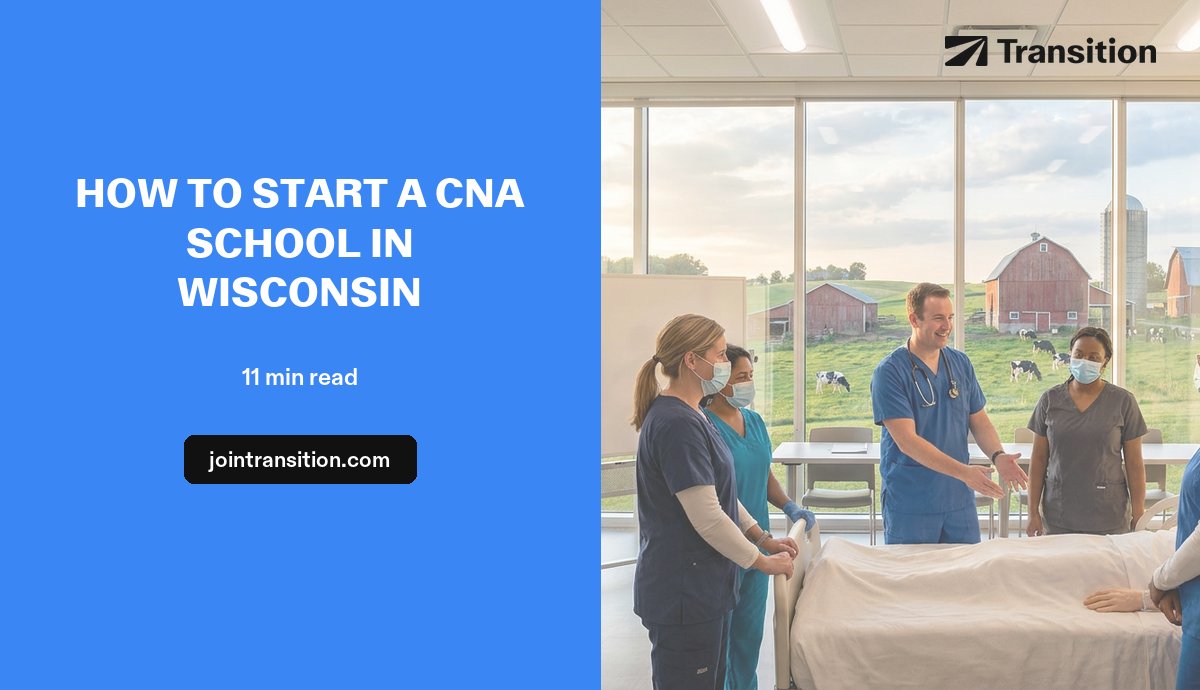
Wisconsin needs nurse aides badly. Long-term care providers statewide have run short-staffed for years — it's why the Legislature cut required training from 120 hours to the 75-hour federal minimum in 2020, and why the state has funded programs like WisCaregiver Careers to push more CNAs onto the registry. If you're thinking about opening a CNA school here, demand is not your problem.
Wisconsin is also one of the more navigable states to do it in: one approving agency — the Department of Health Services (DHS), Division of Quality Assurance — one rulebook (Wis. Admin. Code ch. DHS 129), no separate private career school license, and one of the shortest required curriculums in the country. It's still not easy: DHS runs a two-stage approval with onsite reviews, and a denied application locks you out for six months. But compared to states juggling three agencies, Wisconsin is refreshingly direct.
We help CNA and allied-health schools run their day-to-day operations — enrollment, records, contracts, messaging — so we see this process from the inside across many states. One note before we start: we're operators and software people, not lawyers, and rules change. Verify everything below with the agencies we name before you spend money on it.
Quick Facts: CNA School Requirements in Wisconsin
| Requirement | Wisconsin Answer |
|---|---|
| Total training hours | 75-hour minimum (cut from 120 in 2020) |
| Classroom / clinical split | At least 16 hours clinical; first 16 hours must be classroom before any client contact |
| Credential issued | Nurse Aide (CNA) |
| Approving agency | Wisconsin Department of Health Services, Division of Quality Assurance (DQA) |
| Application | DHS forms via the DQA Nurse Aide Training Program page; submit to DHSWIDQA_NATCEP@dhs.wisconsin.gov |
| Exam vendor | D&S Diversified Technologies (D&SDT-Headmaster), via the TMU portal (wi.tmuniverse.com) |
| Registry | Wisconsin Nurse Aide Registry (WNAR) |
| Typical time to approval | Roughly 2–4 months for program approval; 4–9 months from business formation to first class |
| Instructor requirement | RN with 2+ years of nursing experience, including 1+ year in long-term care, plus a train-the-trainer course |
Step 1: Form Your Business Entity
Before DHS will talk to you about program approval, you need a legal entity. In Wisconsin, business formation goes through the Wisconsin Department of Financial Institutions (DFI) — not a Secretary of State, which trips up people coming from other states. File your Articles of Organization online through DFI's One Stop Business Portal. The online fee for a domestic LLC is $130 ($170 by mail), typically processed within one to two business days. Most owners we work with choose an LLC for liability protection and simplicity.
While you're at it: get a free EIN from the IRS (irs.gov, minutes online), open a dedicated business bank account (tuition mixed with personal money is a bookkeeping nightmare), and budget for Wisconsin's $25 annual report to stay in good standing.
Step 2: Register for State Taxes
Next stop is the Wisconsin Department of Revenue (DOR). Register through DOR's My Tax Account portal, which handles the Business Tax Registration (a small fee, currently $20 with a $10 biennial renewal — verify when you file).
Tuition for educational services is generally not subject to Wisconsin sales tax, but if you sell taxable goods — textbooks, scrubs, supply kits — you may need a seller's permit and to collect tax on those items; confirm with DOR or your accountant. If you'll have employees (at minimum a primary instructor, unless that's you), also register for unemployment insurance with the Wisconsin Department of Workforce Development (DWD), set up state withholding through DOR, and carry workers' compensation insurance.
Step 3: Secure Your Location, Classroom, and Skills Lab
DHS doesn't publish a square-footage formula, but under DHS 129.05 it conducts a preliminary approval onsite review specifically to verify your classroom and equipment can support the training — so your space needs to be real before you apply, not after.
Plan for:
- A classroom that comfortably seats your cohort with room for demonstrations.
- A skills lab that simulates resident care: at least one hospital bed (two is better), a practice mannequin, wheelchair, gait belt, mechanical lift, bedpans, blood pressure cuffs, a handwashing station, linens, and personal care supplies.
- Zoning and occupancy sign-off from your municipality before you sign a lease.
The schools we work with typically spend $8,000–$20,000 outfitting a first lab, depending on how much they buy used. Nursing home liquidations and hospital surplus sales are your friend.
Step 4: Apply for DHS Program Approval
This is the heart of the process. Wisconsin nurse aide training programs are approved by the Division of Quality Assurance (DQA) within DHS under Wis. Admin. Code ch. DHS 129, and no program may begin instruction before approval. How it works:
- Get the application forms. DHS posts them on its "Starting or Maintaining a Nurse Aide Training Program" page (dhs.wisconsin.gov/caregiver/nurse-aide/natd-application.htm), or request them from the NATCEP team at DHSWIDQA_NATCEP@dhs.wisconsin.gov or 608-261-9315. Under DHS 129.05(2), you apply on the department's form and must name the individual responsible for the program's operation and compliance.
- Assemble the package. Document your curriculum (mapped to the DHS 129.07 content requirements), your primary instructor's qualifications (Primary Instructor Application, form F-62610), training schedule, clinical site arrangements, skills lab equipment, and program policies.
- Preliminary approval onsite review. DQA visits your site to verify the classroom and equipment are adequate before issuing preliminary approval.
- Teach under preliminary approval. Preliminary approval runs for a three-month period — you're operating, but being watched.
- Formal approval onsite review. After three months, DQA conducts a second onsite review, then either issues formal approval or revokes the preliminary approval. Approved programs face ongoing reviews (federal rules require re-review at least every two years); form F-62590 is the post-onsite-review questionnaire used in that cycle.
Two things to take seriously: DHS does not currently publish a program application fee (confirm with DQA — your real costs are space, equipment, and staff), and a denied application means you cannot reapply for six months. That's half a year of rent on an empty classroom. Submit a complete, careful application the first time.
Step 5: Hire a Qualified Program Director and Instructors
Wisconsin's requirements live in DHS 129.06 and 129.08, and they're strict where it counts:
- Primary instructor: a registered nurse with at least two years of nursing experience, including at least one year in a nursing home or skilled nursing facility, who has completed a department-approved train-the-trainer course. The approval application is form F-62610.
- Program director / designee: every program names the person responsible for operations and compliance on the approval application.
- Additional trainers: other qualified health professionals may teach their subject areas under the primary instructor's supervision, per DHS 129.
- One nursing-home quirk: facility-based training can run under the director of nursing's general supervision — but the DON may not serve as primary instructor or program trainer.
If you're not an RN, this is your most important hire. Budget $35–$55/hour for a qualified RN instructor in most Wisconsin markets (estimate — Madison and Milwaukee trend higher), and have a backup, because losing your only approved instructor mid-cohort can shut down the program.
Step 6: Build or Buy a State-Compliant Curriculum
Wisconsin's hour requirements are among the lowest in the nation, and that's recent history worth knowing. 2019 Wisconsin Act 185 (passed April 2020) barred DHS from requiring more than the federal minimum, cutting the requirement from 120 hours to 75 hours — later made permanent by rule. Under DHS 129.07(2)(b):
- 75 clock hours minimum of instruction.
- At least 16 hours of supervised practical (clinical) training.
- The first 16 hours must be classroom instruction completed before a student has any direct contact with a client.
- Competency evaluation and provider orientation hours do not count toward the 75.
The remaining ~59 hours aren't split by rule — you allocate them across the required DHS 129.07 content areas (basic nursing skills, personal care, communication, residents' rights, safety, mental health, restorative care, and so on). Many Wisconsin technical colleges still voluntarily run 120-hour programs; you can differentiate on speed with a tight 75-hour program or on depth with more hours — both are legal. Map every syllabus hour to the rule's content requirements; that mapping is what DQA reviews.
Step 7: Set Up Clinical Site Agreements
Your 16+ clinical hours must happen with real clients under supervision, which for most independent schools means a written affiliation agreement with a nursing home or skilled nursing facility — long-term care is the standard setting, since both the curriculum and the instructor experience requirement are built around it.
Common snags:
- Start early. Corporate legal review of an affiliation agreement can take 60+ days.
- Check the facility's federal standing. Facilities hit with certain serious deficiencies can be federally barred from hosting a NATCEP for two years. Ask before you sign.
- Ratios and scheduling. Facilities cap how many students can be on the floor at once; plan cohort sizes around it.
- Give the facility a reason. The best agreements are hiring pipelines: your graduates become their aides. Lead with that.
Step 8: Understand Testing and the Wisconsin Nurse Aide Registry
Wisconsin's competency exam is run by D&S Diversified Technologies (D&SDT-Headmaster) — not Credentia or Prometric — and Headmaster also maintains the Wisconsin Nurse Aide Registry (WNAR) on behalf of DHS. Everything runs through the TMU (TestMaster Universe) portal at wi.tmuniverse.com: schools record training completions there, and candidates schedule exams, view scores, and manage retakes in the same system.
What that means for you:
- You'll get TMU credentials as an approved program and submit graduates' completion records through the portal.
- Students take a knowledge exam (written or oral) and a skills demonstration. Current fees and procedures are in the Wisconsin Candidate Handbook on hdmaster.com — point students there rather than quoting numbers that change.
- Approved schools can apply through Headmaster to become a test site — a real competitive advantage, since students strongly prefer testing in the room where they trained.
- Passing candidates are listed on the WNAR and employable in federally certified facilities. Headmaster support: 888-401-0462 (testing), 888-401-0465 (registry).
Step 9: Set Up Enrollment, Payments, and Student Records
Here's the part almost everyone underestimates. From day one you need to track enrollments, collect tuition on payment plans, get agreements signed, log attendance against a 75-hour requirement where every hour matters, record grades and skills checkoffs, and submit accurate completion records to TMU — while answering the same "is class still on Tuesday?" text forty times.
Most new schools duct-tape this together with spreadsheets, Jotform, Square, and paper folders — which works until your second cohort. This is what we built Transition for: branded online enrollment, payment plans, attendance and grade tracking, e-signed contracts, automated emails and SMS, and student surveys in one system instead of five. When DQA arrives for your formal-approval review, pulling any student's complete file in ten seconds is worth a lot.
Step 10: Launch With a Local Marketing Plan
You don't need a big budget; you need to be findable and fast.
- Google Business Profile first. "CNA classes near me" is how most students will find you. Claim it, add lab photos, and ask every graduate for a review.
- Get on the ETPL. Work with the Wisconsin Department of Workforce Development (DWD) and your local Job Center of Wisconsin to get listed on the Eligible Training Provider List so WIOA-funded students can use vouchers at your school. DHS approval is a prerequisite, so sequence this after Step 4.
- Partner with employers. Wisconsin nursing homes and home care agencies are desperate for aides — some sponsor students outright, and the WisCaregiver Careers initiative has periodically covered training and testing costs.
- Simple website, fast follow-up. One page with schedule, price, and an enrollment link — then respond to every inquiry within minutes. Speed-to-lead wins more enrollments than any ad campaign.
What It Really Costs
Realistic startup ranges for a first-location Wisconsin CNA school (all figures are estimates — your market and choices will move them):
| Item | Estimated Range |
|---|---|
| LLC formation (DFI, online) + misc. filings | $130 – $500 |
| Liability insurance (general + professional, annual) | $1,500 – $4,000 |
| Lease deposit + first months' rent | $3,000 – $10,000 |
| Skills lab equipment (beds, mannequin, lift, supplies) | $8,000 – $20,000 |
| Curriculum development or purchase | $500 – $5,000 |
| Instructor payroll through first cohort | $4,000 – $10,000 |
| DHS application/onsite process (no published fee; travel, prep, misc.) | $0 – $500 |
| Marketing (site, Google, launch ads) | $1,000 – $5,000 |
| Software (enrollment, records, messaging) | $100 – $400/month |
| Realistic total to launch | $20,000 – $55,000 |
Used equipment, a modest space, and serving as your own RN instructor put you near the bottom of that range; hiring an instructor and building a new lab puts you near the top.
How Long It Takes
Plan on 4 to 9 months from filing your LLC to graduating your first cohort. The variance comes from three places: how quickly you lock down a compliant space (the preliminary onsite review can't happen without it), how fast your clinical agreement clears a facility's legal review, and the DHS two-stage approval itself. The good news: you can teach (and collect tuition) during the three-month preliminary window. The bad news: a denied application means a six-month lockout — the single biggest schedule risk in the state.
Common Mistakes to Avoid
- Rushing the application and eating the six-month penalty. Wisconsin's reapplication lockout after a denial is brutal. Have everything ready — instructor approved, site ready, curriculum mapped — before you submit.
- Signing a lease before checking zoning and classroom adequacy. DQA physically inspects your classroom and equipment before preliminary approval; an inadequate space stalls everything.
- Hiring an RN without long-term care experience. Two years as a nurse isn't enough — Wisconsin requires a year in a nursing home or SNF, plus train-the-trainer. Verify before you hire.
- Confusing agencies. LLCs go through DFI, not a Secretary of State — and nurse aide schools do not need EAP approval from DSPS, because DHS-regulated CNA training is exempt. Don't pay for licensure you don't need or skip the one you do.
- Counting orientation or testing toward the 75 hours. They explicitly don't count under DHS 129.07. Build your schedule on 75 true instructional hours.
- Running the school on spreadsheets past your first cohort. Attendance gaps and missing signatures are what turn a routine DQA review into a problem.
Frequently Asked Questions
How much does it cost to start a CNA school in Wisconsin? Plan on roughly $20,000–$55,000 all-in for a first location; the biggest line items are your skills lab, rent, insurance, and instructor payroll. Government costs are low here — a $130 online LLC filing and no published DHS application fee.
Do I need to be a nurse to open a CNA school in Wisconsin? No. You can own the business without a nursing license, but your primary instructor must be an RN with two years of nursing experience, including one year in long-term care, plus a train-the-trainer course. Many owners hire this role; if you are that RN, your economics get much better.
How many hours is CNA training in Wisconsin? The state minimum is 75 hours, including at least 16 hours of supervised clinical training, with the first 16 hours classroom-only before any client contact. Wisconsin cut the requirement from 120 hours in 2020 and now tracks the federal minimum.
Can CNA classes be online in Wisconsin? Partially, sometimes. Clinical hours are always in person, and the first 16 hours must be classroom-delivered before client contact. If you want online or hybrid theory hours, propose it explicitly in your DHS application and get DQA's sign-off in writing.
Do I need a private career school license (EAP) in addition to DHS approval? No — a genuine Wisconsin advantage. Nursing assistant training regulated by DHS is exempt from Educational Approval Program approval under Wis. Stat. 440.52's exemption for programs overseen by another state agency. If you later add programs DHS doesn't regulate (phlebotomy, medical assisting), re-check with EAP at DSPSEAP@wisconsin.gov.
Who runs the CNA exam in Wisconsin? D&S Diversified Technologies (D&SDT-Headmaster) administers the exams and maintains the Wisconsin Nurse Aide Registry through the TMU portal at wi.tmuniverse.com. Wisconsin moved to Headmaster years ago — ignore national articles mentioning Credentia or Pearson VUE for this state.
How long does DHS approval take? There's no statutory clock, but the structure sets a floor: an onsite review before preliminary approval, a three-month preliminary period, then a second onsite review before formal approval. Plan two to four months to reach preliminary approval and teaching status with a complete application.
Disclaimer
This guide is general information, not legal advice. Requirements, forms, and fees change — Wisconsin's own hour requirement changed dramatically in 2020 and could change again. Before making financial commitments, verify current requirements with the DHS Division of Quality Assurance (DHSWIDQA_NATCEP@dhs.wisconsin.gov, 608-261-9315), DFI, DOR, and a Wisconsin-licensed attorney or accountant.
The Paperwork Gets You Open. The Systems Keep You Open.
DHS approval is the starting line — enrollment, payments, attendance, documents, and student communication are the race. See how Transition runs those systems for CNA and allied-health schools like the one you're about to build at jointransition.com.
Get CNA training paid for.
Tell us your county and we text you the route that fits, who to call, and what to bring.