
How to Start a CNA School in Wyoming (2026 Guide)
July 27, 2026 · Wyoming
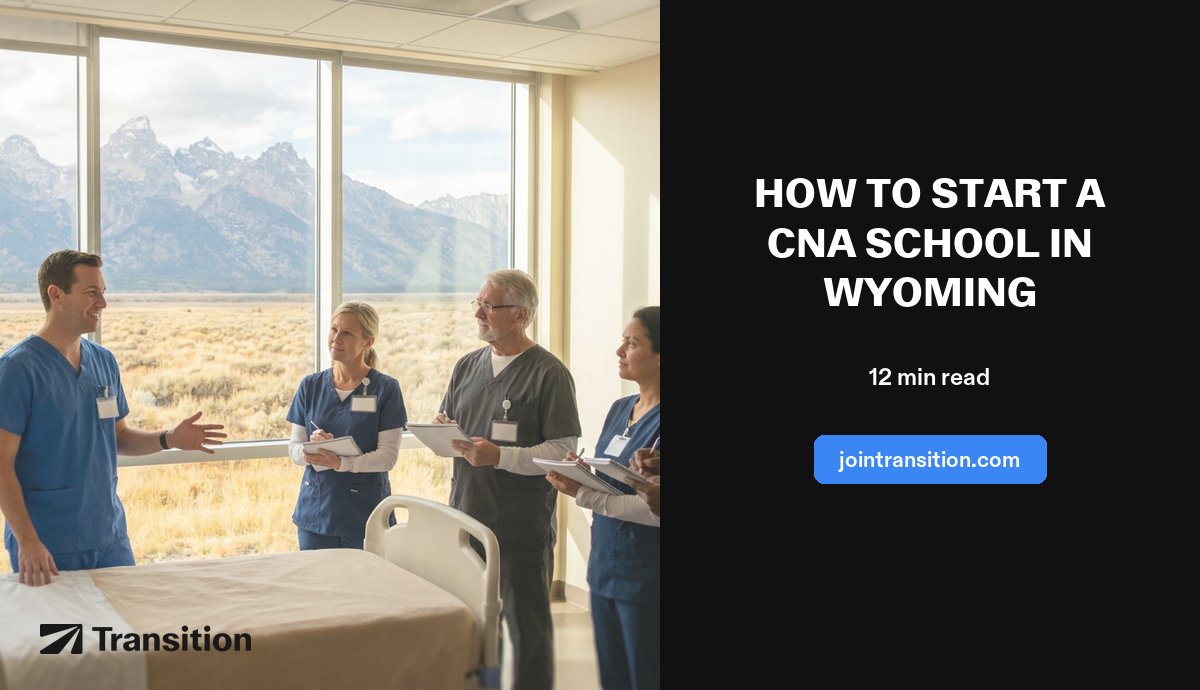
Wyoming has fewer people than any state in the country, spread across nearly 98,000 square miles — and every nursing home, hospital, and assisted living community in it needs certified nurse aides. In towns like Riverton, Gillette, and Rock Springs, the nearest CNA class can be a community college campus an hour or more away. That gap is exactly where a well-run private CNA school earns its keep.
Wyoming's process has a wrinkle that trips people up: two agencies share the work. The Wyoming Department of Health's Healthcare Licensing and Surveys office approves nurse aide training programs (NATCEPs), while the Wyoming State Board of Nursing certifies the aides, runs the Wyoming Nurse Aide Registry, and oversees testing through D&SDT-Headmaster. Get the routing wrong and your application sits in the wrong inbox for weeks. We help CNA and allied-health schools run their day-to-day operations — enrollment, records, contracts, messaging — so we see how these approvals play out in practice.
One note before we start: this is an operator's guide, not legal advice. Rules and fees change, so verify everything with the agencies we name below before you spend money.
Quick Facts: CNA Schools in Wyoming
| Item | Wyoming Requirement |
|---|---|
| Total training hours | 75-hour federal minimum (42 CFR 483.152); verify current state requirements before finalizing your curriculum |
| Classroom/clinical split | At least 16 hours of supervised clinical training; the remainder is classroom and lab |
| Credential issued | Certified Nurse Aide (CNA) |
| Program approval | Wyoming Department of Health, Healthcare Licensing and Surveys (form HLS/CNA-101) |
| Certification and registry | Wyoming State Board of Nursing (WSBN) — Wyoming Nurse Aide Registry (WYNAR), applications via the Nurse Portal |
| Exam vendor | D&SDT-Headmaster, TestMaster Universe (TMU) at wy.tmutest.com — $127 total ($32 knowledge + $95 skills) |
| Instructor requirement | RN meeting federal NATCEP instructor standards (two years of nursing experience, including long-term care); confirm specifics with the state |
| Typical time to open | Roughly 4–9 months from entity formation to first class (estimate) |
Step 1: Form Your Business Entity
Wyoming is famously friendly to new businesses — it invented the LLC in 1977, and there's no state income tax on you or your company. You'll file with the Wyoming Secretary of State's Business Division through the WyoBiz online portal at wyobiz.wyo.gov.
For most school owners, a single LLC is the right structure. The Articles of Organization filing fee is $100 (plus a small card-processing fee online), and online filings typically process within a few business days. Budget for the annual report license tax too — a minimum of $60 per year for most small companies.
Once the LLC is approved, get a free EIN from the IRS and open a dedicated business bank account. Keeping tuition revenue separate from personal funds from day one makes taxes, refunds, and any future audit dramatically easier.
Step 2: Register for State Taxes
Wyoming keeps this step light. There's no personal or corporate income tax, and services — including instruction — are generally not subject to Wyoming sales tax. If you sell tangible goods like textbooks, scrub sets, or supply kits, those sales may be taxable, and you'd register for a sales/use tax license with the Wyoming Department of Revenue (revenue.wyo.gov). Many schools bundle materials into tuition; ask the Department or your accountant how to handle it.
If you'll have employees — and you will, because you need at least one RN instructor — register with the Wyoming Department of Workforce Services for unemployment insurance and workers' compensation. Wyoming runs both programs through the same agency, which simplifies things.
Step 3: Secure Your Location, Classroom, and Skills Lab
Your facility needs a classroom for theory and a skills lab that mirrors a long-term care environment: at least one hospital bed (two is better), a mannequin, a wheelchair, a mechanical lift or transfer equipment, a working sink for handwashing skills, vital-signs equipment, and standard supplies for bathing, feeding, and range-of-motion practice.
Wyoming doesn't publish a rigid square-footage formula, but your setup will be reviewed as part of program approval, and your lab needs to support the exact tasks students are tested on — the skills exam pulls from a published checklist (transferring a resident, measuring blood pressure, feeding a dependent resident, and so on). Build the lab around that checklist and you're ready for both the site review and test day. In Wyoming's smaller markets, consider leasing near the facility you'll partner with for clinicals.
Step 4: Apply for State Program Approval
This is the heart of the process, and it's where Wyoming's two-agency structure matters.
Program approval runs through the Wyoming Department of Health. The Healthcare Licensing and Surveys office (you'll see it abbreviated HLS or OHLS) handles Nurse Aide Training and Competency Evaluation Program approvals. The Training Program Application is form HLS/CNA-101, used for both initial approval and updates. Contact the office at 2300 Capitol Avenue, Suite 510, Cheyenne, WY 82002, by phone at (307) 777-7123, or by email at wdh-ohls@wyo.gov. The Department publishes its current list of approved programs (form HLS/CNA-107), which today includes community colleges, nursing facilities, and private schools — proof that independent programs do get approved here.
The Wyoming State Board of Nursing stays in the picture. WSBN certifies individual nurse aides, maintains the Wyoming Nurse Aide Registry, approved D&SDT-Headmaster as the state's testing vendor, and its rules (notably Chapter 2, Licensure/Certification Requirements, updated effective December 17, 2025) govern who gets certified and how. When you call HLS about your application, ask them to confirm current expectations on both sides — the agencies coordinate, but you're responsible for satisfying both.
Your application package should include your curriculum with an hour-by-hour breakdown, instructor credentials, your clinical site agreement, skills lab equipment list, and program policies (attendance, grading, student records). The state doesn't publish a guaranteed review timeline, so plan conservatively — several weeks to a few months — and submit a complete, organized package the first time. Incomplete applications are the number-one cause of delay in every state we work in.
Step 5: Hire a Qualified Program Director and Instructors
Wyoming NATCEPs follow the federal instructor standards in 42 CFR 483.152: training must be performed by or under the general supervision of a registered nurse with at least two years of nursing experience, at least one of which is in caring for the elderly or chronically ill (long-term care). Other qualified personnel — LPNs, experienced CNAs, other health professionals — can teach under the RN's supervision in their areas of competence.
Practically, your first key hire is an RN with long-term care experience who also enjoys teaching — a rarer combination than it sounds. Your instructor also carries real administrative work in Wyoming: instructors enter each student's training record, completion hours, and completion date into the Headmaster TMU database, which is what makes graduates eligible to schedule exams. Confirm any Wyoming-specific instructor training expectations with HLS and WSBN before finalizing the hire; Headmaster has offered instructor workshops for Wyoming programs since taking over testing.
In Wyoming's tight nursing labor market, expect to pay $35–$55/hour for part-time RN instruction (estimate), and consider hiring two part-timers rather than one full-timer so a single resignation can't shut down your cohort calendar.
Step 6: Build or Buy a State-Compliant Curriculum
The federal floor — which Wyoming programs must meet at minimum — is 75 total hours, including at least 16 hours of supervised clinical training, plus a minimum of 16 hours covering communication, infection control, safety, residents' rights, and respect for independence before any direct resident contact. Required content spans basic nursing skills, personal care, mental health and social service needs, care of cognitively impaired residents, basic restorative services, and residents' rights.
Two cautions from our research. First, third-party websites report wildly different totals for Wyoming — we've seen 105, 120, and 175 hours claimed, none from an official source. Confirm current required hours directly with HLS at (307) 777-7123 before you print a course catalog; many Wyoming programs voluntarily run 100+ hours, and exceeding the floor pays off in pass rates. Second, build your curriculum against the Headmaster skills checklist published for Wyoming — students are tested on three or four randomly selected skills from it, and every one should be drilled in your lab.
Hybrid delivery deserves a look: Headmaster supports virtual knowledge testing in Wyoming, and remote theory can be a genuine advantage in a state this spread out — but clinical hours are always in person, and your delivery format must be approved as part of your application.
Step 7: Set Up Clinical Site Agreements
Your 16+ clinical hours happen in a licensed facility — typically a skilled nursing facility or nursing home, since students need supervised experience with the elderly and chronically ill. You'll need a written affiliation agreement covering supervision, liability insurance, student conduct, health requirements (immunizations, TB screening), and scheduling.
Common snags in Wyoming: small-town facilities may already host the local community college's students, so ask about capacity early; some facilities are barred from hosting NATCEPs due to federal enforcement actions (the Department of Health's HLS/CNA-108 lists prohibitions and waivers — check it before committing to a partner); and distances are real, so cluster clinical days rather than spreading them across weeks of commutes. The best openers we see position their school as a hiring pipeline for the facility — that framing turns a favor into a partnership.
Step 8: Understand Testing and the Wyoming Nurse Aide Registry
Wyoming switched testing vendors on July 1, 2023, when Prometric's contract ended and D&SDT-Headmaster took over. Everything now runs through Headmaster's TestMaster Universe (TMU) system at wy.tmutest.com.
Here's the flow: your instructor enters each graduate's training record into TMU; the student (or your school, if you pre-pay) pays the testing fee — $32 for the knowledge test, $95 for the skills test, $127 total; then the student schedules a test date. The knowledge exam is 60 multiple-choice questions (an audio version is available), and the skills exam is a live demonstration of three or four randomly selected tasks in full scrubs. Established programs often host in-facility test events for their own graduates — ask Headmaster at (800) 393-8664 about becoming a test site, because "train here, test here" is a serious enrollment advantage.
After passing both portions and completing the WSBN application (submitted through the Nurse Portal, with fingerprint background check), your graduate is certified and listed on the Wyoming Nurse Aide Registry (WYNAR). WSBN's initial CNA fee has been $125, with an optional $25 temporary permit valid up to 120 days — verify current amounts on the WSBN fee schedule. Certificates renew every even-numbered year, with continuing-competency options including 400 hours of CNA employment, 200 hours plus 15 hours of continuing education, or 30 hours of continuing education. Graduates who wait more than two years to test must retrain — tell your students this on day one.
Step 9: Set Up Enrollment, Payments, and Student Records
The approval gets you open; the paperwork keeps you open. Wyoming will expect you to maintain student records — attendance, grades, skills checklists, completion documentation — and your instructor has to report accurate completion data into TMU. Meanwhile you're processing applications, collecting tuition and payment plans, getting enrollment agreements signed, and reminding students about clinical schedules and exam dates.
Most new schools cobble this together from spreadsheets, Jotform, Square, and paper folders, and it works until the first busy month. This is the problem Transition was built for: branded online enrollment, payment plans, attendance and grade tracking, e-signed enrollment agreements, automated onboarding emails and texts, and exit surveys — one system instead of five. The schools we work with say the biggest win is never scrambling to reconstruct a student file when a surveyor shows up.
One Wyoming-specific note: check with the Wyoming Department of Education's Private School Licensing office (see the mistakes section below) about required student records and enrollment agreement terms — licensed private trade schools have their own documentation expectations on top of the health-side rules.
Step 10: Launch With a Local Marketing Plan
Wyoming marketing is relationship marketing. Set up your Google Business Profile the day you sign your lease and ask every graduating cohort for reviews — in a state where whole towns share one Facebook group, ten five-star reviews make you the obvious choice.
Get to know your local Wyoming Department of Workforce Services Workforce Center (there are offices in most county seats). CNA training is a workforce-development darling: WIOA funding and employer partnerships can cover tuition for eligible students, filling seats you'd otherwise chase one at a time. Talk to nursing home administrators about sponsored cohorts — many will pay tuition for new hires. Add a simple one-page website with an online application, and respond to every inquiry the same day. In small markets, speed-to-response beats ad spend.
What It Really Costs
Conservative estimates for a modest single-classroom school in Wyoming:
| Expense | Estimated Range |
|---|---|
| LLC formation + annual report | $100–$300 |
| Liability insurance (general + professional) | $2,000–$5,000/yr |
| Rent deposit + first months | $3,000–$10,000 |
| Skills lab equipment (beds, mannequin, lift, supplies) | $8,000–$20,000 |
| Curriculum (purchased or developed) | $1,000–$5,000 |
| Instructor payroll (pre-revenue months) | $5,000–$15,000 |
| Application, licensing, and bond costs | $500–$3,000 |
| Marketing (site, Google, launch) | $1,000–$4,000 |
| Total to launch | $20,000–$60,000 |
Wyoming's cheap formation costs and zero income tax help, but don't skimp on the lab — it's what surveyors inspect and what students judge you on during tours.
How Long It Takes
Plan on 4–9 months from filing your LLC to teaching your first class. The entity takes days. The long poles are hiring your RN instructor (often the slowest step in Wyoming's labor market), securing a clinical site agreement, and state review of your HLS/CNA-101 application — plus Department of Education licensure if it applies. Compress the timeline by running workstreams in parallel: recruit instructors and clinical partners while your paperwork is in review, and finish your curriculum before you apply, not after.
Common Mistakes to Avoid
- Sending your program application to the wrong agency. In Wyoming, program approval is Department of Health (HLS/CNA-101 to wdh-ohls@wyo.gov); aide certification is Board of Nursing. Mailing your program package to WSBN costs you weeks.
- Skipping the Wyoming Department of Education question. Wyoming law (W.S. 21-2-401 through 21-2-407) requires trade, technical, and vocational private schools to be licensed by the WDE, which includes a surety bond for non-degree postsecondary schools. Private CNA schools should call the Private School Licensing office at (307) 777-6210 before opening — assuming health-side approval covers you is how schools get shut-down letters.
- Choosing a clinical partner on the NATCEP prohibition list. Check the Department of Health's HLS/CNA-108 list before signing an affiliation agreement.
- Forgetting the instructor's TMU duties. If training records aren't entered correctly in TestMaster Universe, your graduates can't schedule exams — and they'll blame you.
- Building only to the 75-hour floor without verifying. Confirm current hour requirements with the state, and consider exceeding the minimum; pass rates are your best marketing asset.
- Underestimating winter. Wyoming cohort calendars need weather slack — a ground blizzard that closes I-80 can wipe out a scheduled clinical day, and your makeup plan should exist before January does.
Frequently Asked Questions
How much does it cost to start a CNA school in Wyoming? Most modest programs can launch for roughly $20,000–$60,000, covering formation, insurance, a leased classroom and skills lab, curriculum, instructor payroll, and licensing costs. Facility build-out and instructor wages drive most of the variance.
Do I need to be a nurse to open a CNA school in Wyoming? No. The owner doesn't need a nursing license, but your program must be run by or under the general supervision of an RN with at least two years of nursing experience, including long-term care experience. Most owner-operators who aren't nurses hire an RN program director early.
How many hours is CNA training in Wyoming? Programs must meet at least the federal minimum of 75 total hours with 16 or more hours of supervised clinical training. Third-party sites report higher figures, and many Wyoming programs run longer voluntarily — confirm current requirements with Healthcare Licensing and Surveys at (307) 777-7123 before finalizing your curriculum.
Can CNA classes be online in Wyoming? Clinical hours are always in person, but hybrid theory delivery is increasingly common, and Headmaster offers virtual knowledge testing for Wyoming candidates. Get your delivery format approved as part of your program application rather than assuming.
Who approves CNA training programs in Wyoming? The Wyoming Department of Health's Healthcare Licensing and Surveys office approves training programs (form HLS/CNA-101). The Wyoming State Board of Nursing certifies individual aides, maintains the Wyoming Nurse Aide Registry, and oversees the competency exam administered by D&SDT-Headmaster.
What does the Wyoming CNA exam cost, and who runs it? D&SDT-Headmaster administers the exam through the TMU system at wy.tmutest.com. The current fee is $127 total — $32 for the 60-question knowledge test and $95 for the skills demonstration. Schools can pre-pay fees for their graduates.
Can my school become a CNA test site? Yes — many Wyoming programs host in-facility test events for their graduates. Contact D&SDT-Headmaster at (800) 393-8664 to ask about hosting requirements. It's one of the strongest selling points a new school can offer.
Disclaimer
This guide is for general information only and isn't legal, tax, or regulatory advice. Requirements, forms, and fees change — sometimes mid-year. Verify everything with the Wyoming Department of Health Healthcare Licensing and Surveys office, the Wyoming State Board of Nursing, the Wyoming Department of Education's Private School Licensing office, and the Wyoming Secretary of State before making decisions or spending money.
Ready to Build It?
The paperwork gets you open. The systems keep you open. When you're ready to see how Transition runs enrollment, payment plans, student records, e-signatures, and automated messaging for CNA schools like the one you're planning, visit jointransition.com — we'd love to show you around.
Get CNA training paid for.
Tell us your county and we text you the route that fits, who to call, and what to bring.