
How to Start a Medication Aide Program in California (2026 Guide)
July 28, 2026 · California
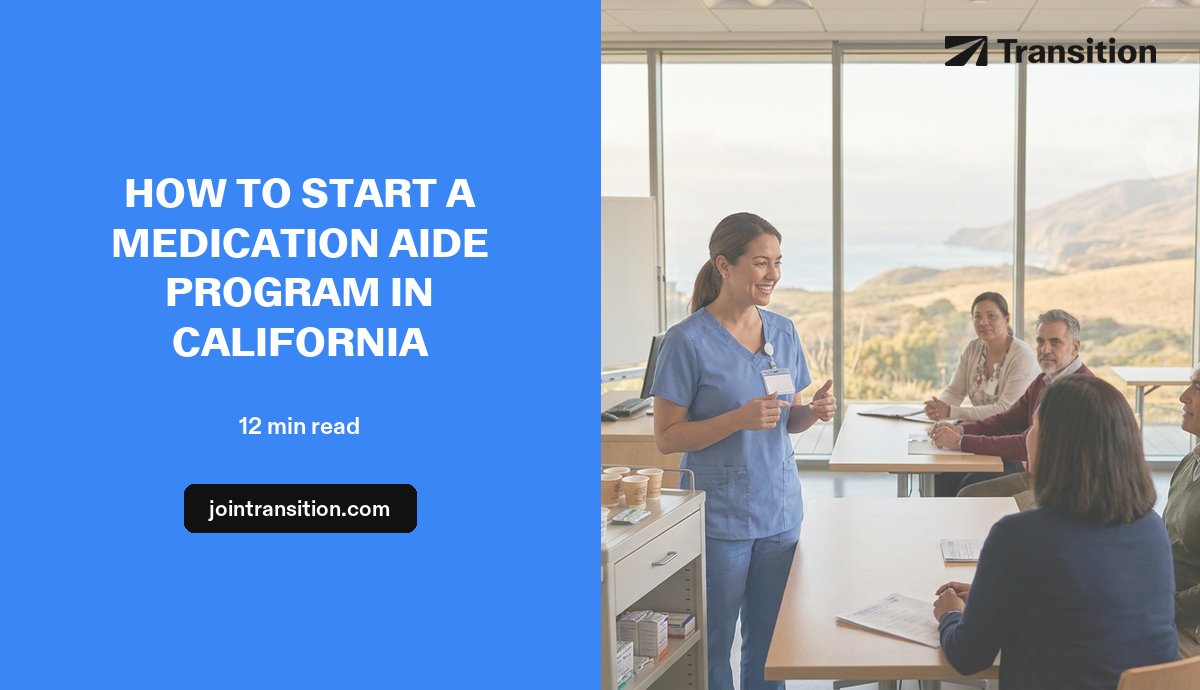
If you came here expecting a California version of a Texas Medication Aide or an Indiana QMA, here's the honest answer up front: California has no general medication aide credential for nursing homes. In a California skilled nursing facility, medications are administered by licensed nurses (RNs and LPNs/LVNs) — there is no unlicensed "certified medication aide" role to train and certify for that setting. If a competitor's post implies otherwise, they're describing a credential that doesn't exist here.
That doesn't mean there's no business — it means the business is more specific, and knowing exactly what's real is what separates a serious training provider from a content mill. California has two legitimate medication-training niches, each with its own agency and rulebook:
-
Assisted living (RCFEs and adult residential facilities), licensed by the California Department of Social Services (CDSS) under Title 22. Direct-care staff who assist residents with the self-administration of medication must complete specific training (Health & Safety Code § 1569.69 for RCFEs, implemented through Title 22). This is a training obligation, not a state-issued certificate or exam.
-
Developmental services, overseen by the Department of Developmental Services (DDS) and regional centers. Direct-care staff in regional-center-funded community care facilities complete the Direct Support Professional (DSP) Training — two 35-hour competency-based courses (70 hours total) under Title 17 — which includes demonstrating how to properly assist individuals with the self-administration of medication.
So the real question isn't "how do I certify medication aides in California" — it's "which of these training niches do I want to serve, and how do I become the provider facilities trust?" This guide answers that honestly. It's general information, not legal advice; verify current requirements with CDSS and DDS before spending money.
Quick Facts: Medication Training in California
| Item | Reality |
|---|---|
| Nursing-home medication aide credential | None. Licensed nurses administer medications in SNFs |
| Real niche #1 | RCFE / assisted living — staff training to assist with self-administration of medication |
| Niche #1 agency & rules | CDSS, Community Care Licensing; Health & Safety Code § 1569.69; Title 22 |
| Real niche #2 | DDS developmental services — Direct Support Professional (DSP) Training |
| Niche #2 structure | Two 35-hour competency-based courses (70 hours total) under Title 17; includes assisting with self-administration of medication |
| Niche #2 agency | Department of Developmental Services (DDS) and regional centers |
| State exam / registry for a "med aide" | None for either niche — competency-based training, not a MACE-style certification |
| Instructor baseline | Registered nurse (and, for medication content, often RN/pharmacist/physician-developed curriculum) |
| Private school licensing | Private, tuition-charging vocational schools generally answer to the Bureau for Private Postsecondary Education (BPPE) |
| Typical time to launch | Roughly 2–5 months, depending on niche and licensing posture |
The honest lay of the land
Before you build anything, decide which niche you're serving — because they don't overlap much:
- You cannot open a school that certifies "medication aides" to pass meds in California nursing homes. That role is filled by licensed nurses.
- You can be the training provider that RCFE and adult residential facilities rely on to meet their Title 22 / H&SC § 1569.69 obligation to train staff who assist residents with self-administration of medication.
- You can deliver DSP Training (Title 17) for the developmental-services world, where the standardized two-course, 70-hour program includes a medication self-administration competency — though note DDS makes this training available through county service hubs at no cost to enrollees, which shapes where a private provider adds value.
In both niches your customers are heavily employers — assisted living operators and community-care providers who need their staff trained and documented — as much as individual students. Framed correctly, California is a real training business. It's just not a certification business.
Step 1 — Form your business entity (skip if you have one)
If you already operate a training school, your existing LLC or corporation can house these courses — no new entity needed. Starting from zero? File Articles of Organization with the California Secretary of State (LLC filing runs about $70, plus California's $800 annual franchise tax), get your EIN, and open a dedicated business bank account. Our How to Start a CNA School in California guide covers entity formation in detail.
Step 2 — Register for state taxes (mostly done if you're operating)
Existing schools rarely need anything new. Tuition for instruction is generally not subject to California sales tax, and your existing payroll registrations with the Employment Development Department (EDD) cover new instructors. New operators register with the EDD for payroll and confirm the annual franchise tax obligation with the Franchise Tax Board. This is a paperwork afternoon, not a project.
Step 3 — Set up your classroom and medication lab
Your CNA skills lab is most of the way there — but note the emphasis in California's niches is assisting with self-administration, not independent administration, so your lab should reflect that reality. Set up MAR (medication administration record) or medication log examples, pill organizers and unit-dose packaging, practice medication containers, and the storage and documentation tools RCFE and community-care staff actually use. Budget modestly; this is supplies, not a build-out.
Step 4 — Pick your niche and match the rules
This is the heart of the work in California, and it splits by niche.
RCFE / assisted living (CDSS, Title 22). Under Health & Safety Code § 1569.69, RCFE staff who assist residents with the self-administration of medications must complete training before doing so, plus ongoing annual training, with the curriculum developed by an appropriate licensed professional (such as an RN, pharmacist, or physician). The exact hour requirements scale with facility characteristics and are set in statute and Title 22 — confirm the current numbers directly, because they've been amended over the years. Your product here is a compliant, well-documented medication training that RCFEs can point to during a CDSS licensing visit. There's no state certificate for the worker and no state exam; your completion documentation is what the facility relies on.
DDS developmental services (Title 17). The DSP Training is a standardized, two-part, 70-hour competency-based program (two 35-hour segments) required for direct-care staff in regional-center-funded community care facilities, and it includes a medication self-administration competency. Because DDS makes the standardized training and challenge tests available (often at no cost through county service hubs), a private provider's value is usually in delivery quality, scheduling, and documentation rather than in owning the curriculum. Know exactly how your offering fits alongside the state's before you market it.
On school licensing: if you charge tuition for open-enrollment vocational courses, you generally fall under the Bureau for Private Postsecondary Education (BPPE). Some short courses and some employer-contracted training may be exempt, but exemptions are specific — confirm your status with BPPE (bppe.ca.gov) before enrolling tuition-paying students. This is the California version of the double-licensure trap, and it's worth getting right up front.
Step 5 — Line up your RN instructor (and curriculum author)
Both niches lean on a registered nurse. For RCFE medication training, the curriculum should be developed by an appropriate licensed professional (RN, pharmacist, or physician per the statute), and delivered by someone qualified to teach it. If the RN who runs your CNA program has real medication and assisted-living depth, they can anchor this. For DSP Training, follow the DDS-specified trainer and competency-evaluation requirements. Either way, your instructor's credentials are what make your training defensible to a facility and to the licensing agency.
Step 6 — Build (or align) the curriculum
For RCFE training, build around assisting with self-administration: the rights of medication self-administration, resident rights including the right to refuse, medication storage and documentation, recognizing and reporting changes and errors, and the legal boundary between assisting with self-administration and administering (a boundary that matters enormously in this setting). Map content and hours to H&SC § 1569.69 and Title 22 rather than to a generic med-aide binder.
For DSP Training, align to the Title 17 competencies and the DDS-standardized year-one and year-two content, including the medication self-administration competency and the associated challenge tests. Don't reinvent what the state has standardized — deliver it well and document it cleanly.
In both cases, teach the scope precisely and put the boundaries in your materials verbatim. Staff who understand they're assisting with self-administration — not practicing nursing — protect themselves, the resident, and the facility's license.
Step 7 — Set up facility relationships
Your customers are largely facilities. For RCFE training, build relationships with assisted living and adult residential operators who need ongoing staff training and appreciate a reliable, documented provider. For DSP Training, connect with community-care providers and, where appropriate, the regional-center ecosystem. Every facility relationship is both a revenue stream (cohort training) and, if you also run a CNA program, a hiring pipeline for your graduates.
Step 8 — Understand "testing" and documentation
Neither niche uses a MACE-style state exam or a medication aide registry. RCFE training relies on documented completion (and annual refreshers) that the facility keeps for licensing. DSP Training uses competency-based evaluation and challenge tests administered within the DDS framework. In both, your value is trustworthy, audit-ready documentation — because the facility, not a state registry, is who relies on it during a licensing review. Clean records aren't a nicety here; they're the product.
Step 9 — Set up enrollment, payments, and student records
Employer-driven, documentation-heavy training lives or dies on clean records and easy scheduling: enrollment, completion certificates, annual refresher tracking, and competency evaluations that a facility can produce on demand during a CDSS or regional-center review.
That operational layer is what Transition does for the schools we work with: branded online enrollment, e-signed agreements, payment plans, attendance and grade tracking, automated email/SMS onboarding and refresher reminders, and surveys — one system instead of spreadsheets, Jotform, Square, and a filing cabinet. If you already run your CNA program on Transition, adding these courses is a configuration, not a project.
Step 10 — Launch with a targeted marketing plan
Because California's niches are employer-driven, market to facilities first: RCFE and adult residential operators needing Title 22 medication training, and community-care providers needing DSP Training — pitch administrators and staff developers directly. Then layer in your own CNA alumni and general job-seekers, and use workforce channels — the California Employment Development Department (EDD) and America's Job Center of California network, where practical health-adjacent training performs well. Publish an honest page that explains exactly what you offer (RCFE medication training and/or DSP Training — not a "med aide certificate"), update your Google Business Profile, and answer every inquiry by text within minutes.
What it really costs
Realistic estimates for adding California medication training to an existing school:
| Item | Estimated range |
|---|---|
| BPPE approval / amendment (if required) | $0 – $5,000+ |
| Lab supplies (MARs, med storage, samples) | $500 – $2,500 |
| Curriculum development (RN/pharmacist-authored) | $1,000 – $5,000 |
| RN instructor payroll (first cohort) | $2,000 – $6,000 |
| Insurance rider / policy update | $0 – $1,000 |
| Marketing (page, ads, facility outreach) | $250 – $2,000 |
| Total to first cohort (existing school) | $3,750 – $21,500 |
Starting from scratch with no school behind you? Add entity formation, the $800 franchise tax, rent, classroom build-out, and full BPPE approval from our CNA guide — often $15,000–$40,000 more. All figures are estimates, not quotes.
How long it takes
Plan on 2–5 months for an existing school, and the variable is usually licensing posture (BPPE) and which niche you choose. RCFE medication training can move quickly once your RN-authored curriculum and documentation are solid; DSP Training requires aligning to the DDS framework. Confirm your BPPE status early, since that gate can add time. New operators building a CNA school first should think in longer timelines — see the full guide.
Common mistakes to avoid
- Advertising a "medication aide certificate." California has no nursing-home med aide credential. Market RCFE medication training or DSP Training specifically — anything else misleads students.
- Blurring "assist with self-administration" and "administer." In RCFEs this line is legally load-bearing. Teach it explicitly and document it.
- Ignoring BPPE. Private, tuition-charging vocational schools generally need BPPE approval. Confirm your status before enrolling paying students.
- Reinventing DSP Training. DDS standardizes the Title 17 curriculum and challenge tests, often free through county hubs. Compete on delivery and documentation, not on owning the content.
- Guessing at RCFE training hours. The H&SC § 1569.69 / Title 22 requirements scale and have been amended. Confirm current numbers rather than copying an old outline.
- Underestimating the employer sale. Your buyers are largely facilities. Build for cohort delivery and audit-ready records, not just individual enrollments.
FAQ
Can I start a medication aide program in California? Not a nursing-home medication aide program — that role is filled by licensed nurses in California. You can build medication training for the assisted living (RCFE) world under Title 22 / H&SC § 1569.69, or deliver DSP Training for developmental services under Title 17.
Is there a state medication aide certificate or exam? No. Neither niche uses a MACE-style state exam or a medication aide registry. RCFE training relies on documented completion; DSP Training uses competency-based evaluation and challenge tests within the DDS framework.
Who oversees these trainings? Assisted living medication training falls under CDSS (Community Care Licensing) and Title 22 / H&SC § 1569.69. DSP Training falls under the Department of Developmental Services and Title 17.
Do I need a license to run the training? If you charge tuition for open-enrollment vocational courses, you generally need approval from the Bureau for Private Postsecondary Education (BPPE), though some short or employer-contracted courses may be exempt. Confirm with BPPE before enrolling paying students.
Who administers medications in California nursing homes? Licensed nurses — RNs and LPNs/LVNs. There is no unlicensed medication aide role in that setting, which is why this guide focuses on the assisted living and developmental-services niches.
Who is my customer? Largely facilities — RCFE and adult residential operators needing Title 22 medication training, and community-care providers needing DSP Training — alongside individual direct-care workers.
Disclaimer
This guide is general information, not legal, tax, or regulatory advice. California's assisted living and developmental-services training rules, hours, and interpretations change over time. Verify current requirements with the California Department of Social Services (cdss.ca.gov), the Department of Developmental Services (dds.ca.gov), the current Health & Safety Code § 1569.69, Title 22, and Title 17 text, the Bureau for Private Postsecondary Education (bppe.ca.gov) for school licensing, and — for business questions — the California Secretary of State and EDD.
Ready to build it without building chaos?
The training gets your students ready. The systems keep you running. See how Transition handles enrollment, e-sign, records, payments, and messaging for CNA, medication training, and allied-health programs like yours at jointransition.com.
Get CNA training paid for.
Tell us your county and we text you the route that fits, who to call, and what to bring.