
How to Start a Medication Aide Program in Colorado (2026 Guide)
July 28, 2026 · Colorado
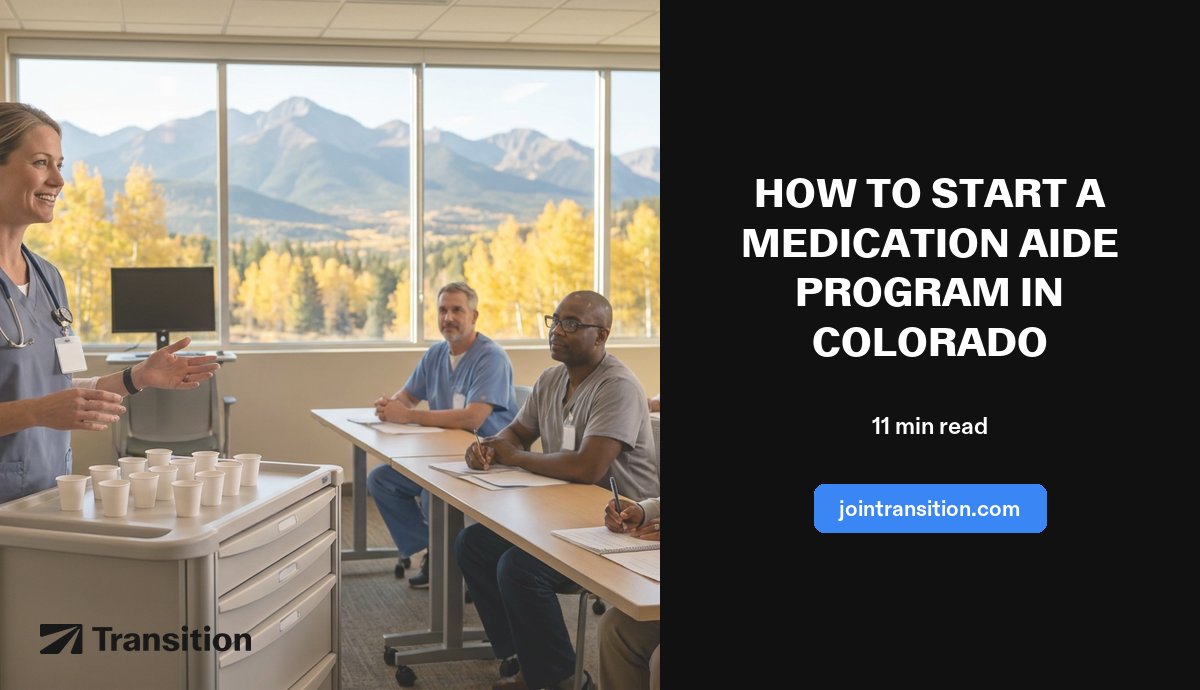
Let's clear something up before you spend a single dollar: Colorado has no "certified medication aide" who passes meds in nursing homes. If you've seen CMA programs in Texas or QMA programs in Indiana and assumed Colorado works the same way, it doesn't — there is no unlicensed medication aide role in Colorado skilled nursing facilities or hospitals, period.
What Colorado has instead is the QMAP — Qualified Medication Administration Person — an unlicensed staffer trained to administer medications in assisted living residences, group homes serving people with intellectual and developmental disabilities, residential child care facilities, and a handful of other authorized settings. The program is run by the Colorado Department of Public Health and Environment (CDPHE), not the Board of Nursing, under C.R.S. 25-1.5-301 through 303 and 6 CCR 1011-1, Chapter 24. And here's the opportunity: since July 1, 2017, CDPHE doesn't run QMAP classes or tests itself. Private Approved Training Entities (ATEs) do — and becoming one is one of the most accessible program approvals in allied health training.
We help CNA and allied-health schools run their day-to-day operations — enrollment, records, payments, messaging — and QMAP is one of the most common add-on programs we see Colorado schools launch. If you already run a school (our How to Start a CNA School in Colorado guide covers that path), this is a fast, low-cost expansion. One note before we start: this is operational guidance from people who work with schools, not legal advice. Verify everything with the agencies named below, because rules and fees change.
Quick Facts: QMAP Training Requirements in Colorado
| Item | Colorado Requirement |
|---|---|
| Credential | Qualified Medication Administration Person (QMAP) — a registry entry, not a license or certification |
| Governing law | C.R.S. 25-1.5-301 to 25-1.5-303; 6 CCR 1011-1, Chapter 24 (effective 3/17/2025) |
| Approving agency | CDPHE — Health Facilities and Emergency Medical Services Division |
| Provider approval | Approved Training Entity (ATE) application to CDPHE, with curriculum review |
| Required hours | No state-mandated hour minimum; Chapter 24 prescribes required content. Most courses run 1–2 days |
| Student prerequisites | 18+, basic reading/writing/math. No CNA certification or experience required |
| Exam | Written + practical competency evaluation, built and administered by the ATE's qualified instructor — no state-run test |
| Instructor requirement | Nurse (RN or LPN), pharmacist, physician, or physician assistant with an active, unrestricted Colorado license |
| Registry | CDPHE QMAP database; online verification only (no paper certificates). $14 per passing student (check current) |
| Allowed settings | Assisted living, adult foster care, alternative care, residential child care, secure residential treatment, state-certified adult day programs, IDD service agencies (PASAs) — not nursing homes or hospitals |
First, Understand What You're Selling (and What You're Not)
A QMAP administers medications from written practitioner orders, documents on the MAR, and manages medication reminder boxes — in the authorized settings listed above. A QMAP cannot make clinical judgments, cannot give injections (with narrow exceptions like directed epinephrine use), and cannot work as a med aide in a skilled nursing facility or hospital. QMAP status also isn't a license or certification — it's an entry in CDPHE's database, and online verification is the only official proof. (The Departments of Corrections and Human Services run separate medication training for their own facilities; your CDPHE approval covers the standard QMAP settings, which is where the commercial demand is anyway.)
Be honest in your marketing from day one. Programs advertising "Colorado medication aide certification for nursing home careers" are selling a pathway that doesn't exist. The honest pitch is strong enough: a one-to-two-day course that qualifies students for real jobs in assisted living and IDD services, with no prerequisite credential required — and Colorado's assisted living and IDD sectors hire QMAPs constantly.
Step 1 — Form Your Business Entity
If you already run a CNA school or training business, skip to Step 3 — your existing LLC and EIN work fine for a QMAP program.
Starting from scratch? File Articles of Organization through the Colorado Secretary of State's online filing system (about $50, typically approved instantly; a $25 Periodic Report keeps you in good standing each year). Get a free EIN from the IRS and open a dedicated business bank account so tuition never mixes with personal funds.
Step 2 — Register for State Taxes
Also brief, and also skippable if you're already operating. Register through MyBizColorado, which sets up your Colorado Department of Revenue accounts and CDLE unemployment insurance in one pass. Tuition is generally not subject to Colorado sales tax (ask your accountant about supply kits sold separately), and set up wage withholding before your first instructor payroll.
Step 3 — Secure Your Classroom and Skills-Practice Space
QMAP training has two parts under Chapter 24, and they have different rules. The classroom portion may be delivered electronically or in person — your call. The skills practice portion must be in person, in a simulated care setting, under the direct supervision of a qualified instructor.
The good news: there's no clinical site requirement at all — no nursing home agreements, no affiliation contracts. Your "lab" is a simulated med pass: medication carts or lockboxes (with double-lock storage for teaching controlled substance handling), medication reminder boxes, practice MAR forms, placebo meds, and stations for the various administration routes. A CNA school's existing classroom easily doubles as QMAP space — this is why the program is such a natural add-on.
Step 4 — Apply to CDPHE to Become an Approved Training Entity
This is the heart of the process. Under Section 4 of Chapter 24, any "agency, association, facility, individual, institution or organization" can apply to become an ATE — you don't need to be a nurse, and you don't need to already operate a facility.
Here's how CDPHE's process works:
- Build your curriculum first. CDPHE publishes an ATE Starter Kit (linked from the QMAP page at cdphe.colorado.gov) with a syllabus guide and the QMAP Required Curriculum Checklist. The department recommends completing the checklist before applying — it materially speeds up review.
- Submit the ATE application through the application link on CDPHE's QMAP webpage, with your curriculum and required attachments.
- Designate a program coordinator. This person is your sole communication liaison with the state — they submit the application, send curriculum updates, file rosters of passing students, and remit fees. Notably, the coordinator does not need to be a licensed clinician; only your teaching instructors do.
- Wait for your approval letter. Once CDPHE approves your curriculum and application, you receive an approval letter and a blank roster template — and you can start teaching.
One rule with teeth: you may not enroll students before approval. Chapter 24 Section 4.2 says students who complete a non-approved program are ineligible for the QMAP database, and facilities can't let them administer medications. There's no salvaging a class taught early.
CDPHE doesn't publish a fixed review timeline or a standing ATE application fee schedule the way some agencies do — confirm current processing details with the QMAP office (cdphe_hfemsd_qmap@state.co.us, 303-692-2853) before you build your launch calendar.
Step 5 — Line Up a Qualified Instructor and a Program Coordinator
Chapter 24 defines a qualified instructor as a nurse, pharmacist, physician, or physician assistant with an active, unrestricted Colorado license. CDPHE's FAQs make two points explicit: LPNs qualify (not just RNs), and medical assistants do not qualify at all.
That's the entire credential requirement — no minimum years of geriatric experience, no train-the-trainer course, no teaching-preparation documentation like Colorado requires for CNA programs. For a CNA school, this usually means your existing RN or LPN instructor can teach QMAP tomorrow. The instructor teaches and oversees both classroom and skills practice, develops the curriculum with the state, administers the competency evaluation, and documents each student's results.
The program coordinator role (application, rosters, fees, state communication) can be you, the owner — no license required.
Step 6 — Build Your Chapter 24-Compliant Curriculum
Unlike CNA training (75 hours by rule), Colorado sets no minimum hour count for QMAP courses. Chapter 24 Section 6.7 instead prescribes required content, and your course must cover all of it in both classroom and skills practice:
- Scope of service: authorized settings, medication restrictions, the seven rights of medication administration, acceptable routes and forms, reading and validating medication orders, expiration and refill dates
- Uses and forms of drugs: purposes, controlled substance classification and accountability, therapeutic/side/adverse effects, medication reference resources
- Medication administration records (MARs), timing rules, and documentation practice
- Communication skills for residents who are elderly or have cognitive, physical, or behavioral challenges, including dementia
- Infection control, safety and emergency procedures
- Drug diversion awareness; preventing and reporting abuse, neglect, and misappropriation
- Procedures: PRN administration, preparing and altering medications, counting and documenting controlled substances, medication errors, storage and disposal, and filling and administering from medication reminder boxes and day/trip packs
Most Colorado QMAP courses run one to two days; survey what local providers charge (commonly in the low hundreds of dollars) to price yours. CDPHE also offers a free online QMAP preparatory course on Colorado TRAIN (train.org/colorado); some ATEs require it as pre-work to keep the in-person day focused on skills. Two more rules: any significant change to your approved course content or evaluation goes to CDPHE before you implement it, and you must keep student competency evaluation records for at least three years.
Step 7 — Sort Out Your DPOS Status Honestly
Here's the Colorado-specific trap most new QMAP providers never think about. The Division of Private Occupational Schools (DPOS), inside the Colorado Department of Higher Education, regulates private schools that charge tuition for occupational education — and a QMAP class sold to the public to qualify people for jobs is occupational education on its face.
Read the exemption statute (C.R.S. 23-64-104) carefully, because there is no QMAP-specific exemption in it:
- Employers training their own employees are exempt — which is why an assisted living residence can become an ATE for its own staff without DPOS involvement.
- Approved nurse aide training programs are exempt under 23-64-104(1)(l) — but that exemption covers nurse aide training, not medication administration courses. Don't assume it stretches to your QMAP program.
- If you already hold a DPOS Certificate of Approval for a CNA or allied-health school, the clean path is adding QMAP as a new program through DPOS Connect (program addition fees apply — check the current DPOS fee schedule).
If you believe you're exempt, DPOS's process is to request a letter of exemption citing the specific statutory criterion — the determination is theirs, not yours. Email DPOS (DPOS@dhe.state.co.us) with your specifics and get the answer in writing before you enroll paying students. The honest answer here is: a standalone, tuition-charging QMAP school should expect DPOS to apply.
Step 8 — Run the Competency Evaluation and Get Graduates Into the Database
There is no state-administered QMAP exam anymore — CDPHE's written and clinical test ended July 1, 2017. Under the current rule, your ATE builds and administers the competency evaluation: a written exam covering all required curriculum content, plus a practical skills test showing each student can safely and accurately administer medications from preparation through documentation. Your qualified instructor administers it and documents results. No test-out options exist — every student takes the full course, regardless of prior experience.
When students pass, your program coordinator submits the roster to CDPHE with the processing fee — $14 per passing student plus a small portal fee, per CDPHE's current FAQs (check current figures). Submit roster and payment the same day (a mismatch stalls everyone's registry entry), and never have students pay the registry fee themselves — the ATE collects and remits it.
Once CDPHE matches payment to roster, your graduates appear in the QMAP database, verifiable through the QMAP Verification page. No paper certificates are issued — the online lookup is the only official proof. Helpfully, QMAP status earned since June 2011 doesn't expire, though employers must provide facility-specific on-the-job training and can require retesting.
Step 9 — Set Up Enrollment, Payments, and Student Records
QMAP's economics are all throughput: short courses, frequent cohorts, and employer-paid seats from assisted living and IDD agencies. That's a lot of small transactions and a lot of records — enrollment forms, competency evaluation documentation you must keep three years, rosters, and fee remittances that have to match to the student.
This is where we come in. Transition gives training programs one system for branded online enrollment, payments (including employer-billed seats), attendance and grade tracking, e-signed agreements, automated onboarding emails and texts, and stored student records. When a facility asks you to verify a hire from a class you taught 14 months ago, you pull it up in seconds — and when you're running a QMAP class every week alongside CNA cohorts, that stops being a nice-to-have.
Step 10 — Launch With a Local Marketing Plan
- Get listed on CDPHE's "Find an Instructor" page. It's the state's own directory of QMAP training contacts, and students and facilities actually use it — ask the QMAP office how to appear once approved.
- Sell to facilities, not just students. Assisted living residences and PASAs need every new unlicensed med-passer QMAP-trained. Offer standing monthly classes, group rates, and on-site delivery — one facility relationship can fill cohorts indefinitely.
- Bundle with CNA. "CNA + QMAP" graduates are more employable in assisted living, and the add-on revenue is nearly pure margin on a classroom you already run.
- Claim your Google Business Profile and collect reviews every cohort — "QMAP class near me" searches convert fast because the course is short and the decision is easy.
- Connect with Colorado Workforce Centers (funded through CDLE) for referral and funding relationships.
What It Really Costs
Estimated startup ranges, assuming you follow the add-on path most founders take (verify all fees at current rates):
| Line item | Estimated range |
|---|---|
| Entity formation (skip if formed) | $0 – $350 |
| Insurance rider/update | $0 – $1,500/yr |
| Classroom (existing space vs. rented) | $0 – $6,000 |
| Med carts, lockboxes, reminder boxes, MAR forms, placebo meds | $500 – $2,500 |
| Curriculum development (instructor time) | $500 – $3,000 |
| Instructor pay through first cohorts | $1,000 – $4,000 |
| CDPHE roster fees (first 50 students at $14) | ~$700 |
| DPOS program addition or application (situation-dependent) | $0 – $3,500 |
| Marketing at launch | $500 – $2,000 |
| Bottom line (existing school) | $3,000 – $12,000 |
| Bottom line (standalone startup) | $8,000 – $25,000 |
Compare that to the $25,000–$75,000 a Colorado CNA school costs to launch, and you can see why QMAP is the add-on we recommend schools evaluate first.
How Long It Takes
For an existing school with a licensed instructor on staff, plan on roughly 1–3 months: a few weeks to build the curriculum against CDPHE's checklist, the department's application and curriculum review (timeline not published — ask the QMAP office for current processing expectations), and any DPOS program-addition review. A standalone startup should plan on 2–5 months to cover entity formation and the DPOS question. The single biggest accelerator is submitting a complete curriculum checklist with your ATE application the first time.
Common Mistakes to Avoid
- Marketing QMAP as a "certification" or a nursing-home credential. QMAP is neither certified nor licensed, and QMAPs cannot work in skilled nursing facilities or hospitals. Overselling this invites complaints and regulator attention.
- Enrolling students before your ATE approval letter arrives. Chapter 24 makes graduates of unapproved courses ineligible for the QMAP database — you cannot fix this retroactively.
- Assuming your CNA program's status covers QMAP with DPOS. The nurse aide exemption in C.R.S. 23-64-104(1)(l) doesn't extend to medication administration training. Get your DPOS answer in writing.
- Submitting rosters and payments separately. CDPHE can't add students to the database until payment and roster match — and your graduates can't legally pass meds until they're in it.
- Copying the starter kit syllabus verbatim. CDPHE says plainly it's incomplete on its own and must be revised against the Required Curriculum Checklist, with CDPHE references removed.
- Letting students pay the $14 registry fee directly. The department instructs ATEs to collect and remit it — direct student payments stall processing.
FAQ
Is there a state QMAP exam in Colorado? Not anymore. CDPHE administered the competency evaluation before July 1, 2017; today each Approved Training Entity builds and administers its own written and practical competency evaluation under Chapter 24. Passing students are added to the state QMAP database via the ATE's roster submission.
How many hours is QMAP training in Colorado? Colorado sets no minimum hour count — 6 CCR 1011-1, Chapter 24 prescribes required content instead. Most Colorado QMAP courses run one to two days, with classroom time (which may be online) plus in-person skills practice and testing.
Do students need to be CNAs before QMAP training? No. Students must be at least 18 and possess basic reading, writing, and math skills — that's it. No CNA certification, healthcare experience, or prior training is required, and no one can test out of the course.
How much does it cost to start a QMAP training program in Colorado? If you already run a school, roughly $3,000–$12,000 gets you to your first class; a standalone startup should budget $8,000–$25,000. The state charges $14 per passing student for database entry (check the current figure); confirm any application costs with CDPHE's QMAP office.
Can QMAP classes be online in Colorado? Partially. The classroom portion may be delivered electronically, but skills practice and the practical competency evaluation must be conducted in person under a qualified instructor's direct supervision. CDPHE's free TRAIN preparatory course can supplement — but not replace — your approved course.
Can QMAPs work in nursing homes or hospitals? No. QMAPs administer medications only in authorized settings: assisted living residences, adult foster care, alternative care facilities, residential child care, secure residential treatment centers, state-certified adult day programs, and IDD service agencies. Nursing homes and hospitals require licensed nurses to administer medications in Colorado.
Does QMAP status expire? QMAP qualifications earned on or after June 10, 2011 do not expire. Employers must provide facility-specific on-the-job training and may require retesting or refresher courses — which, for you, is a recurring revenue stream worth building into your facility partnerships.
Disclaimer
This guide is for general information, not legal advice. Requirements, fees, and rules change — verify current details with the Colorado Department of Public Health and Environment (Health Facilities and Emergency Medical Services Division QMAP office), the Division of Private Occupational Schools, the Colorado Secretary of State, and the Colorado Department of Revenue before making decisions.
The Paperwork Gets You Open. The Systems Keep You Open.
ATE approval is the easy part — the real work is weekly cohorts, employer billing, rosters that match payments, and records you can produce years later. See how Transition runs enrollment, records, messaging, and payments for training programs like yours at jointransition.com.
Get CNA training paid for.
Tell us your county and we text you the route that fits, who to call, and what to bring.