
How to Start a Medication Aide Program in Illinois (2026 Guide)
July 28, 2026 · Illinois
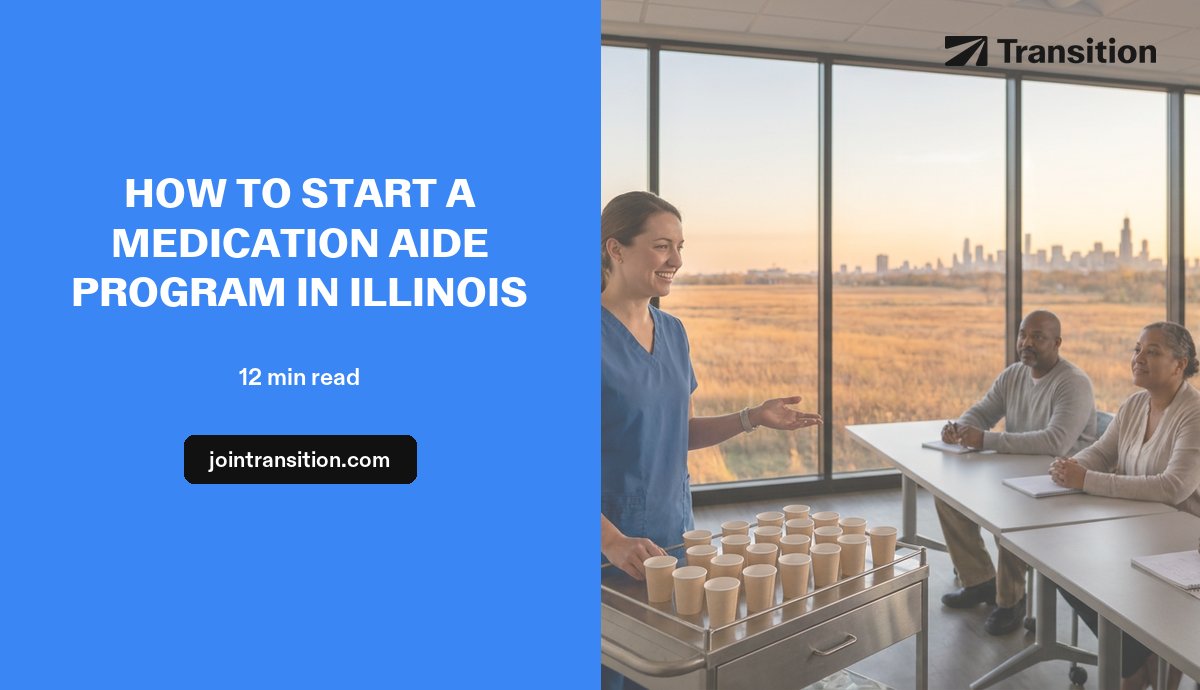
For years, Illinois was the odd one out. Missouri had CMTs, Indiana had QMAs, and Illinois — after a small IDFPR pilot expired in 2019 — had no medication aide credential at all. That changed in August 2024, when Public Act 103-0886 created the Certified Medication Aide (CMA) program under the Illinois Department of Public Health. Illinois now has a real, statutory medication aide pathway for the first time, and the training programs that serve it are only just being built. If you've ever wanted to be early to a market, this is what early looks like.
Two things to understand before you spend a dollar. First, the Illinois CMA works in assisted living and shared housing establishments — not nursing homes. The Nursing Home Care Act still has no medication aide role, so your graduates' employers are assisted living operators, full stop (plus supportive living facilities, pending federal approval). Second, because the credential is so new, IDPH is still standing up the implementing rules for how training programs get approved. The statute is live and specific — 100 hours minimum, CNA prerequisites, an IDPH exam — but the approval mechanics are still coming online, and the founders doing their homework now will be approved first.
Most people reading this already run a CNA school — and if you don't yet, start with our guide to How to Start a CNA School in Illinois, because every Illinois CMA must first be a CNA. We work with CNA and allied-health schools every day on enrollment, records, and compliance, and new-credential launches reward the prepared. Usual note: we're operators and software people, not lawyers. Verify everything with IDPH before you commit.
Quick Facts: Medication Aide Program Requirements in Illinois
| Item | Illinois requirement |
|---|---|
| Credential | Certified Medication Aide (CMA) |
| Authorizing law | 210 ILCS 9/79 (Assisted Living and Shared Housing Act), added by P.A. 103-0886, eff. 8-9-2024 |
| Approving agency | Illinois Department of Public Health (IDPH); implementing rules still rolling out |
| Total training hours | 100 minimum: 60 classroom + 10 simulation lab + 30 RN-supervised clinical practicum |
| Student prerequisites | Active CNA in good standing + 2,000 CNA hours within 3 years; age 18+; high school diploma/GED; CPR; background check |
| Also required | Proof of employment by a qualifying assisted living/shared housing establishment |
| Exam | "Medication Aide Certification Examination" or other IDPH-authorized exam; 3 years to pass after applying |
| Work settings | Qualified assisted living and shared housing establishments; supportive living facilities pending federal approval — not nursing homes |
| Scope limits | No Schedule II drugs; no subcutaneous, IM, intradermal, or IV meds; RN must be on duty and present |
| Private school licensure | IBHE Permit of Approval + New Program of Study application for the added course |
Step 1 — Form your business entity (or skip ahead)
If you already operate an Illinois CNA school, your LLC, EIN, and bank account carry over — adding a medication aide program doesn't require a new entity. Skip to Step 3.
Starting fresh? File LLC Articles of Organization with the Illinois Secretary of State's Department of Business Services at ilsos.gov ($150 filing fee, $75 annual report), get a free EIN from the IRS, and open a dedicated business bank account. An hour with an accountant on entity choice is money well spent.
Step 2 — Register for state taxes (existing schools: nothing new)
Existing schools are already registered — a new program adds no new tax registration. New operators register free through MyTax Illinois (mytax.illinois.gov). Illinois doesn't tax sales of services, and tuition falls in that bucket; goods like textbooks sold separately at retail can trigger sales tax, so many schools bundle materials into tuition. With instructor payroll comes Illinois withholding (Form IL-941) and IDES unemployment insurance — the MyTax joint registration covers both.
Step 3 — Set up your classroom and medication simulation lab
Your CNA classroom handles the 60 classroom hours without modification. The new investment is the simulation lab for the 10 required hours of laboratory study — and it looks different from a CNA skills lab. You're simulating a med pass, not a bed bath: a medication cart or med room setup, practice medication cards and blister packs, pill organizers, crushers and splitters, measuring devices for liquids, eye/ear drop trainers, topical and transdermal patch practice, glucometers, and — critically — realistic Medication Administration Records (MARs), paper and electronic. Most schools we work with build this into a corner of their existing lab for a few thousand dollars rather than leasing new space.
Step 4 — Get your program approved (IDPH + IBHE)
This is the heart of the launch, and in Illinois right now it takes more diligence than usual.
IDPH approval. Under 210 ILCS 9/79(g)(9), students must complete "a course of study approved by the Department as defined by rule" — meaning IDPH approves medication aide training programs, the way it approves BNATPs for CNA training under a separate code. The statute directed IDPH to propose implementing rules within 180 days of the August 2024 effective date, but as of mid-2026 the detailed program-approval rules (application forms, fees, renewal cycles, exam vendor designation) were still being finalized — they had not yet appeared in the Assisted Living and Shared Housing Establishment Code (77 Ill. Adm. Code 295). Your move: contact IDPH's Division of Assisted Living directly, ask for the current status of Certified Medication Aide training program approval, and watch the Illinois Register and JCAR for the Part 295 rulemaking. Being in the first wave of approved programs in a state with zero incumbents is worth the phone calls.
IBHE New Program of Study. If you hold an IBHE Permit of Approval for your CNA school under the Private Business and Vocational Schools Act of 2012 (105 ILCS 426), you cannot simply start teaching a new course — IBHE requires an Application for New Program of Study, with a fee, before you offer it. It's a far lighter lift than the original 6–9 month permit process, and it can ride along with your annual renewal, but it's mandatory. New schools without any IBHE permit face the full initial application ($1,000 for schools under 100 students, minimum $10,000 surety bond) — budget 6–9 months for that. Check IBHE's current PBVS fee schedule at ibhe.org before filing.
Step 5 — Hire qualified instructors
The statute requires the 30-hour clinical practicum to be RN-supervised, and IDPH's rules are expected to spell out full instructor qualifications — Illinois has consistently required experienced RN instructors for aide-level training (its CNA rules require an Illinois RN with 2+ years of experience), so plan for at least that bar. The practical hire is an Illinois-licensed RN with medication-pass and assisted living or long-term care experience; a consulting pharmacist isn't required by the statute but makes your curriculum — and your application — stronger. Your CNA program coordinator may be able to lead both programs; confirm against the final rules before building your schedule around one person.
Step 6 — Build the 100-hour curriculum
The statutory floor is precise: a minimum of 60 hours of classroom-based medication aide education, 10 hours of simulation laboratory study, and 30 hours of RN-supervised clinical practicum "with progressive responsibility of patient medication assistance" (210 ILCS 9/79(g)(9)). Build your syllabus around what the law says CMAs will actually do and must never do:
- Pharmacology fundamentals, drug classifications, and common medications in older adults
- The rights of medication administration, MAR documentation, and error reporting
- Routes CMAs may use — oral, topical, eye and ear drops, transdermal patches — and the hard limits: no Schedule II controlled substances and no subcutaneous, intramuscular, intradermal, or intravenous medications
- RN delegation and supervision under Section 50-75 of the Nurse Practice Act, including the rule that a resident must have an initial physician assessment before a CMA administers anything
- Math competency — the statute requires it "as determined by rule," so drill dosage calculations hard
Map every lesson to the statute and, once published, the final rules. Curriculum-to-rule mismatches are the classic reason applications bounce in Illinois.
Step 7 — Set up clinical sites in assisted living — not nursing homes
Your CNA clinical partners are probably nursing homes. They can't host this practicum, because CMAs can't work there. You need licensed assisted living or shared housing establishments — ideally ones planning to become "qualified establishments," since those operators are motivated to grow their own CMAs. Note what qualification requires of them: an RN on duty and present at all times to delegate and supervise, plus certifications that CMAs won't displace nurses. Larger assisted living groups with existing RN staffing are your natural partners; a small establishment with a part-time nurse may not be viable. Get affiliation agreements in writing, and line up two sites if you can.
Step 8 — Understand the exam, the application, and the employment catch
Certification runs through IDPH, and the statute has three features that should shape how you operate.
The exam. Applicants must pass "the Medication Aide Certification Examination or other examination authorized by the Department." That statutory name matches the NCSBN's national MACE word-for-word, but IDPH had not publicly confirmed its testing vendor as of this writing — and remember, Illinois runs its own CNA exam (the INACE, through SIU Carbondale) rather than using national vendors, so don't assume. Ask IDPH which exam and vendor apply before you promise students anything.
The clock. An applicant who fails to pass within 3 years of filing their application is denied and must reapply under whatever rules exist then. Track your graduates' testing status the way you track INACE attempts.
The employment requirement. Here's the sleeper detail: applicants must submit proof of employment by a qualifying establishment to be certified. Illinois built this credential as an employer-anchored program — which means your best enrollment channel isn't Facebook ads to individual CNAs, it's partnerships with assisted living operators who send you their CNAs and put them on the schedule as CMAs when they pass. Certification fees are set by IDPH and were still being established in rule; check current amounts with the Department.
Step 9 — Set up enrollment, payments, and student records
A medication aide program multiplies your compliance surface: verifying each student's CNA standing and 2,000 hours on the Health Care Worker Registry, CPR cards, background checks, 100 hours of attendance across three delivery formats, practicum sign-offs, employer verification letters, and exam tracking on a 3-year clock — on top of everything your CNA program already generates. This is exactly what we built Transition for: branded online enrollment with prerequisite document collection, payment plans, attendance and grade tracking, e-signed agreements and clinical paperwork, automated onboarding emails and SMS, and end-of-course surveys in one system. Schools that add a second program on spreadsheets feel the pain within one cohort; schools on one system just add a program.
Step 10 — Launch with an employer-first marketing plan
Because certification requires a qualifying employer, market B2B first. Build a one-page pitch for assisted living and shared housing operators: "turn your best CNAs into CMAs, free your nurses' time, cut agency spend." Offer cohort pricing for employers sending three or more students. Then layer on the usual local machine — Google Business Profile, graduate reviews, a simple site, fast follow-up. On funding, Illinois administers WIOA through the Department of Commerce & Economic Opportunity via Illinois workNet; if your CNA program is on your Local Workforce Innovation Area's Eligible Training Provider List, ask about adding the new program. And your own CNA alumni list is the cheapest channel you'll ever have — every graduate hits the 2,000-hour mark eventually.
What it really costs
Estimated ranges for adding a medication aide program to an existing Illinois CNA school:
| Item | Estimated range |
|---|---|
| Medication simulation lab (cart, practice meds, MARs, supplies) | $2,000 – $6,000 |
| Curriculum development or licensing | $1,000 – $4,000 |
| RN instructor payroll (first cohorts) | $4,000 – $10,000 |
| Pharmacist curriculum review (optional) | $500 – $1,500 |
| IBHE New Program of Study application | Check current IBHE fee schedule |
| IDPH program approval fees | Set by rule — confirm with IDPH |
| Marketing (employer outreach, site updates) | $500 – $2,500 |
| Bottom line (existing school) | Roughly $8,000 – $25,000 |
Starting from zero — no entity, no IBHE permit, no classroom — puts you closer to the $22,000–$60,000 range in our Illinois CNA guide, plus the items above.
How long it takes
For an existing school, the honest answer is: your timeline is IDPH's timeline. The statute is in force, but program approvals can only move as fast as the implementing rules and application process. Once the pathway is fully open, expect roughly 3–6 months from application to first cohort — curriculum, IBHE new-program approval, instructor hiring, and clinical agreements can all run in parallel while you wait. New schools should add the 6–9 months IBHE's initial permit typically takes. Founders who make contact with IDPH now and have their package drafted will launch months ahead of founders who wait to read about final rules in a newsletter.
Common mistakes to avoid
- Building for the nursing home market. Illinois CMAs work in assisted living and shared housing — the Nursing Home Care Act has no medication aide role. Wrong clinical partners, wrong employer pipeline, wrong pitch.
- Enrolling CNAs who don't qualify. Active certification in good standing plus 2,000 documented CNA hours within the last 3 years. Verify against the Health Care Worker Registry at enrollment, not at graduation.
- Ignoring the employment requirement. Students without a qualifying assisted living employer can finish your course and still not get certified. Recruit employers before you recruit students.
- Teaching outside the scope. A curriculum that trains injections or Schedule II handling signals to IDPH that you don't know the statute. Teach the limits as hard content.
- Skipping the IBHE New Program of Study filing. An existing permit covers your existing programs. Offering a new course without IBHE approval risks penalties on the license your whole school depends on.
- Promising exam details you can't verify. Vendor, fees, and scheduling were still being finalized in rule. Say "IDPH's designated exam" until you can say more.
FAQ
Can CNAs give medications in Illinois nursing homes? No. The Certified Medication Aide credential applies only in assisted living and shared housing establishments (and supportive living facilities, pending federal approval). Illinois' old nursing-home-adjacent Medication Aide pilot under IDFPR expired in 2019 and was formally repealed by P.A. 103-0886 — the same law that created the new CMA.
How many hours is medication aide training in Illinois? A minimum of 100 hours: 60 hours of classroom instruction, 10 hours of simulation lab, and 30 hours of RN-supervised clinical practicum with progressively greater medication-assistance responsibility (210 ILCS 9/79).
What are the prerequisites for students? Age 18+, a high school diploma or equivalency, English proficiency, math competency, current CPR through AHA or Red Cross, a background check under the Health Care Worker Background Check Act, and — the big two — active CNA certification in good standing plus 2,000 hours of CNA practice within the 3 years before applying.
Do students need a job before they can be certified? Effectively yes. The statute requires proof of employment by a qualifying establishment as part of the certification application. Structure your program around employer partnerships so graduates have that box checked.
Is the Illinois exam the MACE? The statute names "the Medication Aide Certification Examination or other examination authorized by the Department" — the same name as NCSBN's national MACE — but IDPH hadn't publicly confirmed its vendor as of this writing. Given that Illinois runs its own CNA exam through SIU Carbondale, confirm with IDPH rather than assuming.
How much does it cost to add a medication aide program in Illinois? For an existing CNA school, plan roughly $8,000–$25,000: simulation lab supplies, curriculum, RN payroll, and application fees. IDPH and IBHE fee amounts for this specific program were still being set — check both agencies' current schedules.
What about medication training for DD or home-care settings? Separate world. Illinois DD community agencies train "authorized direct support persons" to administer medications under IDHS rules (59 Ill. Adm. Code 116), with an "M" designation on the Health Care Worker Registry — but that training is delivered through IDHS-approved agency programs with RN trainers, not private career schools. The IDPH CMA is the credential a private school can build a program around.
A quick disclaimer
This guide is for information, not legal advice — and it covers the newest credential in Illinois, where implementing rules were still being finalized at publication. Statutory citations here come from Public Act 103-0886 and 210 ILCS 9/79, but fees, forms, exam vendors, and approval mechanics will be set and adjusted by IDPH rule. Verify current status with IDPH's Division of Assisted Living, IBHE's PBVS division, and your own attorney before making commitments.
The paperwork gets you open. The systems keep you open.
Adding a second program is where spreadsheet-run schools start to crack — twice the prerequisites, twice the records, twice the deadlines. Transition runs enrollment, payments, attendance, documents, and messaging for CNA and allied-health schools in one system, so adding a program means adding a program — not adding chaos. See how it works at jointransition.com.
Get CNA training paid for.
Tell us your county and we text you the route that fits, who to call, and what to bring.