
How to Start a Medication Aide Program in Minnesota (2026 Guide)
July 28, 2026 · Minnesota
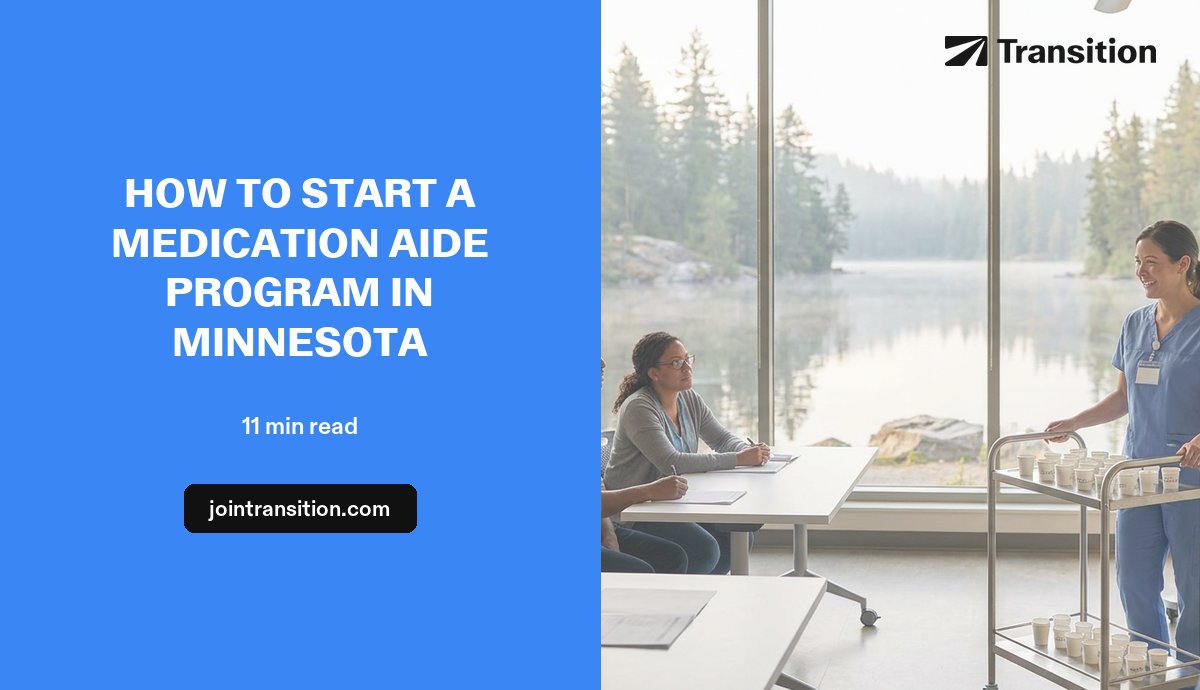
Minnesota's medication aide is the TMA — Trained Medication Aide — and the rules around it are unlike almost any other state's. There is no state exam, no registry, and no "TMA certification." What Minnesota requires instead, under Minnesota Rules 4658.1360, is completion of a standardized medication administration training program — and for decades, the only place to get it was a Minnesota State college. That changed in 2025, when the legislature added Minn. Stat. 144A.61, subds. 3b and 3c, putting the Minnesota Department of Health (MDH) in charge of approving TMA curricula and publishing an approved list. The door for providers beyond the state college system is visibly opening — MDH is rewriting the rule as we publish this.
That makes 2026 a genuinely interesting moment to add medication aide training to your school. If you already run a CNA program in Minnesota (if not, start with our guide on How to Start a CNA School in Minnesota), a TMA course is the natural next rung: your CNA graduates are the student pool, the course is 48 hours, and nursing homes are desperate for staff who can pass meds.
We work with CNA and allied-health schools every day on enrollment, records, and compliance. The usual honest caveat: we're operators, not lawyers, and Minnesota's TMA rules are literally being rewritten right now — verify everything below with MDH before you spend money.
Quick Facts: Medication Aide Training in Minnesota
| Item | Minnesota Requirement |
|---|---|
| Credential | Trained Medication Aide (TMA) — certificate of completion, not a state certification; no registry, no expiration |
| Governing rules | Minn. R. 4658.1360 (nursing homes); Minn. Stat. 144A.61, subds. 3b–3c (curriculum approval); Minn. Stat. 144G.60–.62 (assisted living) |
| Approving agency | Minnesota Department of Health (Health Regulation Division) — approves TMA curricula and maintains the approved list |
| Course length | 48 hours in the standardized curricula (OnTrack: 22 online + 24 in-person lab/clinical + 2-hour final); the rule sets content, not hours |
| Student prerequisite | Completion of an MDH-approved nursing assistant training program; registry status and the CNA exam are not required by rule |
| Exam | No state exam, no MACE — course-based testing (75% knowledge / 80% skills in the standardized model); no test-out |
| Settings | Nursing homes and certified boarding care homes (TMA course required); assisted living/home care use employer training + RN delegation |
| Instructor | Not set in rule; approved curricula are RN-led with curriculum-specific train-the-trainer |
| Also required | OHE private career school licensure or program addition for tuition-charging schools — 48 hours exceeds the 40-hour exemption |
Step 1: Form Your Business Entity
If you already operate a licensed Minnesota school, skip to Step 3 — your existing LLC and EIN carry the new program. If you're starting fresh: file LLC Articles of Organization with the Minnesota Secretary of State through the Business Filings portal at sos.mn.gov ($155 online, $135 by mail; annual renewals free), get your free EIN from the IRS, and open a dedicated business bank account.
Step 2: Register for State Taxes
Also brief, and also skippable for existing schools: register with the Minnesota Department of Revenue via e-Services. Tuition for instructional services is generally not subject to Minnesota sales tax, though retail sales of supplies to students are. When you hire staff, add employer withholding and Minnesota Unemployment Insurance registration through uimn.org.
Step 3: Secure Your Classroom and Med-Pass Lab
A TMA course is far lighter on real estate than a CNA program. If you already run a CNA skills lab, you're adding a medication station, not a second building. Roughly half the standardized 48-hour model is in-person lab and clinical practice, so build a realistic med-pass environment: a medication cart, locked storage, pill organizers and blister-pack samples, practice medication administration records (MARs), eye/ear drop and inhaler trainers, and hygiene supplies. Students need to rehearse the full loop the rule cares about — check the MAR, prepare the dose, administer, document, report to the nurse — until it's muscle memory.
Step 4: Understand Approval — Who Can Actually Offer TMA Training in Minnesota
This is the heart of the post — and where Minnesota differs from nearly every other state.
The rule. Minn. R. 4658.1360 says unlicensed personnel may administer medications in a nursing home only if they have (A) completed an MDH-approved nursing assistant training program and (B) "completed a standardized medication administration training program for unlicensed personnel in nursing homes which is offered through a Minnesota postsecondary educational institution." Historically, that second clause meant the standardized course delivered through Minnesota State colleges — private schools were effectively locked out.
The 2025 change. Minn. Stat. 144A.61 was amended to add subdivision 3b — "the commissioner of health must review and approve curricula that meet the requirements in Minnesota Rules, part 4658.1360, subpart 2, item B" — and subdivision 3c, requiring MDH to maintain a public list of acceptable curricula for nursing home and boarding care employees. MDH now publishes an Unlicensed Medication Aide Curriculum Application (issued November 2025, no fee listed), and its approved list currently features the OnTrack Medication Aide Training Program from the LeadingAge Minnesota Foundation — a hybrid, RN-trainer-delivered program that runs at facilities and training sites, not just college campuses. MDH has also announced a rulemaking project to update 4658.1360 itself.
What that means for you, honestly. As of mid-2026, a private school has three realistic routes:
- Deliver an MDH-approved curriculum. Get your RN through the curriculum's train-the-trainer (OnTrack provides RN instructor training; 651-425-1110) and run cohorts under it. Because the rule's letter still says "postsecondary educational institution" while rulemaking is in progress, confirm your delivery arrangement in writing with MDH's Health Regulation Division (651-201-4200, health.fpc-nar@state.mn.us) before enrolling students.
- Partner with a Minnesota State college. The colleges deliver the standardized Medication Aide course statewide, including hybrid formats. Hosting cohorts for a college, or feeding CNA graduates into one under a referral arrangement, is the conservative path with zero regulatory ambiguity.
- Submit your own curriculum to MDH. The application requires the full curriculum, training tools, and online login credentials for evaluation against the six content areas in 4658.1360, subp. 2, item B. Once approved, any substantive change needs MDH sign-off before implementation.
The other market: assisted living and home care. Here's the distinction most guides botch. The TMA course is a nursing home and certified boarding care requirement. Assisted living facilities (Minn. Stat. 144G.60–.62) and comprehensive home care providers (Minn. Stat. 144A.4795) run on a different model: unlicensed staff may administer medications after employer-provided training, competency testing, and delegation by a registered nurse, with documented RN supervision — including direct observation of a med pass within 30 days of starting. There is no state certificate in that world at all. That's an honest, separate business line: assisted living operators buy medication training and competency-testing packages, and many send staff through the TMA course voluntarily as the strongest credential available. Just never tell an assisted living client the course is legally required for them — it isn't.
And the second license. Minnesota's private career school law (Minn. Stat. 136A.821–.834) leaves only two exemptions after the 2023 and 2026 amendments: programs of 40 clock hours or less, and programs where total charges are $500 or less. A 48-hour TMA course fails the hours test, so if you charge over $500, you need OHE. If you already hold an OHE license for your CNA program, adding TMA is a program addition through the MNSAS portal — $500 per additional program (check the current fee with OHE). Unlicensed and tuition-funded? Budget the full $3,730 initial license. Pricing the course at $500 or less all-in keeps you in exemption territory — genuinely viable, since many Minnesota TMA courses price near that range anyway.
Step 5: Hire a Qualified Instructor
Unlike the CNA side, Minn. R. 4658.1360 sets no instructor qualifications — but the approved curricula do, and in practice the answer is an RN. OnTrack is built around an RN Trainer who completes its train-the-trainer with 1:1 instructor support; the Minnesota State course is taught by college nursing faculty. No pharmacist involvement is required in Minnesota.
If you run a CNA school, your primary instructor — a Minnesota-licensed RN with long-term care experience — is very likely your TMA instructor too. Same lesson as the CNA side: train-the-trainer is curriculum-specific, so pick the curriculum before paying to certify anyone. Budget $35–$50/hour for RN instructor time, more in the Twin Cities.
Step 6: Build or Adopt the 48-Hour Curriculum
You won't write this curriculum from scratch — and under the 2025 law, you shouldn't try without going through MDH. The rule requires six content areas at minimum: checking the resident's medication record; preparing the medication; administering it (oral, suppository, eye drops, ear drops, inhalant, or topical); assisting with self-administration; documenting date, time, dosage, method, and reasons for non-administration; and knowing what gets reported to a nurse.
The standardized model that satisfies it runs 48 hours. OnTrack splits it into 22 hours of self-paced online modules, 24 hours of in-person lab and clinical practice, and a 2-hour proctored final. The Minnesota State course requires 48 attendance hours minimum, a 75% cumulative score on quizzes and knowledge exams, then 80% on every skill in the final skills exam, critical steps included. Note that the hour count lives in the standardized curricula, not the rule text — one more reason not to invent your own numbers. Hybrid delivery is normal here, which helps you reach working CNAs; lab and clinical hours are always live and in person.
Step 7: Set Up Lab and Clinical Arrangements
The in-person half of the course needs a supervised practice environment. Many providers run it in their own med-pass lab; others arrange facility time with a nursing home partner so students practice in a real medication room under the RN instructor. If you go the facility route, put a written agreement in place and sort background studies before students walk in — same playbook as CNA clinicals.
Your facility partners are also your customer base: participating nursing homes can claim TMA tuition, books, and fees through the DHS Nursing Facility Employee Scholarship Program, and assisted living providers have the HCBS employee scholarship equivalent. A school that shows up with "your CNAs, TMA-trained, reimbursable" is an easy yes.
Step 8: Understand Testing and Documentation (There Is No Registry)
Set expectations correctly, because students and employers constantly get this wrong. Minnesota has no TMA state exam — no MACE, no Headmaster or Credentia involvement — and no TMA registry. Passing the course produces a certificate of completion (a college transcript works too, per MDH), which never expires. There is no test-out or challenge option, even for medication aides trained in other states: the course itself is the requirement.
The compliance weight sits on the employer instead: under 4658.1360, subp. 3, the nursing home must keep written documentation verifying course completion for every unlicensed person administering medications, and it also verifies the nursing assistant training prerequisite. As a school, your job is to make that easy — clean completion records, retrievable years later, because a facility will call you in 2031 asking you to re-issue a certificate a student lost.
Step 9: Set Up Enrollment, Payments, and Student Records
A TMA program has its own operational rhythm: verifying each student's nursing assistant training before enrollment, tracking 48 hours of attendance across online and in-person components, logging scores against the 75%/80% thresholds, invoicing facilities for scholarship-reimbursed cohorts, and archiving completion certificates forever.
That's the work we built Transition to handle: branded online enrollment with prerequisite document collection, payments and facility invoicing, attendance and hour tracking, e-signed agreements, and automated email/SMS follow-ups — one system instead of spreadsheets, Jotform, Square, and a filing cabinet. When a graduate or a surveyor needs proof of completion, it's a search, not an excavation.
Step 10: Launch with a Local Marketing Plan
- Sell to your own alumni first. Every CNA graduate is a TMA prospect the day they finish. An automated "ready for your next credential?" sequence to past cohorts is the cheapest enrollment channel you'll run.
- Sell to facilities, not just students. Lead with DHS scholarship reimbursement — a nursing home that can't pass meds on the evening shift will fund a whole cohort.
- Plug into DEED and CareerForce. Minnesota's workforce system funds healthcare upskilling; TMA is a textbook wage-progression course for WIOA dollars.
- Google Business Profile and fast follow-up. Reviews compound, and answering inquiries within minutes beats ad spend.
What It Really Costs
Realistic estimated ranges for adding a TMA program to an existing Minnesota school (standalone founders: add the CNA-school startup costs from our Minnesota CNA guide):
| Item | Estimated Range |
|---|---|
| OHE program addition (existing license) | $500 (check current fee; $3,730 initial license if not yet licensed; exemption possible at ≤$500 tuition) |
| Curriculum license + RN train-the-trainer | $500–$2,500 (varies by curriculum; confirm with the provider) |
| Med-pass lab equipment (cart, storage, MAR supplies, trainers) | $2,000–$6,000 |
| RN instructor payroll (prep + first cohort) | $3,000–$6,000 |
| Insurance adjustment | $0–$1,000/yr |
| Marketing (first 6 months) | $500–$2,000 |
| Software, records, enrollment systems | Often covered by your existing school platform |
| Bottom line (add-on cash outlay) | ~$7,000–$18,000 |
A fraction of a CNA-school launch — which is exactly why the margins on a well-run TMA program are attractive.
How Long It Takes
For an existing school: plan on 2–4 months — curriculum selection and MDH confirmation of your delivery arrangement, train-the-trainer, the OHE program addition, lab buildout, and first-cohort enrollment can all run in parallel. Two things stretch the timeline: submitting your own curriculum for MDH approval (no published review timeline — ask MDH directly), and full OHE licensure if you're not already licensed, the long pole for new schools. Watch the 4658.1360 rulemaking closely; the rewritten rule may change the delivery question in your favor, and you want your application in early when it does.
Common Mistakes to Avoid
- Promising a "TMA certification." Minnesota doesn't issue one — no registry, no state certificate, no renewal. Market a certificate of completion honestly.
- Ignoring the "postsecondary institution" clause. The rule's current text routes the course through a Minnesota postsecondary educational institution. Get your delivery arrangement confirmed with MDH in writing — curriculum approval alone doesn't settle it.
- Assuming the 40-hour OHE exemption covers you. It doesn't — the course is 48 hours. You need OHE licensure, a program addition, or a deliberate ≤$500 price point.
- Conflating the two markets. Nursing homes require the TMA course; assisted living runs on RN delegation under 144G.60–.62 with no certificate. Selling the wrong compliance story loses facility accounts.
- Buying train-the-trainer before choosing a curriculum. Certificates are curriculum-specific here, same as on the CNA side.
- Losing completion records. With no registry, your records are the only proof your graduates have. Archive them like compliance documents.
FAQ
How much does it cost to start a medication aide program in Minnesota? As an add-on to an existing school, roughly $7,000–$18,000: the OHE program addition, curriculum licensing and train-the-trainer, med-pass lab equipment, and first-cohort instructor payroll. A standalone launch adds full CNA-school startup costs and the $3,730 OHE initial license.
Is there a Minnesota TMA certification or registry? No. Completing the 48-hour course earns a certificate of completion that never expires; there is no state exam, no MACE, and no registry. Employers — not the state — keep documentation that each medication-passing employee completed the course (Minn. R. 4658.1360, subp. 3).
How many hours is TMA training in Minnesota? The standardized curricula run 48 hours — for example, 22 online hours, 24 in-person lab and clinical hours, and a 2-hour final in the OnTrack model. The rule itself specifies required content rather than an hour count.
Do students need to be CNAs before TMA training? To work as a TMA in a nursing home, students must first complete an MDH-approved nursing assistant training program — but by rule they don't need to have passed the CNA exam or be on the registry, though some curricula (like OnTrack) require active registry status to enroll. Six months of experience is recommended, not required.
Can a private school offer TMA training in Minnesota? Increasingly, yes — with care. The 2025 amendments to Minn. Stat. 144A.61 put MDH in charge of approving TMA curricula, and the approved list already includes a privately developed, RN-trainer-delivered program. But the current rule still references delivery through a Minnesota postsecondary institution and is under active rulemaking, so confirm your model with MDH before enrolling students. Partnering with a Minnesota State college remains the zero-ambiguity route.
Can TMA classes be online in Minnesota? Partially. Hybrid delivery is standard — roughly half the standardized course can run as self-paced online modules — but the lab, clinical practice, and skills testing are in person.
Do assisted living staff need the TMA course? No. Assisted living facilities operate under Minn. Stat. 144G.60–.62: unlicensed staff may administer medications after employer-provided training, competency testing, and RN delegation with documented supervision. Many assisted living employers still choose the TMA course as a best-practice credential — a real sales opportunity, as long as you're honest that it's optional there.
Disclaimer
This guide is general information, not legal advice. Minnesota's medication aide framework is in active transition — MDH is conducting rulemaking to update Minn. R. 4658.1360, and the curriculum-approval process under Minn. Stat. 144A.61 is barely a year old. Verify current requirements with the MDH Health Regulation Division (651-201-4200, health.fpc-nar@state.mn.us), the Office of Higher Education, and your own attorney and accountant before making commitments.
The Paperwork Gets You Open. The Systems Keep You Open.
In a state with no TMA registry, your school's records are the credential — and the schools that win are the ones whose enrollment, attendance, and completion documentation never miss. See how Transition runs enrollment, payments, student records, e-signatures, and automated messaging for programs like yours at jointransition.com.
Get CNA training paid for.
Tell us your county and we text you the route that fits, who to call, and what to bring.