
How to Start a Medication Aide Program in Missouri (2026 Guide)
July 28, 2026 · Missouri
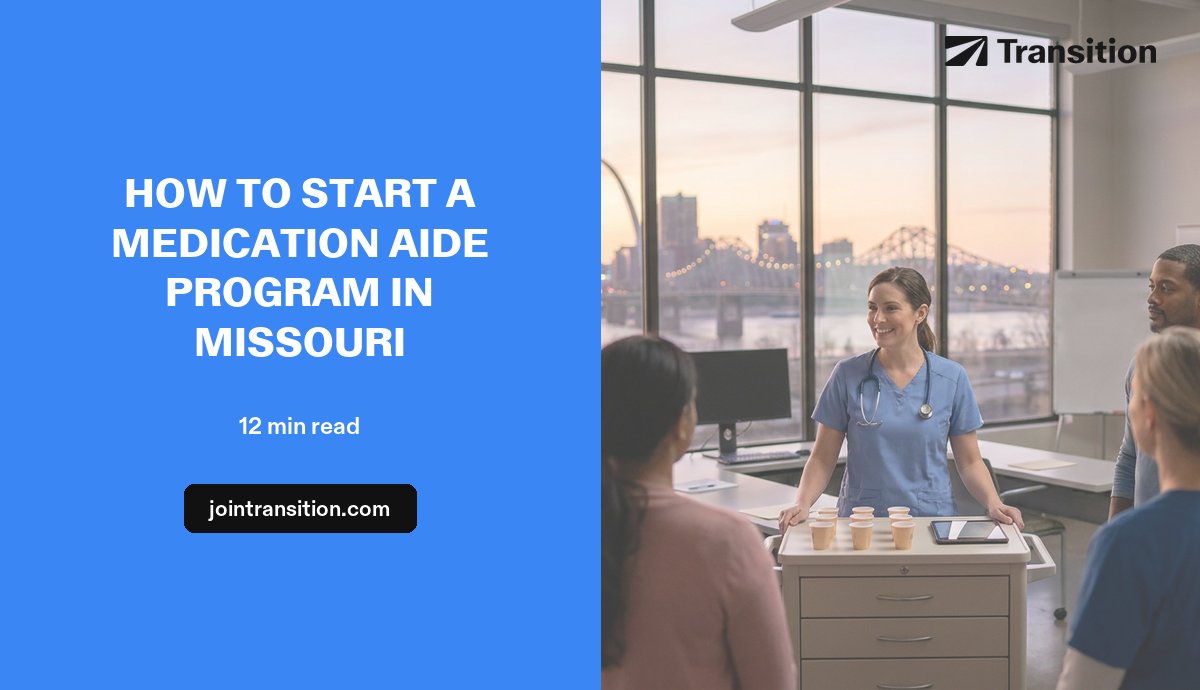
Walk into any skilled nursing facility in Missouri and watch the morning med pass. In most buildings, the person pushing that cart isn't a nurse — it's a Certified Medication Technician (CMT), a CNA who completed a state-approved course and now administers nonparenteral medications under nurse oversight. Facilities need CMTs on every shift, which means they need someone to train them. If you're already in the CNA training business, a medication aide program looks like the obvious next product line.
Here's the Missouri twist to understand before you spend a dollar: the state tightly controls who may sponsor a CMT course. Under 19 CSR 30-84.020, only certain educational institutions can be approved as CMT training agencies — and Missouri's proprietary school office says outright that privately certified career schools cannot offer CMT or Level I Medication Aide programs. That doesn't kill the opportunity, but it changes its shape. There are real, legal paths into this market; they just don't all look like "open a private med aide school."
We work with CNA and allied-health training programs every day, running their enrollment, records, and compliance operations, and we wrote the companion guide on How to Start a CNA School in Missouri. This guide covers the medication side: the CMT course plus Missouri's two add-on credentials, the Level I Medication Aide (L1MA) and the Insulin Administration course. One note first: we're operators, not lawyers. Treat this as a well-researched map and verify the details with the agencies we name.
Quick Facts: Medication Aide (CMT) Training in Missouri
| Item | Missouri Requirement |
|---|---|
| Credential | Certified Medication Technician (CMT) |
| Total training | 60 classroom hours + minimum 8 hours clinical practice + 2-part final exam (19 CSR 30-84.020) |
| Approving agency | Missouri DHSS, Section for Long-Term Care Regulation — Health Education Unit |
| Who may sponsor a course | Vo-tech schools, area career centers, comprehensive high schools, community colleges, approved 4-year institutions. A long-term care facility cannot be the training agency; proprietary schools are excluded per MDHEWD |
| Student prerequisites | High school diploma/GED; active on the Missouri CNA Registry with 6 months of CNA employment; letter of recommendation; clean background/EDL |
| Exam | Department-approved 50-question written final (80% to pass) + minimum 2-hour practicum in an ICF/SNF; test events scheduled on the TMU platform (mo.tmutest.com, D&SDT-Headmaster) |
| Registry | Missouri CNA Registry (DHSS) — lists CMT status alongside CNA status |
| Approval period | 2 years; renewal application due 30 days before expiration |
| Instructor requirement | Missouri-licensed RN with a DESE CMT teaching certificate who has completed the instructor/examiner workshop |
| Add-on programs | Level I Medication Aide, 16 hours (19 CSR 30-84.030); Insulin Administration, 4 hours (19 CSR 30-84.040) |
Step 1: Form Your Business Entity (Skip If You Have One)
If you already run a certified CNA school or an eligible institution, skip ahead — your entity, EIN, and bank account carry over, and adding a program doesn't require a new company. If you're starting fresh: file an LLC through the Missouri Secretary of State's Online Business Filing portal ($50 filed online), get a free EIN from the IRS, and open a dedicated business bank account. Missouri has no annual report requirement for LLCs, which keeps upkeep simple.
Step 2: Register for State Taxes (Skip If You're Already Registered)
Existing schools are already set up here. New entities register with the Missouri Department of Revenue (Form 2643 or MyTax Missouri) — tuition isn't subject to Missouri sales tax, so most training providers only need employer withholding — and with the Division of Employment Security via UInteract for unemployment insurance once payroll starts.
Step 3: Figure Out Your Lane — Missouri's Sponsorship Rule
This is the step that makes Missouri different, so it comes before the application. Under 19 CSR 30-84.020, a CMT educational training agency must be an area vocational-technical school, an area career center, a comprehensive high school, a community college, or an approved four-year institution of higher learning. The rule adds, in plain words: "A long-term care facility cannot be a training agency." And MDHEWD — the agency that certifies private career schools — states on its CNA/CMT/L1MA page that schools certified through its proprietary school program cannot offer CMT or L1MA courses.
So who are you in this market? Four realistic lanes:
- You're an eligible institution. Community colleges, career centers, and similar institutions apply directly to the DHSS Health Education Unit. If that's you, this guide is your checklist.
- You partner with one. Private operators commonly deliver medication training under a sponsorship arrangement with an eligible educational training agency: the agency holds the approval; you bring instructors, students, or facility relationships. Put it in writing and confirm the structure with the Health Education Unit before advertising anything.
- You're a facility. An ICF or SNF can host the CMT course in its building — including the classroom portion — but only under a written agreement with an approved educational training agency, which remains responsible for instructors, testing, and certification (19 CSR 30-84.020(3) and (9)(G)).
- You're an RN building a training business. Becoming an approved CMT instructor/examiner (Step 5) and teaching under sponsoring agencies is a real model, and it positions you for the L1MA and insulin courses, which have broader sponsorship rules.
Whatever you do, don't build a plan that assumes a proprietary school certificate lets you run CMT classes. It doesn't, and MDHEWD says so explicitly.
Step 4: Apply for DHSS Health Education Unit Approval
CMT program approval runs through the Health Education Unit (HEU) of the DHSS Section for Long-Term Care Regulation — the same unit that approves CNA training agencies (cnaregistry@health.mo.gov, 573-526-5686). Under 19 CSR 30-84.020(9), an eligible school files an application with the HEU that includes:
- The names of your department-approved instructors
- The classroom space and equipment you'll use (sufficient space, equipment, and teaching aids to meet course objectives)
- A copy of your signed agreement with the cooperating agency — the licensed ICF or SNF where clinical practice and the final practicum exam happen
- The names of the RNs who will supervise clinical observation
Approval lasts two years, with a new application due 30 days before expiration. DHSS can inspect the school or cooperating facility if complaints surface, and it can revoke training agency status if requirements aren't met. The regulation doesn't publish an application fee — confirm current requirements and any costs with the HEU.
Step 5: Line Up a Qualified Instructor/Examiner
Missouri's CMT instructor bar is specific, and it's higher than the L1MA bar. Under 19 CSR 30-84.020(8), a CMT instructor/examiner must:
- Hold a current Missouri RN license (or Missouri Board of Nursing temporary permit) with no current disciplinary action — LPNs cannot teach the CMT course
- Hold a current CMT teaching certificate from the Department of Elementary and Secondary Education (DESE), Division of Career Education
- Complete an instructor/examiner workshop and be listed on the department's instructor/examiner registry
- Sign an agreement with the department to keep the final examination and test-bank access secure
The instructor may be an employee of the ICF/SNF where training happens, as long as the facility has a cooperative agreement with the sponsoring agency. One nice touch: pharmacists may assist as guest instructors for medication systems, interactions, adverse reactions, and errors — a consultant pharmacist strengthens both content and marketing. Plan the pipeline early: the DESE certificate plus workshop takes longer to assemble than a CNA instructor approval, and your program stops if your only instructor leaves.
Step 6: Use the State Curriculum — 60 Classroom Hours
You don't write a CMT curriculum in Missouri; the state prescribes it. The course is at least 60 classroom hours taught by the approved instructor, using the student manual and course developed by DESE and the Missouri Center for Career Education at the University of Central Missouri (the rule incorporates the Revised 2008 edition, historically accessed at cmttest.org — ask the HEU for current materials and ordering). Students and instructors must each have a copy of the manual.
Required content covers body systems and medication effects, medical terminology, infection control, medication classifications, dosages and forms, acquisition/storage/security, observation problems in medication therapy, and administration by every nonparenteral route — oral, rectal, vaginal, otic, ophthalmic, nasal, topical, transdermal patches, and metered dose inhalers. Students must score at least 80% on each written exam within the course to sit the final. Most providers run the 60 hours over three to six weeks in evening or weekend blocks, because nearly every student is a working CNA.
Step 7: Sign a Cooperating Agency Agreement for the Clinical Hours
The course includes a minimum of 8 hours of clinical practice in a licensed ICF or SNF, directly supervised by the instructor/examiner or a designated RN employed by the cooperating facility — who can require more than 8 hours if a student hasn't mastered the content. The final practicum exam must also happen in an ICF/SNF.
The rule requires a signed written agreement between the training agency and each cooperating facility spelling out roles, responsibilities, and liabilities; the facility must give students and examiners access to the medication room, supervised access to residents, and access to the documentation area. Send the HEU a copy of the current agreement. Practical advice from the programs we work with: your cooperating facility is also your customer — most CMT students are sent (and often paid for) by their employer, so treat the DON relationship as the core of your sales pipeline.
Step 8: Understand Enrollment Rules, Testing, and the Registry
Prerequisites are strict, and you'll verify them at enrollment. Under 19 CSR 30-84.020(6), a CMT student needs a high school diploma or GED; six months of employment as a CNA listed as active on the Missouri CNA Registry; a letter of recommendation from a long-term care administrator or director of nursing; no Employee Disqualification List listing or federal indicator on any CNA registry; and no disqualifying convictions. The rule also lists a TABE basic-skills test, but DHSS announced that effective April 1, 2019, the TABE is no longer required for CMT enrollment — confirm current policy with the HEU. Nursing students and recent nursing graduates have separate challenge pathways that skip the course.
The final is a two-part, state-controlled exam: a department-approved 50-question written test (80% to pass) and a minimum two-hour practicum covering preparation, administration, and documentation of medications by all nonparenteral routes, conducted in the ICF/SNF. A failed final may be retaken once within 90 days without repeating the course. Today, Missouri schedules CMT classes and test events on the TMU platform (mo.tmutest.com) run by D&SDT-Headmaster — the same system Missouri CNA programs live in — so your staff will manage rosters and test dates there.
Certification and the registry: completion records go to a department-approved certifying agency (typically one of Missouri's long-term care associations) within 30 days, and successful students are listed as CMTs on the Missouri CNA Registry. A signed CMT Course Evaluation Record authorizes a graduate to pass medications for up to 60 days while the listing processes. Employers must verify registry status before hiring — teach your graduates to check their own listing.
Step 9: Set Up Enrollment, Payments, and Student Records
A medication program is smaller than a CNA program, but the compliance surface is denser per student: prerequisite verification, 60 hours of attendance, per-exam scores at the 80% line, clinical sign-offs, cooperating agency agreements, and 30-day reporting windows. This is what we built Transition for — schools use it to run branded online enrollment with prerequisite document collection, payment plans, attendance and grade tracking, e-signed agreements, and automated email/SMS reminders that keep working CNAs showing up to night classes. One system instead of spreadsheets and a filing cabinet.
Step 10: Launch with a Facility-First Marketing Plan
CMT students don't find you the way CNA students do — most are sponsored by their employer. Market accordingly:
- Sell to DONs and administrators first. A one-page flyer with your course calendar, per-student pricing, and group rates for facilities will outperform consumer ads.
- Set up a Google Business Profile anyway — "CMT classes near me" searches are real, and CNAs paying their own way will find you there. Collect reviews from every cohort.
- Talk to Missouri Job Centers (Office of Workforce Development, jobs.mo.gov). Medication credentials attached to employed CNAs fit workforce upskilling programs well.
- Bundle with your CNA pipeline. If you or your partners train CNAs, the CMT course is the natural six-months-later follow-on — build the email sequence now.
The Add-On Product Lines: L1MA and Insulin Administration
Missouri gives a medication-training operation two more programs worth offering, each with its own rule:
Level I Medication Aide (L1MA) — 19 CSR 30-84.030. A minimum 16-hour course qualifying aides to administer medications in residential care facilities (RCFs) and assisted living facilities (ALFs). No CNA certification required — any person 18 or older employable in an RCF/ALF for direct care can enroll, so the funnel is much wider than CMT. The final is a 25-question written exam (80%) plus a practicum administering at least 10 medications at 100% accuracy, and L1MAs need 4 hours of update training every two years to stay active. Two operator-relevant differences: the instructor may be an RN or an LPN with one year of nursing experience and a Train-the-Trainer workshop, and eligible training agencies are broader — licensed RCFs/ALFs, Department of Mental Health facilities, and long-term care associations as well as the educational institutions. Proprietary schools are still excluded per MDHEWD, but if you operate or partner with an assisted living facility, you have a direct route here that doesn't exist for CMT.
Insulin Administration — 19 CSR 30-84.040. A short course — at least 4 classroom hours — qualifying existing CMTs and L1MAs to administer insulin, with a 10-question written exam and a practicum performed on an actual resident (not simulated) at 100% accuracy. Students need a written recommendation from their administrator or director of nursing; the instructor must be an RN already approved as an L1MA instructor, CNA instructor/examiner, or CMT instructor. It's a low-cost, high-margin add-on for any program with the instructor and facility relationships — confirm sponsorship details for your situation with the HEU.
What It Really Costs
Assuming you (or your sponsoring partner) already have classroom space — realistic estimated ranges for adding a Missouri medication program:
| Item | Estimated Range |
|---|---|
| Entity formation (if new) | $50–$200 |
| State curriculum manuals (per student) | Check current pricing with the HEU/publisher |
| Med cart, med room props, teaching supplies | $1,500–$5,000 |
| Instructor pay (RN, per 68-hour course cycle) | $2,500–$5,000 |
| DESE teaching certificate + instructor workshop costs | Varies — confirm with DESE and the HEU |
| Consultant pharmacist guest sessions (optional) | $500–$1,500 per cohort |
| Insurance rider for the new program | $500–$1,500/yr |
| Marketing to facilities (first 6 months) | $500–$2,000 |
| Software, records, enrollment systems | $1,000–$3,000/yr |
| Bottom line (cash outlay, existing classroom) | ~$6,000–$18,000 |
These are estimates for planning, not quotes. The big variable isn't equipment — it's whether you must build a partnership with an eligible sponsoring institution, which costs time and possibly revenue share rather than cash.
How Long It Takes
For an eligible institution with an approved instructor already in place, plan on roughly 2–4 months from application to first class: assembling the cooperating agency agreement, HEU review, and TMU scheduling. If your instructor still needs the DESE teaching certificate and instructor/examiner workshop, add the wait for the next workshop date — that's the most common long pole. If you're a private operator building a sponsorship arrangement with a community college or career center, the partnership negotiation will take longer than any state paperwork; 4–9 months is a realistic planning window. The two-year renewal cycle starts the day you're approved, so calendar the 30-days-before-expiration deadline immediately.
Common Mistakes to Avoid
- Assuming a proprietary school certificate covers CMT. It doesn't — MDHEWD-certified schools cannot offer CMT or L1MA courses. Missouri restricts CMT sponsorship to specific educational institutions; plan your structure around that from day one.
- Enrolling students who don't meet the six-month rule. A CMT student must have six months of employment as an active-registry CNA plus a written recommendation. Enrolling an ineligible student wastes their tuition and puts your approval at risk.
- Hiring an LPN to teach CMT. LPNs can teach the L1MA course, but the CMT instructor must be an RN with the DESE teaching certificate and workshop. Verify credentials before you publish a class schedule.
- Confusing CMT and L1MA scopes. CMTs work in skilled and intermediate care nursing facilities; L1MAs work in residential care and assisted living. They're different courses, different rules, different markets — sell them that way.
- A handshake with the clinical facility. The signed cooperating agency agreement is a required part of the application, and the HEU must receive the current version. Get it in writing and keep it current.
- Missing the two-year renewal window. The renewal application is due 30 days before expiration, and DHSS can revoke agencies that drift out of compliance. Keep records continuously audit-ready.
FAQ
Who can offer a CMT course in Missouri? Only a DHSS-approved educational training agency: an area vocational-technical school, area career center, comprehensive high school, community college, or approved four-year institution (19 CSR 30-84.020). Long-term care facilities can host courses but cannot be the training agency, and MDHEWD-certified proprietary schools cannot offer CMT programs.
Can my private CNA school add a medication aide program? Not directly — Missouri's proprietary school office states that schools certified through it cannot offer CMT or L1MA courses. Realistic routes: partner with an eligible institution that sponsors the course, supply approved instructors under such a sponsorship, or pursue the L1MA route if you operate a licensed RCF/ALF. Our Missouri CNA school guide covers the proprietary certification side in detail.
What are the prerequisites to take the CMT course? A high school diploma or GED, active status on the Missouri CNA Registry with six months of CNA employment, a letter of recommendation from a long-term care administrator or director of nursing, and a clean background (no EDL listing or disqualifying convictions). The TABE test in the rule has not been required since April 1, 2019, per DHSS.
How many hours is Missouri's CMT course? At least 60 classroom hours plus a minimum of 8 hours of clinical practice in a licensed ICF or SNF, followed by a two-part final exam — a 50-question written test (80% to pass) and a minimum two-hour practicum — under 19 CSR 30-84.020.
What's the difference between a CMT and a Level I Medication Aide? A CMT works in skilled and intermediate care nursing facilities and must first be a CNA with six months of experience; the course is 60+ hours. An L1MA works in residential care and assisted living facilities, needs no CNA certification, and completes a minimum 16-hour course under 19 CSR 30-84.030. The 4-hour Insulin Administration course (19 CSR 30-84.040) is an add-on available to both.
Where do CMT students test, and where is the credential listed? The department-approved written final and the in-facility practicum are administered by your approved instructor/examiner, with classes and test events managed on the TMU platform (mo.tmutest.com, run by D&SDT-Headmaster). Successful students are listed as CMTs on the Missouri CNA Registry, which employers must check before hiring.
Disclaimer
This guide is for general information, not legal advice. Missouri's rules, forms, and processes change — the CMT, L1MA, and insulin rules each carry amendment histories and COVID-era suspensions, and agency workflows keep moving into TMU. Verify current requirements with the DHSS Health Education Unit (cnaregistry@health.mo.gov, 573-526-5686), MDHEWD (PropCompliance@dhewd.mo.gov), and your own attorney and accountant before making commitments.
The Paperwork Gets You Open. The Systems Keep You Open.
Between prerequisite checks, 80% exam thresholds, cooperating agency agreements, and two-year renewals, a Missouri medication program rewards operators who run tight systems. See how Transition handles enrollment, payments, student records, e-signatures, and automated messaging for training programs like yours at jointransition.com.
Get CNA training paid for.
Tell us your county and we text you the route that fits, who to call, and what to bring.