
How to Start a Medication Aide Program in Nebraska (2026 Guide)
July 28, 2026 · Nebraska
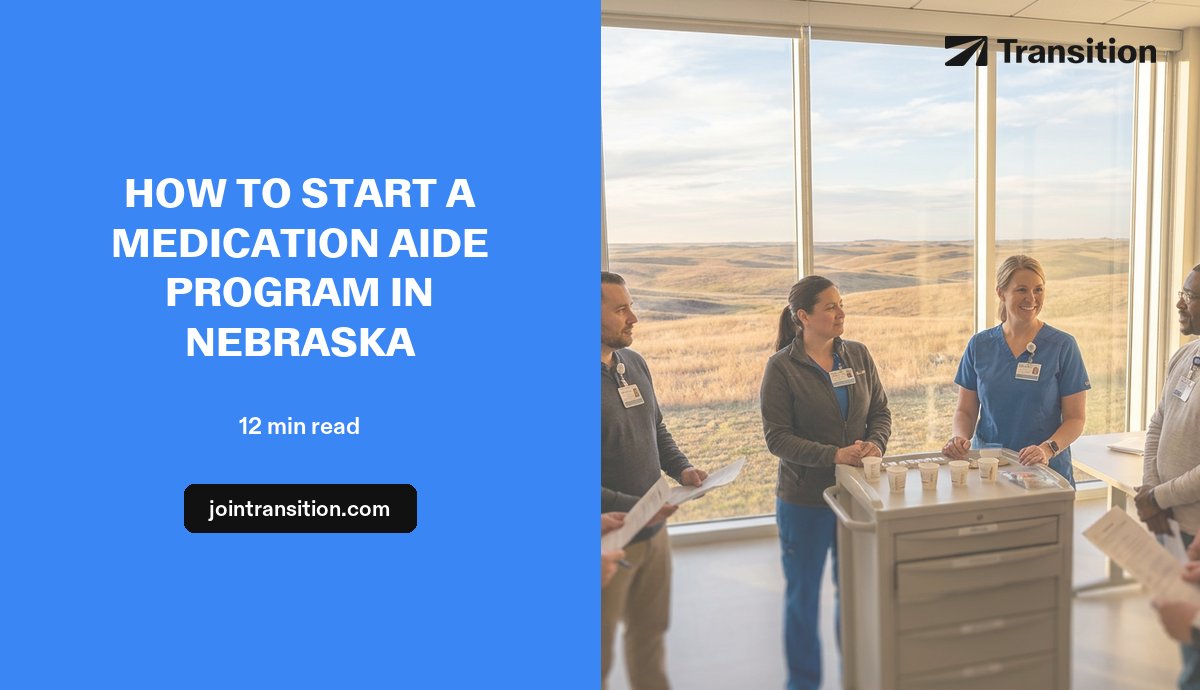
Nebraska runs one of the more accessible medication aide models in the country, and it surprises people coming from neighboring states. The credential is a Medication Aide (40-hour) on the Nebraska DHHS Medication Aide Registry — and, unlike Arizona, Montana, or most of the region, there is no CNA prerequisite. A student needs to be 18, complete the state-defined 40-hour course, and pass a state-approved competency exam. That opens your funnel wide: you're not limited to recruiting from your own nurse aide graduates.
The other thing to understand up front is which agency owns this. Nebraska medication aides are governed by the Medication Aide Act (Neb. Rev. Stat. § 71-6718 and following) and administered by the Nebraska Department of Health and Human Services (DHHS), Division of Public Health through the Medication Aide Registry — with the course competencies and provider rules set out in 172 NAC 96 (and companion regulations in Chapter 95). This is a health-department program, not a Board of Nursing program, though a licensed health professional — typically an RN — has to stand behind the training.
We work with CNA and allied-health schools around the country on the operations side — enrollment, records, e-sign, messaging — and a second program is usually where the economics turn, because the classroom and staff are already paid for. Here's the roadmap. It's general information, not legal advice; verify current requirements with DHHS before spending money.
Quick Facts: Medication Aide Program Requirements in Nebraska
| Item | Requirement |
|---|---|
| Credential earned | Medication Aide (40-hour), placed on the DHHS Medication Aide Registry |
| Total training hours | 40-hour course on the competencies in 172 NAC 96-005.01 |
| Approving agency | Nebraska DHHS, Division of Public Health — Medication Aide Registry |
| Statute / rules | Medication Aide Act, Neb. Rev. Stat. § 71-6718 et seq.; 172 NAC 96 (registry/course) and Chapter 95 (medication aide regulations) |
| Student prerequisites | 18 or older; no CNA/nurse aide certification required |
| Course provider requirement | Course must be designed, directed, and reviewed by a licensed health care professional (e.g., RN); the instructor signs the competency portion of the application |
| Exam | State-approved competency exam; 72% or greater to pass (written exam commonly ~$35) |
| Registry process | Application for Registration as Medication Aide – 40 Hour + documentation of course completion; $18 non-refundable registration fee; ~30 days to appear on the registry |
| Work settings | Nursing homes, assisted living facilities, and intermediate care facilities for individuals with developmental disabilities (ICF/DD) |
| Typical time to launch | Roughly 2–4 months for an existing school |
Step 1 — Form your business entity (skip if you have one)
If you already operate a training school, your existing LLC or corporation can house this program — no new entity needed. Starting from zero? File a Certificate of Organization with the Nebraska Secretary of State through the online business services portal (LLC filing runs about $100–$110 online, plus Nebraska's publication requirement), get your EIN, and open a dedicated business bank account. Our How to Start a CNA School in Nebraska guide covers entity formation in detail.
Step 2 — Register for state taxes (mostly done if you're operating)
Existing schools rarely need anything new. Tuition for instruction is generally not subject to Nebraska sales tax, and your existing withholding and unemployment accounts with the Nebraska Department of Revenue and Department of Labor cover new instructors. New operators register through the Department of Revenue's online system. This is a paperwork afternoon, not a project.
Step 3 — Set up your classroom and medication lab
Your CNA skills lab is most of the way there. A medication aide course adds the administration environment students will train in: a locked medication cart, MAR (medication administration record) books or an eMAR setup, med cups and unit-dose packaging, practice medication containers, and supplies for the routes taught. Because the competency assessment has students demonstrate safe administration using a MAR, mirror that workflow in your lab. Budget a few thousand dollars, not a build-out.
Step 4 — Meet the 40-hour course and provider requirements (172 NAC 96)
This is the heart of the process, and Nebraska structures it differently from a Board-approval state. Rather than licensing your "program" as an institution, the rules focus on the course and who stands behind it. Under 172 NAC 96-005:
- The 40-hour course must cover the competencies identified in 172 NAC 96-005.01 — the same competency set applies whether the graduate will work in a nursing home, an assisted living facility, or an ICF/DD.
- The course (and any competency assessment) must be designed, directed, and reviewed by a licensed health care professional. If a medication aide conducts a competency assessment, it still must be designed, directed, and reviewed by a licensed health care professional.
- The course instructor signs the competency portion of the student's registration application, and the licensed health care professional signs the competency assessment.
- The provider must give each student documentation of successful course completion showing the hours — that certificate is part of what the student submits to the registry.
Practically, that means your RN (or another qualified licensed health professional) is the linchpin: they own the curriculum and the sign-off. Confirm the current provider expectations and any notification steps directly with the DHHS Licensure Unit, and note the special pathway in the rules for nursing and allied-health students who complete the required competency content within an approved program.
On the school-licensing question: if you operate as a private, for-profit career school in Nebraska, private postsecondary career schools are overseen by the Nebraska Department of Education. Adding a 40-hour medication aide course to an existing licensed or exempt school is usually straightforward, but confirm your specific status before enrolling tuition-paying students in an open-enrollment course.
Step 5 — Line up your RN (or licensed health professional) instructor
Nebraska's model runs on a licensed health care professional — most commonly an RN — who designs, directs, and reviews the course and competency assessment, and an instructor who signs off on each student's competency. If the RN who runs your CNA program has medication-administration depth, this can be the same person — one more reason the second program is cheaper than the first. Choose someone whose credentials defensibly match the pharmacology and administration content, and keep their sign-off documentation clean, because it travels with every student's registry application.
Step 6 — Build a curriculum that matches 172 NAC 96-005.01
The required content is the competency set in 172 NAC 96-005.01, delivered across the 40-hour course. Build the curriculum straight from that competency list rather than a generic binder, and show hours against each area. Core content runs the usual medication-aide territory: safe medication administration, the rights of medication administration, resident rights including the right to refuse, basic pharmacology and drug classifications, administration techniques across the permitted routes, documentation, and the legal boundaries of the role.
Teach the scope precisely. A Nebraska medication aide provides medications in nursing homes, assisted living facilities, and ICF/DD settings under the framework of the Medication Aide Act — not as an independent prescriber, and not outside the acts the Act permits. Put those boundaries in your slides verbatim so graduates never oversell what they can do.
Step 7 — Set up clinical/practicum arrangements
Nebraska's model emphasizes competency demonstration over a fixed clinical-hour count, but students still have to prove they can administer safely, and facilities are where that competency gets real. If you run a CNA program, your existing nursing home and assisted living partners are the obvious ask — and medication aide graduates are an easy sell, because facilities are chronically short on medication-competent staff and every graduate is a hiring lead. Document how and where competency is assessed, and keep the licensed health professional's review in the file.
Step 8 — Understand testing and the registry
After the course, the student takes a state-approved competency exam and must score 72% or greater to pass (the written exam commonly runs about $35, paid to the exam provider). Then they submit the Application for Registration as Medication Aide – 40 Hour to the DHHS Medication Aide Registry, along with documentation of course completion and the $18 non-refundable registration fee. It typically takes about 30 days from the exam date to appear as active on the registry, though it can take longer — so your exam-scheduling and application workflow is part of the product. Employers verify aides on the registry; there's no separate certificate to track.
Step 9 — Set up enrollment, payments, and student records
A 40-hour program lives or dies on throughput: more cohorts per year, shorter cycles, same paperwork per student — competency sign-offs, completion certificates, exam registrations, and registry applications. Every one of those has to be complete and correct, or a student stalls before the registry.
That operational layer is what Transition does for the schools we work with: branded online enrollment, e-signed agreements, payment plans, attendance and grade tracking, automated email/SMS onboarding and exam-deadline reminders, and surveys — one system instead of spreadsheets, Jotform, Square, and a filing cabinet. If you already run your CNA program on Transition, adding a medication aide program is a configuration, not a project.
Step 10 — Launch with a targeted marketing plan
Because Nebraska requires no CNA first, your market is wider than in most states. Market in three lanes: your own CNA alumni and general job-seekers (a 40-hour, entry-accessible credential is an easy sell); facility partnerships (nursing homes, assisted living, and ICF/DD operators sponsor cohorts and can upskill a broad bench since aides don't need to be CNAs first — pitch directors of nursing directly); and workforce channels — your local Nebraska Department of Labor / American Job Center and the WIOA eligible training provider list, where short, high-completion programs perform well. Add a medication aide page to your site, update your Google Business Profile services, and answer every inquiry by text within minutes.
What it really costs
Realistic estimates for adding a 40-hour medication aide program to an existing Nebraska school:
| Item | Estimated range |
|---|---|
| DHHS registry fee (per student) | $18 each |
| Exam fee (per student) | ~$35 each |
| Medication cart, MAR books, lab supplies | $1,500 – $4,000 |
| Curriculum development or licensing | $500 – $3,000 |
| RN instructor payroll (first cohort) | $1,500 – $4,000 |
| Insurance rider / policy update | $0 – $750 |
| Marketing (page, ads, alumni campaign) | $250 – $1,500 |
| Total to first cohort (existing school) | $3,750 – $13,250 |
Starting from scratch with no school behind you? Add entity formation, rent, and classroom build-out from our CNA guide — roughly $10,000–$25,000 more. All figures are estimates, not quotes.
How long it takes
For an existing school, plan on 2–4 months from decision to first registered aides: a few weeks to build the 40-hour curriculum from the 172 NAC 96-005.01 competencies and line up your licensed health professional, deliver the course, then the exam plus roughly 30 days for registry processing. The registry turnaround is the tail on the timeline — build it into what you promise students. New operators should think in CNA-school timelines instead — see the full guide.
Common mistakes to avoid
- Gatekeeping on CNA status. Nebraska has no CNA prerequisite for the 40-hour medication aide. Schools still requiring it are shrinking their own funnel.
- Skimping on the licensed-professional sign-off. The course must be designed, directed, and reviewed by a licensed health care professional, and competency sign-offs travel with each student's registry application. Sloppy documentation stalls students.
- Building from a generic curriculum. The content has to match the competencies in 172 NAC 96-005.01. Build from the rule, not a borrowed binder.
- Forgetting the registry lag. It takes about 30 days from exam to active registry status — sometimes longer. Set student expectations accordingly.
- Overselling the scope. Nebraska medication aides provide medications in nursing homes, assisted living, and ICF/DD settings under the Medication Aide Act — not beyond what the Act permits. Graduates promised more become refund requests.
- Ignoring your school-licensing posture. Private career schools answer to the Nebraska Department of Education. Confirm your status before enrolling tuition-paying students in an open-enrollment course.
FAQ
How much does it cost to start a medication aide program in Nebraska? If you already operate a training school, roughly $3,750–$13,250 to first cohort — mostly lab supplies, curriculum, and instructor payroll, plus small per-student registry ($18) and exam (~$35) fees. From scratch, budget CNA-school numbers plus this program.
How many hours is medication aide training in Nebraska? 40 hours, covering the competencies in 172 NAC 96-005.01. The same 40-hour course applies whether the graduate will work in a nursing home, assisted living facility, or ICF/DD.
Do students need to be a CNA first? No. Nebraska has no nurse aide prerequisite for the 40-hour medication aide — students need to be 18, complete the course, and pass the exam. That's a big difference from most states.
Who approves medication aide training in Nebraska? Nebraska DHHS, Division of Public Health, through the Medication Aide Registry, under the Medication Aide Act (Neb. Rev. Stat. § 71-6718 et seq.) and 172 NAC 96 — a health-department program, not a Board of Nursing program, though a licensed health professional must design and direct the course.
What exam do students take, and what's passing? A state-approved competency exam requiring 72% or greater to pass (written exam commonly ~$35). After passing, the student registers with DHHS with a $18 fee and documentation of course completion.
Where can Nebraska medication aides work? Nursing homes, assisted living facilities, and intermediate care facilities for individuals with developmental disabilities (ICF/DD), providing medications under the Medication Aide Act.
Disclaimer
This guide is general information, not legal, tax, or regulatory advice. Nebraska's medication aide rules, fees, and interpretations change over time. Verify current requirements with Nebraska DHHS (dhhs.ne.gov), the current Medication Aide Act and 172 NAC 96/95 text, the Nebraska Department of Education for school licensing, and — for business questions — the Nebraska Secretary of State and Department of Revenue.
Ready to add the program without adding the chaos?
The paperwork gets you registered. The systems keep you running. See how Transition handles enrollment, e-sign, records, payments, and messaging for CNA, medication aide, and allied-health programs like yours at jointransition.com.
Get CNA training paid for.
Tell us your county and we text you the route that fits, who to call, and what to bring.