
How to Start a Medication Aide Program in New Jersey (2026 Guide)
July 28, 2026 · New Jersey
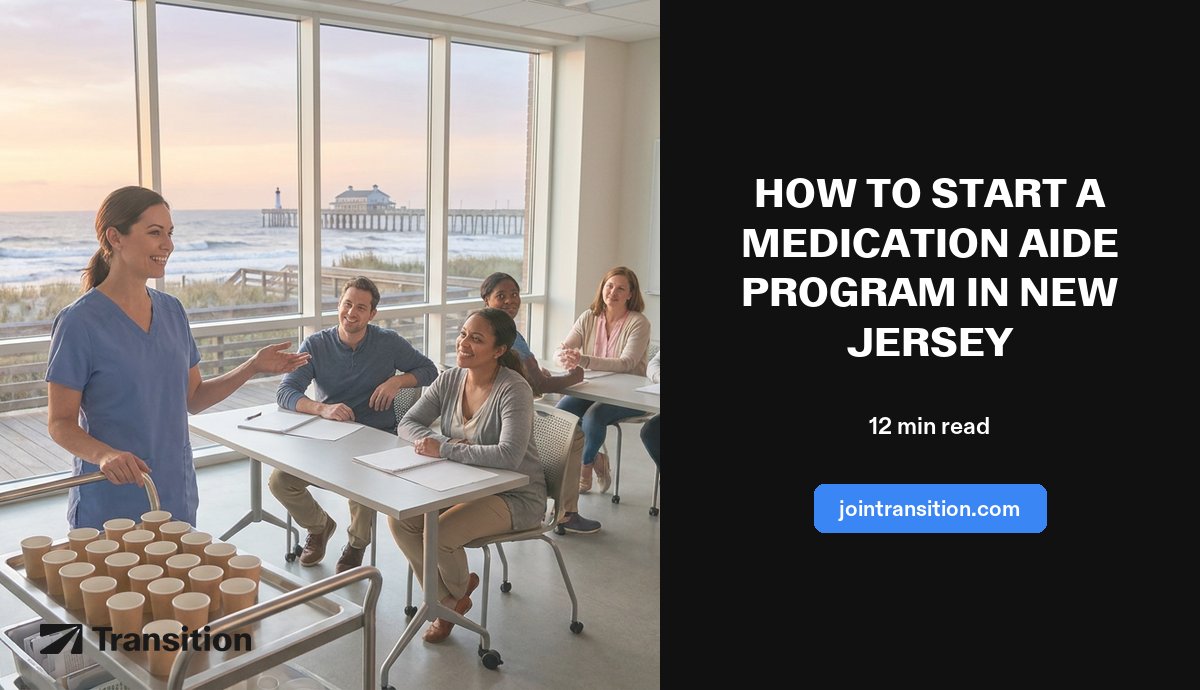
New Jersey requires an honest conversation before you build anything, because the medication aide role here is narrower than in most states — and if you don't understand the limit, you'll design a program for a market that doesn't exist. New Jersey has a Certified Medication Aide (CMA) credential, but it lives entirely in the assisted living world: assisted living residences, comprehensive personal care homes, and assisted living programs. It is approved and certified by the New Jersey Department of Health (NJDOH) under the assisted living regulations at NJAC Chapter 8:36.
Here's the part most guides skip: New Jersey nursing homes do not use unlicensed medication aides. In a New Jersey skilled nursing facility, medications are administered by licensed nurses — there is no CNA-plus-med-pass role on the SNF floor the way there is in Ohio or Tennessee. So if your business plan was "train aides to pass meds in nursing homes," that plan doesn't work in New Jersey. What does work is training the state's real, DOH-recognized assisted living CMA — a credential assisted living operators genuinely need and hire for. Build for that, and you have a viable program. Build for the nursing-home fantasy, and you'll enroll students into a job that isn't there.
We work with CNA and allied-health schools around the country on the operations side — enrollment, records, e-sign, messaging — and the New Jersey lesson is that clarity about scope is the product. This is general information, not legal advice; verify current requirements with the New Jersey Department of Health before spending money. For the underlying credential, see our How to Start a CNA School in New Jersey guide.
Quick Facts: Medication Aide Program Requirements in New Jersey
| Item | Requirement |
|---|---|
| Total training hours | Roughly 40 classroom hours plus a supervised clinical component (a minimum of 3 directly supervised medication passes) per the DOH-approved course |
| Classroom/clinical split | Classroom instruction split between an RN and a registered pharmacist, plus supervised medication passes at an assisted living community |
| Credential earned | Certified Medication Aide (CMA) — assisted living only |
| Approving agency | New Jersey Department of Health (NJDOH) |
| Application | CMA training program approval application to NJDOH; $100 non-refundable fee; approval valid 2 years (NJAC 8:36-11.5) |
| Student prerequisites | Current New Jersey certification as a nurse aide (CNA), homemaker–home health aide (HHA), or personal care assistant (PCA); read/write/comprehend English; arithmetic skills; criminal background check |
| Exam | DOH-approved standardized written medication-administration examination |
| Instructor requirements | RN trainer who has attended the DOH one-day Train-the-Trainer Medication Aide Workshop; a registered pharmacist teaches the pharmacology portion |
| Work settings | Assisted living residences, comprehensive personal care homes, and assisted living programs — not nursing homes |
| Certification term | 2 years; renewal requires at least 10 hours of continuing education |
| Typical time to launch | Roughly 2–5 months for an existing school |
Step 1 — Form your business entity (skip if you have one)
If you already run a New Jersey training school, your existing LLC or corporation houses this program — no new entity needed. Starting from zero? File a Public Records Filing for New Business Entity and register through the New Jersey Division of Revenue and Enterprise Services (the LLC formation fee is about $125 — confirm the current amount), get your EIN from the IRS, and open a dedicated business bank account. Our New Jersey CNA school guide walks through formation in detail.
Step 2 — Register for state taxes (mostly done if you're operating)
Register with the New Jersey Division of Revenue and Enterprise Services for tax and employer accounts if you haven't. Tuition for instruction is generally not subject to New Jersey sales tax, and your existing employer withholding and unemployment/disability registrations cover new instructors. An existing school adding a program almost never needs new tax registrations — confirm with the Division of Taxation if you're unsure.
Step 3 — Set up your classroom and medication lab
Your CNA skills lab covers most of the physical setup. What a CMA course adds is the assisted-living medication-administration environment students will train and test in: a locked medication cart, MAR (medication administration record) books or an eMAR setup, med cups and pill organizers, practice medication containers and unit-dose packaging, and supplies for oral, topical, and eye/ear/nose administration. Because the New Jersey course requires supervised medication passes at an assisted living community, your most important "lab" is a real assisted living clinical partner — more on that in Step 7. Physical supplies here are a few thousand dollars, not a build-out.
Step 4 — Apply for New Jersey Department of Health program approval
This is the heart of the process, and — importantly — it runs through the Department of Health, not the Board of Nursing that oversees CMA programs in many other states. The CMA training program is approved under the assisted living regulations at NJAC 8:36, specifically the CMA Program provisions at NJAC 8:36-11.5. Key mechanics:
- Submit the CMA training program approval application to NJDOH with a $100 non-refundable fee; program approval is valid for two years (NJAC 8:36-11.5).
- Your application documents the curriculum, your RN trainer(s) and the registered pharmacist who delivers the pharmacology content, your assisted living clinical site for the supervised medication passes, and how you evaluate students.
- Critically, your RN trainers must attend the Department's one-day Train-the-Trainer Medication Aide Workshop before they can teach the CMA course. Build that into your timeline — you cannot train trainers around it.
On the double-licensure question: because the CMA course is a Department of Health–approved health training program, it's a different animal from a general private-career-school program. If your school also offers programs that fall under the New Jersey Department of Labor's private career/vocational school licensing or the Department of Education's oversight, confirm your overall mix with those agencies — but the CMA course itself is credentialed by NJDOH.
Step 5 — Hire (or assign) your RN trainer and pharmacist
New Jersey's model is distinctive: it requires both an RN and a registered pharmacist in the teaching mix. The classroom portion is commonly structured with the RN delivering the bulk of the medication-administration content and the pharmacist delivering the pharmacology unit — this pharmacist involvement is a real requirement, not a nicety, and it's a cost most other states don't impose. Your RN trainer must also have completed the DOH Train-the-Trainer Medication Aide Workshop. If the RN who runs your CNA program has medication-administration depth and completes the workshop, that can be your CMA trainer — but budget for the pharmacist's teaching hours from day one.
Step 6 — Build a curriculum that matches NJAC 8:36
Build to the Department's CMA training course structure. In practice the New Jersey course runs roughly 40 classroom hours plus a supervised clinical component requiring a minimum of three directly supervised medication passes at an assisted living community, with the classroom time divided between the RN and the pharmacist. Confirm the current DOH course outline and hour breakdown when you apply — the Department maintains the approved curriculum, and you build to it rather than inventing your own.
Content covers the preparation and administration of medications; observing, reporting, and documenting resident status; safety principles; measurement systems, body systems, and common diseases; and the rules of what a CMA may and may not do. Teach the scope precisely: in assisted living, a CMA administers routine medications via permitted routes (oral, ophthalmic, topical, and similar) under the delegation and supervision of a registered professional nurse — no injections except pre-drawn insulin, no dosage calculation, no pre-pouring for multiple residents, and no independent contact with prescribers (the boundaries in NJAC 8:36-11.5). Put those limits in your slides verbatim.
Step 7 — Set up clinical site agreements
This is where New Jersey's scope becomes concrete: clinical practice happens in an assisted living residence, comprehensive personal care home, or assisted living program — the only settings where CMAs work. You need a real assisted living partner willing to host the supervised medication passes, with an RN available to supervise. If you run a CNA program, your best route is an assisted living operator you already place graduates with. Do not try to route CMA clinicals through a skilled nursing facility — the credential isn't used there, and it defeats the purpose. Put the agreement in writing before you apply; the DOH application asks where the supervised passes occur.
Step 8 — Understand testing and certification
A CMA candidate completes the DOH-approved course, demonstrates the supervised medication passes, and passes a DOH-approved standardized written examination on medication administration (the written component is required; an oral version cannot substitute). Applicants must sit the exam within a set window after completing the course — confirm the current window and the current testing vendor and fees with NJDOH when you apply. Certification eligibility also requires current New Jersey certification as a nurse aide, homemaker–home health aide, or personal care assistant, English literacy and arithmetic skills, and a criminal background check through the New Jersey State Police and FBI. Certification is valid for two years and renews with at least 10 hours of continuing education — a future revenue line for your school.
Step 9 — Set up enrollment, payments, and student records
A CMA program generates real recordkeeping: prerequisite verification (CNA/HHA/PCA certification), background-check status, the English and arithmetic screenings, attendance, documentation of the supervised medication passes, and exam eligibility packets. The Department can ask to see it, and your two-year program re-approval goes smoother when every file is complete.
That operational layer is what Transition does for the schools we work with: branded online enrollment, e-signed agreements, payment plans, attendance and grade tracking, automated email/SMS onboarding and exam-deadline reminders, and surveys — one system instead of spreadsheets, Jotform, Square, and a filing cabinet. If your CNA program already runs on Transition, adding a CMA program is a configuration, not a project.
Step 10 — Launch with a targeted marketing plan
The buyer here is an assisted living operator and the aides who work for them — not nursing homes. Market in three lanes. First, your own CNA/HHA/PCA alumni already working in assisted living — a wage-raising certification for a short course is an easy pitch. Second, assisted living partnerships: pitch administrators and directors of nursing at assisted living residences and comprehensive personal care homes directly, and offer sponsored cohorts to upskill their staff. Third, workforce channels — your local One-Stop Career Center and the New Jersey Department of Labor's Eligible Training Provider List, where short, high-completion programs perform well. Add a CMA page to your site that is explicit about the assisted-living scope, update your Google Business Profile, and answer inquiries by text quickly.
What it really costs
Realistic estimates for adding a CMA program to an existing New Jersey school:
| Item | Estimated range |
|---|---|
| DOH program approval fee | $100 |
| Medication cart, MAR books, lab supplies | $1,500 – $4,000 |
| Curriculum materials / licensing | $500 – $2,500 |
| RN trainer + Train-the-Trainer workshop | $500 – $2,500 |
| Registered pharmacist teaching hours (first cohort) | $1,000 – $3,000 |
| Marketing (page, ads, alumni campaign) | $250 – $1,500 |
| Total to first cohort (existing school) | $3,850 – $13,600 |
Starting from scratch with no school behind you? Add entity formation, rent, and classroom build-out from our CNA guide — roughly $10,000–$30,000 more. All figures are estimates, not quotes. Note the pharmacist teaching line — it's a New Jersey-specific cost most states don't impose.
How long it takes
For an existing school, plan on 2–5 months from decision to first graduates: time to build the DOH-approved course package, get your RN trainer through the Train-the-Trainer workshop (schedule this early — it can gate everything), the Department's review and program approval, then the roughly 40-hour course, the supervised passes, and the exam window. Run the assisted living clinical agreement and curriculum in parallel with the application. New operators should think in CNA-school timelines instead; see the full guide.
Common mistakes to avoid
- Assuming nursing homes are in scope. They aren't. New Jersey's CMA is an assisted living credential — comprehensive personal care homes and assisted living programs, not SNFs, where licensed nurses pass meds. Design for assisted living or don't design at all.
- Forgetting the pharmacist. New Jersey requires a registered pharmacist in the teaching mix for the pharmacology content. Budget those hours from day one.
- Skipping the Train-the-Trainer workshop. Your RN trainer must complete the DOH one-day Train-the-Trainer Medication Aide Workshop before teaching. It can gate your whole timeline.
- Enrolling students who lack the prerequisite. Applicants must already be a New Jersey CNA, HHA, or PCA. Verify before enrolling.
- Routing clinicals through a nursing home. The supervised medication passes must occur in an assisted living setting. A SNF clinical defeats the credential.
- Overstating the scope. CMAs give routine medications under RN delegation — no injections except pre-drawn insulin, no dosage calculation, no independent prescriber contact. Graduates promised more become refund requests.
FAQ
How much does it cost to start a medication aide program in New Jersey? For an existing training school, budget roughly $3,850–$13,600 to first cohort — the DOH program fee is only $100, and the spend is mostly lab supplies, curriculum, and instructor time, including the state-required pharmacist hours. From scratch, add CNA-school startup numbers.
How many hours is medication aide training in New Jersey? The DOH-approved course runs roughly 40 classroom hours (split between an RN and a registered pharmacist) plus a supervised clinical component requiring a minimum of three directly supervised medication passes at an assisted living community. Confirm the current DOH course outline when you apply.
Do students need to be CNAs first? Yes — students must already hold current New Jersey certification as a nurse aide (CNA), homemaker–home health aide (HHA), or personal care assistant (PCA), plus English literacy, arithmetic skills, and a background check.
Who approves medication aide programs in New Jersey? The New Jersey Department of Health (NJDOH), under the assisted living regulations at NJAC Chapter 8:36 (CMA Program provisions at 8:36-11.5) — not the Board of Nursing. The program approval fee is $100 and approval is valid two years.
Can New Jersey medication aides work in nursing homes? No. This is the key limitation. New Jersey's CMA credential is used only in assisted living residences, comprehensive personal care homes, and assisted living programs. In New Jersey nursing homes, licensed nurses administer medications — there is no unlicensed medication aide role on the SNF floor.
What exam do students take? A Department of Health–approved standardized written examination on medication administration, taken within a set window after completing the course. Confirm the current testing vendor, window, and fees with NJDOH.
Disclaimer
This guide is general information, not legal, tax, or regulatory advice. New Jersey's CMA is an assisted-living credential with a scope narrower than many states', and rules, fees, course hours, and exam logistics will keep moving. Verify current requirements with the New Jersey Department of Health (nj.gov/health), the current NJAC Chapter 8:36 text, and — for business questions — the New Jersey Division of Revenue, the Division of Taxation, and the Department of Labor's private career school office before spending money.
Ready to add the program without adding the chaos?
The paperwork gets you approved. The systems keep you running. See how Transition handles enrollment, e-sign, records, payments, and messaging for CNA, medication aide, and allied-health programs like yours at jointransition.com.
Get CNA training paid for.
Tell us your county and we text you the route that fits, who to call, and what to bring.