
How to Start a Medication Aide Program in North Carolina (2026 Guide)
July 28, 2026 · North Carolina
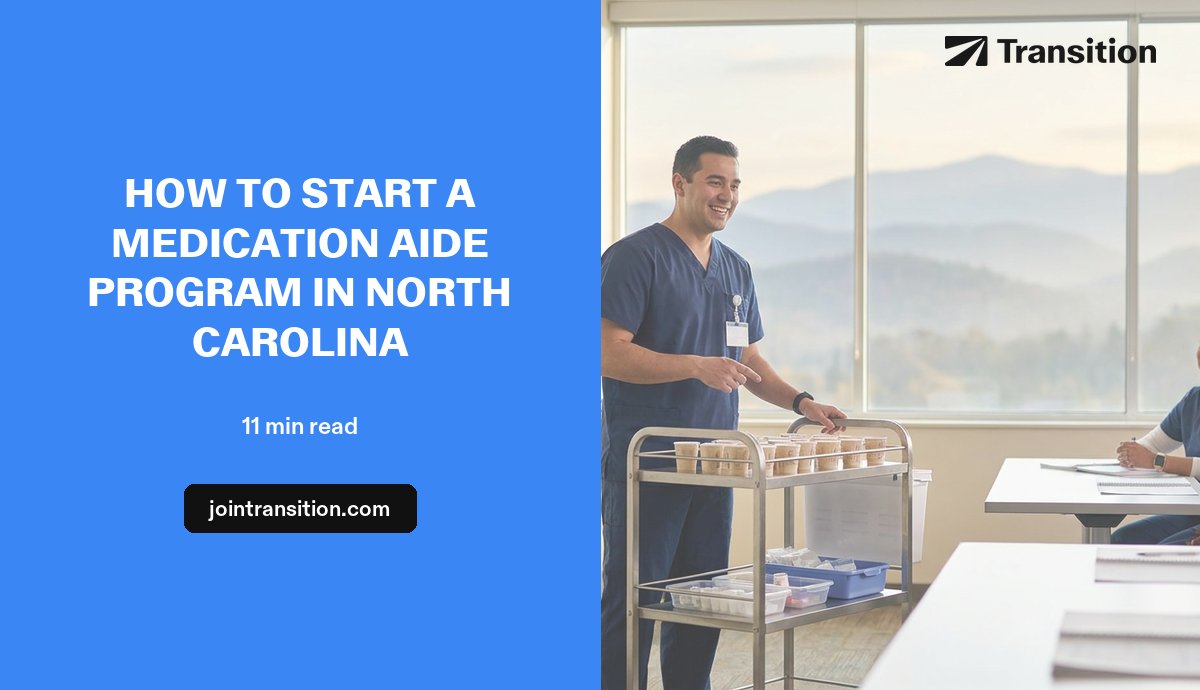
If you run a nurse aide school in North Carolina, a medication aide course is the most natural add-on in your catalog: your NA I graduates need it to earn more, the facilities hosting your clinicals are begging for staff who can pass meds, and the course itself is measured in days, not months.
Here's the part most guides get wrong: North Carolina doesn't have one medication aide pathway. It has two, under different rules for different buildings. The nursing home track: a 24-hour N.C. Board of Nursing-approved course, a Credentia-administered state exam, and listing on the N.C. Medication Aide Registry, authorized by G.S. 131E-114.2 for skilled nursing facilities. The adult care home track serves assisted living and family care homes under G.S. 131D and 10A NCAC 13F/13G: a state-published 15-hour course (10 classroom hours plus 5 hours of clinical skills validation), a written exam with a 90% pass bar, and its own registry. Different curricula, different instructor rules, different exams. A school that offers both, correctly labeled, owns a real niche.
We work with CNA and allied-health schools across the country on enrollment, records, and messaging, and med aide programs are one of the fastest revenue lines we see schools add. This guide is general information, not legal advice — verify current requirements with the N.C. Board of Nursing (NCBON) and the Division of Health Service Regulation (DHSR) before you enroll a single student. And if you don't have a school yet, start with our companion guide, How to Start a CNA School in North Carolina.
Quick Facts: Medication Aide Training in North Carolina
| Item | Nursing home (SNF) track | Adult care home track |
|---|---|---|
| Credential | Medication Aide, listed on the N.C. Medication Aide Registry | Medication aide for adult care homes, listed on the state's adult care home medication aide registry |
| Training hours | 24-hour NCBON-approved training program | 15-hour course (10 classroom + 5 clinical skills validation); a 5-hour course exists for certain staff — confirm with DHSR |
| Key rules | G.S. 131E-114.2; 21 NCAC 36 .0403 and .0406; 10A NCAC 13O .0201 | G.S. 131D-4.5B; 10A NCAC 13F/13G .0503 |
| Who approves training | NCBON (Board-approved curriculum taught by Board-certified RN instructors) | DHSR Adult Care Licensure Section publishes the standardized courses |
| Exam | State competency exam administered by Credentia (online, live-proctored) | State written exam (90% to pass) via Credentia, plus clinical skills validation by an NC-licensed RN or pharmacist |
| Student prerequisites | High school diploma or equivalency; NA I Registry listing to work in a nursing home | Set by adult care home rules and the employer; no NA I listing required |
| Instructor | NC RN, unencumbered license, 2+ years including medication administration, NCBON Medication Aide Instructor certification | RN or licensed pharmacist in good standing with their NC board |
| Typical time to launch | Roughly 2–5 months, driven by instructor certification | Often faster — the curriculum is already published |
Step 1 — Form your business entity (brief, because you may be done already)
If you already operate an approved NA I program, you have this handled: an LLC filed with the North Carolina Secretary of State (Articles of Organization run $125, annual report $200 — confirm at sosnc.gov), an EIN, and a business bank account. Adding a medication aide course doesn't require a new entity — it's a new program under the school you have. Starting from zero? File the LLC first, then read the CNA-school guide linked above; the groundwork is identical.
Step 2 — Register for state taxes (also brief)
Existing schools: no new registrations, just a new revenue line in the books. New operators: register with the North Carolina Department of Revenue for withholding when you hire, and with the NC Division of Employment Security for unemployment insurance. Tuition for instruction is generally not subject to NC sales tax, but confirm your specific mix of tuition, books, and supplies with a CPA.
Step 3 — Set up your classroom and medication lab
Neither track demands a hospital-grade skills lab the way NA I training does, but students need to practice the thing they'll be tested on: safe preparation and administration of medications by the routes the curricula cover — oral, topical, ophthalmic, otic, nasal.
A workable med aide lab: a medication cart or med room setup, sample medication administration records (MARs), pill organizers and cups, training placebos, blister packs, gloves and handwashing supplies, and vital signs equipment. If you already run a CNA lab, you're adding a cart and consumables, not a room — this is one of the cheapest labs in allied health.
Step 4 — Get your program approved (the two-track heart of the process)
Nursing home track. The credential exists because Senate Bill 622 (2005) added G.S. 131E-114.2, letting nursing homes use medication aides for the technical aspects of medication administration — no IV or injectable medications, ever. The training side runs through the N.C. Board of Nursing: students must complete the Board-approved 24-hour medication aide training program (21 NCAC 36 .0403), and the practical gate for a school is that the class must be taught by an RN whom NCBON has certified as a Medication Aide Instructor with an Instructor Approval Number issued before the first class meets. There's no separate DHSR site survey like your NA I approval; the Board-approved curriculum plus a Board-certified instructor is the backbone. Confirm the current program requirements and any provider-level paperwork directly with NCBON before you advertise.
Adult care home track. After 2011 legislation (see G.S. 131D-4.5B), DHSR's Adult Care Licensure Section developed standardized medication administration courses for adult care homes: a 15-hour course — 10 hours of classroom instruction plus 5 hours of clinical skills validation built around the state's Medication Administration Skills Validation Form (DHSR/AC 4605) — and a shorter 5-hour course that satisfies a narrower training mandate for certain staff. DHSR publishes the instructor and student manuals; your job is to deliver them faithfully with a qualified instructor (RN or licensed pharmacist). Check DHSR's ACLS training page for which course applies to which students before you enroll anyone.
The proprietary school question. If your school already holds a license from the State Board of Proprietary Schools (NC Community College System) for NA I training, plan to update your licensed course list before adding med aide — don't assume a short course flies under the radar. Offering med aide training standalone? G.S. 115D-88 exempts, among others, schools overseen by "another legally existing licensing or approving board or agency" and courses the Board deems continuing education for already-qualified individuals — categories a Board-curriculum med aide course may arguably fit. But the Board makes that call, not you. Ask for a written determination; it's an email now versus a compliance problem later.
Step 5 — Hire (or become) a qualified instructor
For the 24-hour nursing home course, NCBON's rule (21 NCAC 36 .0406) is specific. Your instructor needs:
- An active, unencumbered North Carolina RN license
- At least two years of RN practice experience that includes medication administration
- Successful completion of the Board-approved medication aide instructor training program — a 16-hour course taught by a Board-approved Master Teacher
- Current NCBON certification as a Medication Aide Instructor, renewed every two years (renewal requires having taught at least one medication aide class in the preceding two years)
That certification course runs on NCBON's schedule, not yours — it is usually the single longest lead-time item in launching this program, so register early.
For the adult care home courses, the bar is broader: a registered nurse or licensed pharmacist in good standing with their North Carolina occupational board, knowledgeable in current standards of practice. Your existing NA I instructor may qualify today. The clinical skills validation itself must be conducted by an NC-licensed RN or pharmacist per 10A NCAC 13F/13G .0503.
Step 6 — Use the state's curriculum (don't write your own)
North Carolina hands you the syllabus on both tracks. The nursing home course is the Board of Nursing's standardized 24-hour curriculum — the competency exam is written against it (10A NCAC 13O .0201 requires the exam to cover each course requirement in the Board-approved program), so teaching anything else hurts your pass rate. The adult care home course materials — instructor manual, student manual, skills validation form — are published by DHSR. Your value-add isn't authoring content; it's scheduling, quality instruction, exam prep, and getting working CNAs through in a weekend-friendly format. Two long weekends for the 24-hour course is a common structure.
Step 7 — Plan the hands-on component
The nursing home track's 24 hours are training hours, not a facility clinical rotation — students practice administration skills in your lab. Where partnership pays off is the adult care home track: those 5 hours of clinical skills validation must be signed off by an RN or pharmacist, and facilities often want validation done on-site with their own MAR system. Many adult care homes will contract you to run the course and validation for their staff — group contracts with assisted living operators are the best B2B revenue in this niche, and your NA I clinical partners are the first calls.
Step 8 — Understand the exams and the registries
Both state exams now run through Credentia — the same vendor that took over North Carolina's nurse aide exam — via the Credentia platform with live online proctoring (no walk-in testing).
Nursing home track: the candidate completes the 24-hour course, applies through Credentia, and tests online. To work as a medication aide in a nursing home, they must also hold a current Nurse Aide I Registry listing and have no substantiated findings on the Health Care Personnel Registry — build the NA I prerequisite into your admissions checklist, because a student without it has bought a credential they can't use. Passing candidates are added to the N.C. Medication Aide Registry within 30 business days, and a candidate gets three exam attempts before the rule requires retaking the full training program (10A NCAC 13O .0201).
Adult care home track: a standardized written exam set by the Department with a 90% passing score (10A NCAC 13F/13G .0503), administered through Credentia's NC Medication Aide (Adult Care/Med Tech) program, plus the RN- or pharmacist-conducted clinical skills validation. Successful candidates are listed on the state's adult care home medication aide registry. Test vouchers can be purchased through training programs — a nice detail to bundle into your tuition.
Questions on either registry go to DHSR's Health Care Personnel Education and Credentialing Section at 919-855-3969.
Step 9 — Set up enrollment, payments, and student records
A med aide program is short, high-volume, and repeat-heavy — which makes administration the failure mode. You're verifying NA I listings at enrollment, collecting e-signed agreements, tracking 24 or 15 hours of attendance to the hour, storing skills validation forms, confirming completions so students can test — then doing it again every few weeks. The schools we work with run it all through Transition: branded online enrollment, prerequisite document collection, e-sign, payment plans, attendance tracking, and automated email/SMS reminders that fill weekend cohorts from your CNA alumni list. One system, one student record, every cohort.
Step 10 — Launch with a targeted marketing plan
Your best market already knows you: every NA I graduate you've produced is a med aide prospect, and one automated "ready to earn more?" campaign to your alumni list can fill a first cohort. Beyond that, add the program to your Google Business Profile and website (people search both "medication aide class near me" and "med tech class NC"), pitch adult care home and nursing home administrators on group training contracts, and get in front of NCWorks career centers — short, wage-raising credentials are exactly what workforce counselors like to fund. Then run cohorts predictably and answer inquiries in minutes; speed-to-lead still wins.
What it really costs
Estimates for adding a medication aide program to an existing school, with a standalone range for new operators:
| Item | Estimated range |
|---|---|
| NCBON instructor certification (course, application, travel) | $300 – $1,200 |
| Medication lab additions (cart, MARs, supplies) | $800 – $3,000 |
| Curriculum materials and student handbooks | $200 – $1,000 |
| Instructor payroll (first cohort, both tracks) | $1,000 – $3,000 |
| Marketing (alumni campaign, GBP updates, ads) | $300 – $1,500 |
| Proprietary school course addition / determination | $0 – $500 |
| Total, added to an existing school | $2,600 – $10,200 |
| Standalone launch (add entity, insurance, first classroom costs) | $8,000 – $25,000 |
Label these planning estimates — confirm current exam, application, and licensing fees with NCBON, DHSR, Credentia, and the proprietary school board before setting tuition.
How long it takes
For an existing school: roughly 2–5 months from decision to first graduates. The pacing item is almost always NCBON instructor certification — the 16-hour instructor course runs on a set calendar, and no one teaches the 24-hour course without an Instructor Approval Number in hand. The adult care home track can launch faster because the curriculum is published and your RN likely already qualifies. A standalone operator should add the entity, facility, and (if required) proprietary licensing timeline from our CNA guide on top.
Common mistakes to avoid
- Blurring the two tracks. The 24-hour nursing home course and the 15-hour adult care home course are different credentials with different exams and registries. Marketing one as qualifying students for the other generates refund demands and complaints.
- Teaching before the Instructor Approval Number is issued. NCBON certification must be in place before your RN teaches the 24-hour course — a class taught by an uncertified instructor is a class you may have to eat.
- Enrolling nursing home-track students who aren't on the NA I Registry. They can finish your course and still be unemployable in a SNF. Verify NA I listing at enrollment, not at graduation.
- Underselling the 90% pass bar on the adult care home exam. That's a high floor. Build practice exams into the 10 classroom hours and track your pass rates from cohort one.
- Assuming a short course is automatically exempt from proprietary school licensure. G.S. 115D-88 has plausible exemptions, but the State Board of Proprietary Schools makes the determination. Get it in writing.
- Teaching beyond the scope. No IV or injectable medications, ever, on either track — keep your curriculum and your marketing inside the statute.
FAQ
How much does it cost to start a medication aide program in North Carolina? If you already run a school, plan on roughly $2,600–$10,200 to add the program — instructor certification, a modest med lab, and marketing. Standalone launches run higher because you're building entity, insurance, and classroom from scratch.
How many hours is medication aide training in North Carolina? The nursing home track requires the 24-hour NCBON-approved training program (21 NCAC 36 .0403). The adult care home track uses the state's 15-hour course — 10 classroom hours plus 5 hours of clinical skills validation — with a 5-hour option for certain staff under G.S. 131D-4.5B.
Who approves medication aide training programs in North Carolina? The N.C. Board of Nursing governs the 24-hour nursing home course and certifies its RN instructors. DHSR's Adult Care Licensure Section publishes the standardized adult care home courses, and DHSR's Health Care Personnel Education and Credentialing Section runs the registries.
Do students need to be CNAs first? For the nursing home track, effectively yes — G.S. 131E-114.2 requires medication aides in nursing homes to also be listed on the Nurse Aide I Registry, and candidates need a high school diploma or equivalency. The adult care home track has no NA I requirement.
What exam do students take, and who administers it? Both tracks test through Credentia with live online proctoring: a competency exam for the nursing home registry (three attempts before retraining is required) and a written exam requiring 90% for the adult care home track, plus RN- or pharmacist-conducted skills validation.
Can the training be online? Testing is online through Credentia, but skills practice and the adult care home clinical skills validation are hands-on by design. Confirm current delivery rules with NCBON and DHSR before advertising a hybrid format.
Where can North Carolina medication aides work? Nursing home-track aides work in skilled nursing facilities; adult care home-track aides work in adult care homes, family care homes, and the adult care portion of combination homes. There is no unlicensed medication aide role in North Carolina hospitals, and neither track permits IV or injectable medications.
Disclaimer
This guide is general information, not legal or tax advice. Requirements, fees, forms, and vendors change. Verify current rules with the N.C. Board of Nursing, NC DHSR (919-855-3969), Credentia, and the State Board of Proprietary Schools before making commitments.
Ready to add the program, not the paperwork pile?
The paperwork gets you open. The systems keep you open. See how Transition runs enrollment, e-sign, records, payments, and messaging for medication aide and CNA programs like yours at jointransition.com.
Get CNA training paid for.
Tell us your county and we text you the route that fits, who to call, and what to bring.