
How to Start a Medication Aide Program in Oklahoma (2026 Guide)
July 28, 2026 · Oklahoma
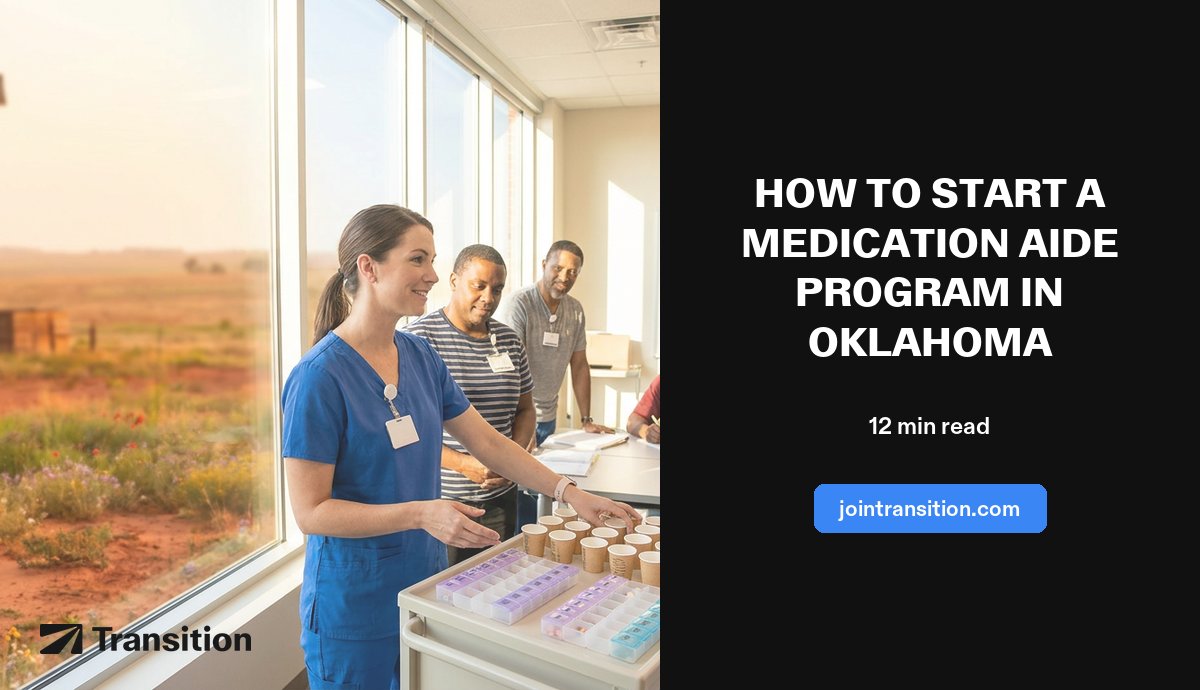
If you run a CNA school in Oklahoma, a Certified Medication Aide (CMA) program is the most natural add-on in the catalog. The students are already in your building — Oklahoma requires medication aide trainees to hold an active aide certification before they can even enroll — and the state's minimum course is just 40 hours. Your graduates come back, pay again, and leave with a credential that raises their wage in nursing facilities, assisted living centers, and residential care homes across the state.
The approval runs through the agency you already know: the Oklahoma State Department of Health (OSDH), which approves CMA training programs under OAC Title 310, Chapter 677, Subchapter 13, using a dedicated application (ODH Form 743C). But the details differ from your Long-Term Care Aide program in ways that trip people up — different instructor rules, a different exam pathway through Oklahoma CareerTech's testing centers, and a skills requirement (a supervised medication pass on 20 or more individuals) that quietly dictates your clinical site strategy. We work with CNA and allied-health schools every day, and the Oklahoma operators who add CMA programs smoothly are the ones who understood those differences before they applied.
If you're starting completely from scratch — no entity, no school license — read our companion guide, How to Start a CNA School in Oklahoma, first; this post assumes you're adding a program and keeps the business-formation steps brief. As always: we're a software company that lives in this world, not a law firm. Verify the current rules with the agencies named below before you spend money.
Quick Facts: Medication Aide Program Requirements in Oklahoma
| Item | Requirement |
|---|---|
| Credential name | Certified Medication Aide (CMA), with advanced (ACMA) endorsements available |
| Total training hours | 40 minimum, including at least 16 hours of supervised practical training (OAC 310:677-13-4) |
| Student prerequisites | Current certification in good standing as a Long-Term Care Aide, Home Health Aide, or ICF/IID Care Aide; able to read, write, and speak English. For certification: age 18+, high school diploma or GED, 6 months of CNA experience, no abuse notations |
| Approving agency | Oklahoma State Department of Health (OSDH), Nurse Aide Registry |
| Application | ODH Form 743C + $100 application fee (OAC 310:677-3-2(b)) |
| Also required | Oklahoma Board of Private Vocational Schools (OBPVS) licensure for most private schools; existing licensees typically amend to add the program |
| Written exam | Administered by a Department-approved entity — in practice, the Oklahoma CareerTech Testing Center's Health Certification Project, developed with OSDH; 70% to pass |
| Skills exam | Medication pass with 100% accuracy on 20+ individuals, observed by an instructor and scored by a physician, licensed nurse, or registered pharmacist |
| Registry | Oklahoma Nurse Aide and Nontechnical Services Worker Registry; CMA certification renews every 12 months with 8 CE hours |
| Program approval cycle | OSDH determines completeness within 30 days, then approves or disapproves within 30 days; approved programs are evaluated every 3 years |
| Instructor requirement | Physician, licensed nurse, pharmacist, respiratory therapist, speech therapist, or certified diabetes educator with 1 year of experience in their area of expertise; RN supervisor required if an LPN instructs |
Step 1 — Form your business entity
Already running an approved school? Skip to Step 3. If you're new: file Articles of Organization for an LLC through the Oklahoma Secretary of State's online business filing system for $100 (about $104 with the card processing fee), with approval typically in 2–3 business days and a $25 Annual Certificate due each year. Then get a free EIN from the IRS and open a dedicated business bank account. Our Oklahoma CNA school guide covers this step in full.
Step 2 — Register for state taxes
Also brief, and also skippable for established schools: register with the Oklahoma Tax Commission through its OkTAP portal. Tuition for instructional services is generally not subject to Oklahoma sales tax, but taxable goods like textbooks or supply kits may require a sales tax permit — ask the OTC about your mix. Employers also register for withholding with the OTC and unemployment insurance with the Oklahoma Employment Security Commission (OESC).
Step 3 — Set up your classroom and medication lab
The good news for existing CNA schools: your classroom already qualifies, and a CMA skills area is far cheaper than a CNA lab. OSDH asks you to describe your classroom and skills training facility standards, and skills training must mirror "the setting in which the certified medication aide will function." Practically, plan for:
- A medication cart stocked the way a nursing facility's would be (used carts are widely available)
- Practice medications — placebo tablets, liquids, topicals, drops, inhalers, and patch stand-ins covering every route in the required curriculum
- Medication Administration Records (MARs) for documentation practice, plus a controlled-substance count book
- Blood pressure cuffs and stethoscopes (vital-sign measurement with administration is a required content area)
- A current drug reference
If you plan to add advanced modules later (insulin, glucometry, tube feedings), budget for glucometers, injection mannequins, and gastrostomy models — but you can add those after your base program is approved.
Step 4 — Apply for OSDH program approval (ODH Form 743C)
Certified Medication Aide training programs are approved by the Oklahoma State Department of Health under OAC 310:677, Subchapter 13. Department approval is required before you offer any training. The application is ODH Form 743C, submitted to the OSDH Nurse Aide Registry in Oklahoma City with a $100 application fee per OAC 310:677-3-2(b).
The 743C is an attachment-driven package. Expect to submit:
- Your record-retention method (trainee applications, performance records, exam results — kept at least 3 years) and where records are maintained
- The written information you give trainees: policies, objectives and syllabus, trainee rights, registry-listing and OSBI background check notices
- Your procedure for distributing the Affidavit of Lawful Presence (required before testing under Oklahoma's HB 1804)
- An itemized list of charges to trainees
- Instructor qualifications, with a designated RN supervisor if applicable (Step 5)
- Classroom and clinical facility locations and standards
- A program outline with objectives, curriculum, instruction methods, and a day-by-day lesson plan with hour breakdowns
- Your Skills Performance Checklist (OSDH provides an optional model)
The review clock runs in two 30-day stages: within 30 days of receipt, OSDH determines whether your application is complete (and tells you in writing what's missing if not); within 30 days after completeness, it approves or disapproves. Approved programs are then evaluated every three years — a longer cycle than the two-year LTCA approval — with advance notice required for program changes in between.
One structural note: OSDH treats each aide category as its own program. Your LTCA approval doesn't extend to CMA training, and your CMA approval won't cover advanced modules — under OAC 310:677-13-9(g), advanced training programs (insulin, tube feeding, inhalers) must be separately submitted and approved before you offer them.
OBPVS: amend, don't assume
If you're a private school training the general public, the Oklahoma Board of Private Vocational Schools (OBPVS) license requirement applies to your CMA program just as it does to your CNA program. If you already hold an OBPVS license, adding a medication aide course typically means submitting the new program and its tuition schedule to the board for approval as an amendment to your existing license rather than starting over — confirm the current procedure and fees with OBPVS directly, and get any exemption ruling in writing. Facility-based programs training only their own employees are in different territory; if you're not sure, ask before you enroll your first student.
Step 5 — Line up qualified instructors
Oklahoma's CMA instructor rule (OAC 310:677-13-3) is broader than the CNA rule, and that's an opportunity. Each instructor must be a physician, licensed nurse, pharmacist, respiratory therapist, speech therapist, or certified diabetes educator, teaching within their area of expertise, with at least one year of experience in that area. If a licensed practical nurse serves as an instructor, the program must designate a registered nurse as the training program supervisor — the same RN-oversight pattern you know from your NATCEP.
Two practical notes from the schools we work with. First, your existing CNA instructor is often your CMA instructor — a nurse with a year of relevant experience qualifies, so many schools launch with zero new hires. Second, a consulting pharmacist or certified diabetes educator teaching a few pharmacology or diabetes sessions strengthens both your application and your program — a natural fit if you plan to offer the insulin module later.
Step 6 — Build the 40-hour curriculum
Under OAC 310:677-13-4(a), the CMA training program must include "a minimum of forty (40) hours of classroom and supervised practical training with a minimum of sixteen (16) hours of supervised practical training." That leaves up to 24 classroom hours at the minimum — and many Oklahoma programs run longer than 40 total hours to cover the material well.
The required subject areas in OAC 310:677-13-4(b) are specific, and your day-by-day lesson plan needs to show where each one lives: preparation and administration of medication across every route (oral, topical, eye/ear/nose, vaginal, rectal, inhalant, transdermal), the rights of medication administration, storage and controlled drug procedures, documentation and labeling, drug references, and vital signs with administration; observing, reporting, and documenting resident status, including blood pressure and drug-drug/drug-food interactions; principles of safety; measurement systems; and body systems and common diseases relevant to medication administration, from digestive through nervous, plus drug metabolism.
Once your base program is running, the advanced (ACMA) modules in the same section are your upsell menu, each with its own hour minimums: diabetes care with insulin administration (12 classroom + 4 practical hours), nasogastric/gastrostomy tubes plus inhalers and nebulizers (8 combined hours), glucose monitoring only (6 + 2), tubes only (4 + 2), and inhalers/nebulizers only (2 + 1). Advanced modules require 100% skill proficiency on return demonstration and written scores of 80–90% depending on the module, and completed hours can count toward a CMA's annual continuing education — which makes ACMA courses attractive to working aides who need CE anyway.
Step 7 — Secure a practical training site (the 20-person medication pass)
Here's the requirement that shapes everything: to pass the skills portion, each student must achieve 100% accuracy on a medication pass administered to at least twenty (20) or more individuals under direct observation by an instructor (OAC 310:677-13-5(b)(3)), documented and retained in the student's training file. You cannot do that with mannequins. Your supervised practical hours need to happen in a real setting comparable to where CMAs work — for most programs, a nursing facility.
That means a written affiliation agreement with a facility willing to let your trainees pass medications under instructor observation. Facilities that host your CNA clinicals are the first call, and many are eager — a facility that helps train CMAs gets first crack at hiring them. The usual snags apply: verbal agreements that stall at signature, corporate legal review that takes weeks, and per-shift limits on trainees. Line up a second site if you can.
Worth knowing for your marketing: certified medication aides in Oklahoma may work in nursing facilities, continuum of care facilities, specialized facilities, residential care homes, adult day care facilities, and assisted living centers (OAC 310:677-13-2), and state law also provides for medication aides in correctional settings under 63 O.S. § 1-1950.3(E). Every CMA works under the supervision of a licensed nurse or physician, with hard limits — no insulin, glucose testing, or tube administration without the corresponding advanced training, and no taking physician orders.
Step 8 — Understand testing, certification, and renewal
The CMA competency evaluation has two parts. The written exam must be administered and scored by a Department-approved entity — in practice, the Oklahoma CareerTech Testing Center's Health Certification Project, which developed the CMA and CMA–Insulin Administration written exams with OSDH and administers them at test sites around the state. A 70% score passes the base written exam (80% for insulin), and three consecutive failures mean retraining before retesting. The skills demonstration — the 20-person medication pass — is scored by a physician, licensed nurse, or registered pharmacist and typically completed through your program at the practical site.
Before testing, candidates attest to the certification prerequisites in OAC 310:677-13-8: at least 18 years old, a high school diploma or GED, current Oklahoma nurse aide certification with no abuse notations, six months of experience as a certified nurse aide, and the physical and mental capability to safely perform the duties. Note the layering: admission to your program requires an active LTCA, HHA, or ICF/IID aide certification and the ability to read, write, and speak English — but certification also requires the age, education, and experience attestations. Screen for all of it at enrollment, not at test day; a student who finishes your course but is four months short on CNA experience is a refund conversation you don't want.
Successful candidates are listed as CMAs on the Oklahoma Nurse Aide and Nontechnical Services Worker Registry. Certification renews every 12 months (a $10 fee) with 8 hours of continuing education per year after the first — and OSDH separately approves CE providers ($75 application), another recurring-revenue line for your school.
Step 9 — Set up enrollment, payments, and student records
A CMA program multiplies your record-keeping: prerequisite verification (registry status, CNA experience, education attestations), the Skills Performance Checklist, the documented 20-person medication pass, three-year record retention, and OBPVS student-file standards — on top of enrollment agreements, payments, and attendance.
This is the problem we built Transition to solve: branded online enrollment with prerequisite document collection, payment plans, attendance and grade tracking, e-signed agreements, automated onboarding emails and texts, and student records in one system instead of spreadsheets plus a filing cabinet. Schools running multiple programs — CNA plus CMA plus CE — feel the difference most, because every program shares one student database.
Step 10 — Launch with a built-in audience
Marketing a CMA program is easier than marketing a CNA program, because your best prospects already know you:
- Your CNA alumni. Email and text every graduate from the past two years. Six months of CNA experience is the certification threshold, so your alumni list is a pre-qualified pipeline that refreshes with every cohort.
- Employer partnerships. Nursing facilities, assisted living centers, and residential care homes pay more for CMAs and often sponsor tuition for current staff. Your clinical partners are the warmest leads.
- Google Business Profile. Add the CMA program to your services and ask graduates for reviews that mention it.
- Oklahoma Works. Aide upskilling fits workforce funding priorities; talk to your local Oklahoma Works American Job Center about WIOA-funded students, especially if you're on the eligible training provider list.
What it really costs
Realistic estimates for adding a CMA program to an existing Oklahoma school (label: estimates — your market will vary):
| Item | Estimated range |
|---|---|
| OSDH application fee (ODH Form 743C) | $100 |
| OBPVS program amendment/fees | $100–$1,000 |
| Medication cart, practice meds, MAR supplies | $1,000–$4,000 |
| Curriculum (purchased or developed) | $500–$3,000 |
| Instructor pay (first cohort) | $1,500–$4,000 |
| Marketing (first 3 months) | $250–$1,500 |
| Bottom line (existing school) | $3,500–$13,500 |
Starting from zero with no existing school? Add the entity, insurance, lease, and licensure costs from our CNA school guide — realistically $15,000–$50,000 all-in. Oklahoma CMA courses commonly price in the several-hundred-dollar range per student, so a modest cohort can recover your setup cost quickly; check competitors in your metro before setting price.
How long it takes
For an established school, plan on 2–5 months from decision to first CMA cohort. The variance comes from three places: how fast you produce a complete 743C package with a day-by-day lesson plan (incomplete applications stall the 30-day clock), how quickly your practical site agreement gets signed, and OBPVS's board calendar for program amendments. Starting the OSDH and OBPVS paperwork in parallel — with the facility conversation already underway — is the schedule saver. From absolute scratch, stack this on top of the 4–9 months a new Oklahoma school takes to open.
Common mistakes to avoid
- Enrolling students who can't be certified. Admission only requires an active aide certification, but testing requires 18+, a diploma or GED, and six months of CNA experience. Verify all of it at enrollment.
- Treating the medication pass as an afterthought. The 100%-accuracy pass on 20+ individuals requires real residents and instructor observation time. Negotiate it into your facility agreement up front or stall at the finish line.
- Offering advanced modules without separate approval. Insulin, glucometry, and tube-feeding modules each require their own Department approval first (OAC 310:677-13-9(g)).
- Skipping the OBPVS amendment. OSDH program approval doesn't update your private vocational school license.
- Forgetting the Affidavit of Lawful Presence. Students can't sit for the written exam without it; your 743C requires a documented distribution procedure.
- Loose records. Medication pass documentation, skills checklists, and trainee files must be retained at least three years, and your three-year OSDH evaluation will ask for them.
FAQ
How much does it cost to start a medication aide program in Oklahoma? If you already run an approved school, roughly $3,500–$13,500 — the OSDH application itself is $100, and the bulk goes to lab supplies, curriculum, and instructor pay. From scratch, budget what a full CNA school costs ($15,000–$50,000) plus the CMA additions.
How many hours is medication aide training in Oklahoma? A minimum of 40 hours of combined classroom and supervised practical training, of which at least 16 hours must be supervised practical training, under OAC 310:677-13-4. Advanced modules (insulin, tube feeding, inhalers) carry additional hour minimums.
Who can enroll in a CMA program in Oklahoma? Students must hold a current Oklahoma certification in good standing as a Long-Term Care Aide, Home Health Aide, or ICF/IID Care Aide and be able to read, write, and speak English. To be certified after training, they must also be 18 or older, hold a high school diploma or GED, have six months of CNA experience, and have no abuse notations on the registry.
Do I need a nurse to teach a medication aide course in Oklahoma? Not necessarily — instructors may be physicians, licensed nurses, pharmacists, respiratory therapists, speech therapists, or certified diabetes educators with a year of experience in their area of expertise. But if an LPN instructs, an RN must be designated as training program supervisor.
Where can CMAs work in Oklahoma? Nursing facilities, continuum of care facilities, specialized facilities, residential care homes, adult day care facilities, and assisted living centers, always under the supervision of a licensed nurse or physician. State law also provides for medication aides in correctional settings. Hospitals and home settings are not on the authorized list.
What exam do Oklahoma CMA students take? A written exam — administered through Department-approved testing, in practice Oklahoma CareerTech's Health Certification Project test sites — requiring 70% to pass, plus a skills demonstration: a medication pass with 100% accuracy on at least 20 individuals, scored by a physician, licensed nurse, or registered pharmacist.
Can CMA training be online in Oklahoma? Some Oklahoma providers deliver classroom hours online, but the minimum 16 supervised practical hours and the 20-person medication pass must happen in person. Describe any online delivery explicitly in your ODH 743C application rather than assuming it's allowed.
Disclaimer
This guide is for general information, not legal advice. Rules, fees, and forms change — sometimes quietly. Before spending money, verify current requirements with the Oklahoma State Department of Health (Nurse Aide Registry), the Oklahoma Board of Private Vocational Schools, the Oklahoma CareerTech Testing Center, the Oklahoma Secretary of State, and the Oklahoma Tax Commission.
The paperwork gets you open. The systems keep you open.
Once OSDH approves your 743C, the real work is prerequisite screening, records, payments, and staying evaluation-ready — across every program you run. See how Transition handles enrollment, student records, messaging, e-sign, and compliance for multi-program schools like yours at jointransition.com.
Get CNA training paid for.
Tell us your county and we text you the route that fits, who to call, and what to bring.