
How to Start a Medication Aide Program in Virginia (2026 Guide)
July 28, 2026 · Virginia
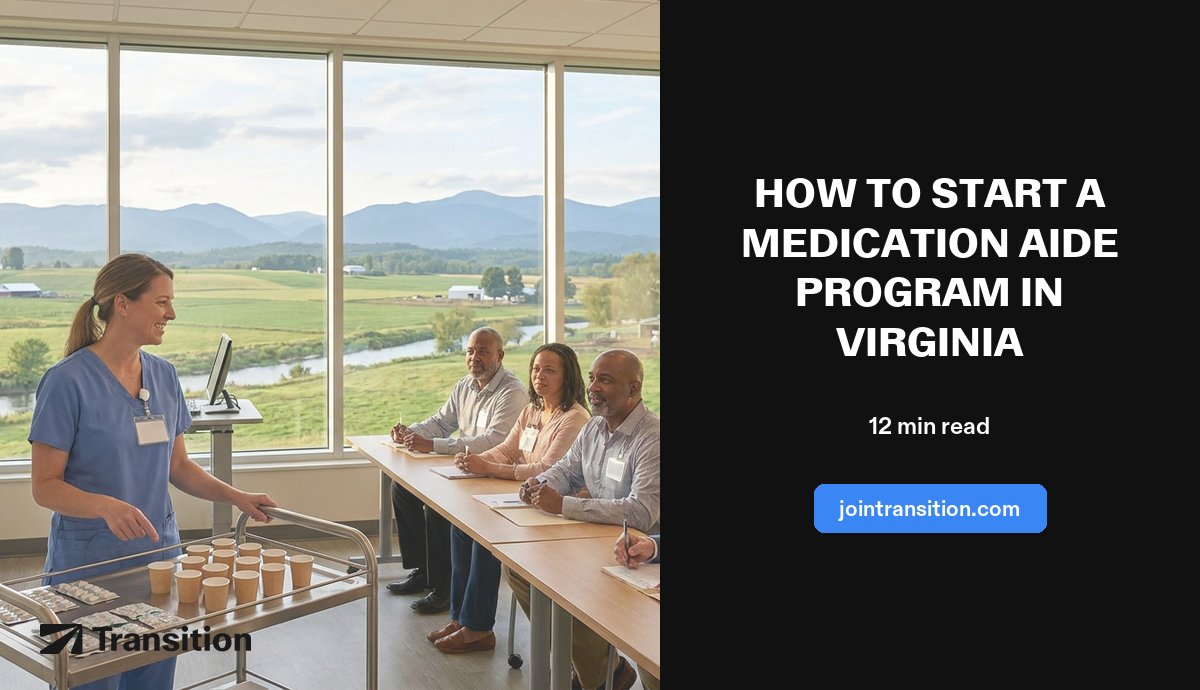
In a Virginia assisted living facility, medications can only be administered by licensed staff or a Registered Medication Aide (RMA) — an aide who completed a Board of Nursing-approved 68-hour program, passed the state exam through PSI, and holds an active registration. Every ALF in the Commonwealth needs RMAs on the schedule, and somebody has to train them. That somebody could be you.
If you already run a CNA school in Virginia — and most people reading this do — adding a medication aide program is one of the most natural expansions available. Same classroom, overlapping student base, a $500 application fee, and a Board-published curriculum you don't have to write from scratch. If you're starting from zero, read our companion guide first: How to Start a CNA School in Virginia. We help Virginia training schools run enrollment, records, and day-to-day operations, so we see how these programs actually get built.
One note before we start: this is an operator's guide, not legal advice. Regulations change, and the Virginia Board of Nursing and the agencies named below are always the final word. Verify everything against current sources before you file.
Quick Facts: Virginia Medication Aide Programs
| Item | Virginia requirement |
|---|---|
| Credential | Registered Medication Aide (RMA) |
| Total training hours | Minimum 68 hours (18VAC90-60-60) |
| Hour split | At least 40 classroom + at least 20 supervised skills practice in an ALF + 8-hour insulin module |
| Approving agency | Virginia Board of Nursing (Department of Health Professions) |
| Application | Application to Establish a Medication Aide Training Program, filed at least 90 days before first class |
| Program approval fee | $500 (18VAC90-60-30) |
| Student prerequisite | VDSS direct care staff training for ALF employment, or an approved nurse aide education program |
| Exam vendor | PSI (written exam; clinical competency evaluated by the program) |
| Credential verification | DHP License Lookup, Virginia Board of Nursing |
| Where RMAs work | Assisted living facilities licensed by the Virginia Department of Social Services |
| Instructor requirement | RN, LPN, or pharmacist with 3+ years medication experience, plus a Board-approved instructor course |
| Pass-rate rule | Cumulative first-time pass rate of at least 80% over two years to keep approval |
Step 1 — Form Your Business Entity (Skip If You Have One)
If you already operate a CNA school or another training business as an LLC or corporation, you can run the medication aide program under that same entity — skip to Step 3.
If not: form your entity through the Virginia State Corporation Commission's Clerk's Information System at cis.scc.virginia.gov. An LLC (Form LLC-1011) costs $100 to file, plus a $50 annual registration fee — confirm current amounts on the SCC site. Then get a free EIN from the IRS and open a dedicated business bank account.
Step 2 — Register for State Taxes (Also Brief)
Existing schools are already registered — skip ahead. New entities should register with the Virginia Department of Taxation through its online business registration, covering employer income tax withholding if you hire instructors as employees, and register for unemployment insurance tax with the Virginia Employment Commission. Tuition for instructional services is generally not subject to Virginia sales tax, but confirm with Virginia Tax if you sell textbooks or supplies separately.
One Virginia-specific note that saves real money: check whether you need SCHEV certification as a postsecondary school. Under Virginia Code § 23.1-226, professional and occupational training programs subject to the approval of a regulatory board under Title 54.1 — which includes the Board of Nursing — are exempt from SCHEV certification. But the exemption is not automatic. If your school offers only exempt programs, you still apply to SCHEV for written approval of the exemption. If you already hold SCHEV certification or a SCHEV exemption letter for your CNA school, adding a Board of Nursing-approved medication aide program typically stays within that same framework, but confirm your status with SCHEV's Private Postsecondary Education office before you enroll students.
Step 3 — Secure Your Classroom and Skills Space
There's no separate facility license for a medication aide program, but your setup has to support the curriculum. You'll need:
- A classroom adequate for at least 40 hours of didactic instruction
- Medication administration practice equipment: a med cart or med room setup, pill organizers, practice medication cards/MARs (medication administration records), blood glucose monitoring supplies, and insulin administration training materials for the required 8-hour insulin module
- Access to an assisted living facility for the supervised skills practice hours (more on that in Step 7)
If you already run a CNA lab, most of your infrastructure carries over. The genuinely new pieces are the medication cart, documentation systems, and pharmacology teaching materials — a much smaller lift than outfitting a CNA lab with beds and mannequins.
Step 4 — Apply for Board of Nursing Program Approval
This is the heart of the process. Medication aide training programs are approved by the Virginia Board of Nursing, part of the Department of Health Professions (DHP), under regulation 18VAC90-60 (Regulations Governing the Registration of Medication Aides). Note the agency: even if your CNA program is used to dealing with the Board's nurse aide education side, the medication aide program is its own approval track with its own application, curriculum, and rules.
The mechanics, per 18VAC90-60-40:
- Submit the Application to Establish a Medication Aide Training Program (available on the Board's Medication Aide Education Programs page at dhp.virginia.gov) at least 90 days before your first expected class offering.
- Pay the $500 program approval application fee set in 18VAC90-60-30.
- Document how you meet every requirement: qualified instructors (Step 5), the Board-approved curriculum (Step 6), your skills-practice arrangements, and your student records plan.
The Board grants initial approval once your documentation shows compliance. If approval is denied, you can request an informal conference within 30 days. Once approved, staying approved has teeth:
- Your cumulative first-time exam pass rate over the past two years must stay at or above 80%.
- You must report substantive changes — instructors, curriculum, location — within 10 days.
- The Board can conduct unannounced compliance visits.
- Every student must receive copies of the applicable Virginia laws and regulations, and completion certificates must show your program name, Board approval number, and the instructor's signature.
The Board also runs periodic virtual seminars walking applicants through the approval process — check the Medication Aide Education Programs page for the next session. In our experience, applicants who talk to Board education staff early avoid the most common resubmission delays.
Step 5 — Hire Qualified Instructors
Virginia's instructor requirements live in 18VAC90-60-50, and they're broader than many states — you don't need an RN specifically:
- A primary instructor must be a licensed RN, LPN, or pharmacist holding a current, active, unrestricted Virginia license (or multistate privilege) with at least three years of experience administering or dispensing drugs.
- An RN, LPN, or pharmacist with less than three years of that experience can serve as a secondary instructor, but only for the supervised skills practice hours.
- Every instructor must first complete a Board-approved instructor preparation course — including a post-course examination — designed to prepare them to teach the medication aide curriculum, covering adult learning principles and evaluation strategies.
That instructor course is a real gating item. Budget time for your instructor to find and complete it before your application goes in, because the Board will want proof. Instructors are also formally responsible for planning learning experiences, ensuring the curriculum is completed, evaluating students, and maintaining student records — put those duties in writing in your instructor agreements.
Step 6 — Use the Board-Approved 68-Hour Curriculum
Here's a piece of good news: Virginia publishes the curriculum. The Board's website provides the Board Approved Curriculum for the 68-hour program, and 18VAC90-60-60 defines the structure:
- Minimum 68 total hours of student instruction and training
- At least 40 hours of classroom/didactic instruction — and these must be over and above any facility orientation or direct-care training
- At least 20 hours of supervised skills practice administering medications to residents of an assisted living facility (up to 20% of skills practice may be simulation lab)
- An 8-hour module on facilitating client self-administration or assisting with insulin administration
Required content includes safe medication administration in ALFs, aseptic technique, basic pharmacology, medication preparation and administration, and documentation and reporting. Programs may also offer optional four-hour refresher modules that facilities can use for continuing education — a nice recurring-revenue add-on once you're established.
Equally important is who you can enroll. Under 18VAC90-60-60(A), a student must have already completed either the direct care staff training required by the Department of Social Services for ALF employment or an approved nurse aide education program. For CNA school operators, that second pathway is the business model in a sentence: your CNA graduates are pre-qualified for your medication aide program. Verify and document each student's prerequisite before enrollment.
Step 7 — Set Up Your Assisted Living Facility Agreements
Because the 20 skills-practice hours must happen with residents of an assisted living facility (aside from the limited simulation allowance), you need at least one ALF partner. ALFs in Virginia are licensed by the Department of Social Services (VDSS), and under VDSS standard 22VAC40-73-670, their medication administration must be performed by licensed staff or Board-registered medication aides — which means every ALF administrator you call has a standing staffing need your program solves.
Get a written affiliation agreement covering supervision, scheduling, liability insurance, and resident consent. Common snags: facilities treating students as unpaid staff (they can't — students work under instructor supervision), and med-pass timing conflicts. Medications happen on the facility's schedule, not yours, so plan skills sessions around actual med-pass windows.
Step 8 — Understand Testing and Registration
Virginia's competency evaluation has two parts, per 18VAC90-60-90:
- A clinical evaluation of minimal competency in medication administration skills — completed by your program, documented on a Board-provided form.
- A written examination — administered by PSI, the Board's current test vendor.
Students apply for registration online through the Board of Nursing (initial applications are accepted exclusively online), pay the Board's $50 registration fee (18VAC90-60-30) plus a separate exam fee to PSI, and schedule the written exam through PSI's website. Build the PSI Candidate Bulletin into your final class session so students walk out knowing exactly how to register. Candidates have two years from completing training to pass, with three attempts before they must retake the program. Employers verify RMA registrations through DHP's License Lookup.
Your incentive is aligned with your students': that 80% cumulative first-time pass rate is what keeps your approval. Track every graduate's exam outcome from day one.
Step 9 — Set Up Enrollment, Payments, and Student Records
A medication aide program multiplies your administrative surface: prerequisite verification for every enrollee, attendance across 68 hours, skills checklists on Board forms, completion certificates with your approval number, and exam outcome tracking for the pass-rate rule.
This is where Transition comes in for the schools we work with. One system handles branded online enrollment, payment plans, attendance and grade tracking, document e-sign for prerequisite records and ALF agreements, and automated email/SMS that keeps students moving from enrollment through PSI registration — instead of spreadsheets, Jotform, and paper skills sheets. When the Board shows up unannounced, your records are one search away.
Step 10 — Launch With a Local Marketing Plan
Your two audiences are ALF administrators (who need staff trained) and direct care workers or CNAs (who want the raise that comes with an RMA registration).
- Go facility-first. Email and visit ALF administrators within 30 minutes of your location. Offer employer-sponsored cohorts — many ALFs will pay tuition to get compliant med-pass coverage.
- Market to your own CNA alumni. They already meet the prerequisite, and they already trust you.
- Set up a Google Business Profile and collect reviews from your first cohorts; "medication aide class near me" searches convert well.
- Connect with Virginia Works, the Commonwealth's workforce development agency (Department of Workforce Development and Advancement), and your local workforce board about training partnerships and potential funding for eligible students.
- Respond fast. Prospective students enroll with whoever answers first. Automated follow-up beats a prettier website every time.
What It Really Costs
Realistic estimated ranges for adding a medication aide program to an existing school (standalone startups should add the entity, facility, and general startup costs from our CNA guide):
| Item | Estimated range |
|---|---|
| Board of Nursing application fee | $500 (fixed, per 18VAC90-60-30) |
| Instructor preparation course | $200 – $800 |
| Med cart, practice meds, MARs, insulin/glucometer supplies | $1,500 – $5,000 |
| Curriculum materials, textbooks, printing | $500 – $2,000 |
| Instructor pay for first cohort (68 hours) | $2,500 – $6,000 |
| Insurance rider / liability update | $300 – $1,500 |
| Marketing launch | $500 – $2,500 |
| Total (added to existing school) | $6,000 – $18,000 |
These are estimates — your instructor market and equipment choices drive most of the variance. A standalone launch with a new lease and entity typically runs meaningfully higher.
How Long It Takes
Plan on four to seven months from decision to first graduate. The regulation requires your application to be in at least 90 days before your first class, so the Board review window is your floor. What drives variance in Virginia: how quickly your instructor completes the Board-approved instructor course, how fast you land an ALF affiliation agreement for skills practice, and whether your application documentation is complete on the first submission. Schools that attend a Board application seminar and pre-build their records systems consistently land at the short end.
Common Mistakes to Avoid
- Applying late. The 90-day advance filing requirement in 18VAC90-60-40 is a hard floor — you cannot backfill it after advertising a start date.
- Enrolling unqualified students. Every student needs documented completion of VDSS direct care staff training or a nurse aide program before enrollment. Verify it; don't take their word.
- Confusing the 68-hour RMA program with the 32-hour DBHDS course. Virginia has a separate, shorter medication administration training for DBHDS-licensed settings like group homes. It does not create an RMA, and the RMA program's rules don't apply to it. Market each honestly.
- Skipping the instructor course. A three-year RN resume is not enough — the Board-approved instructor preparation course with its post-course exam is mandatory before teaching.
- Ignoring the pass-rate rule. Below 80% cumulative first-time passes over two years, your approval is at risk. Track outcomes per cohort from the start.
- Forgetting the 10-day change reports. New instructor, new address, curriculum change — the Board expects notice within 10 days, and unannounced visits do happen.
FAQ
How much does it cost to start a medication aide program in Virginia? If you're adding it to an existing school, expect roughly $6,000–$18,000, anchored by the fixed $500 Board of Nursing application fee, instructor costs, and medication practice equipment. A standalone school should also budget the formation, facility, and insurance costs covered in our CNA school guide.
How many hours is Virginia's medication aide course? A minimum of 68 hours under 18VAC90-60-60: at least 40 classroom hours, at least 20 hours of supervised skills practice in an assisted living facility, and an 8-hour insulin module.
Do I need to be a nurse to open a medication aide program? No. The owner doesn't need a license, but your primary instructor must be an RN, LPN, or pharmacist with at least three years of medication administration or dispensing experience, plus completion of the Board-approved instructor course.
Where can Registered Medication Aides work in Virginia? The RMA registration is built for assisted living facilities licensed by the Department of Social Services, where VDSS standards require medication administration by licensed staff or Board-registered medication aides. RMAs are not a nursing home role in Virginia — skilled nursing medication administration stays with licensed nurses — and DBHDS-licensed group homes use a separate 32-hour medication administration training instead.
Who gives the medication aide exam in Virginia? The written exam is administered by PSI, the Board of Nursing's test vendor. Students apply to the Board online, then schedule with PSI directly. The clinical competency evaluation is completed by your program on a Board form. Candidates get three attempts within two years of finishing training.
Can the training be online? Up to 20% of the skills-practice hours may be simulation, but the rest must occur with residents in an assisted living facility. For didactic delivery formats, describe your planned approach in your application and confirm with Board education staff before building an online-heavy program.
Do I need SCHEV certification to offer this program? Programs approved by a Title 54.1 regulatory board like the Board of Nursing fall under a SCHEV certification exemption in Virginia Code § 23.1-226 — but the exemption requires written approval from SCHEV rather than applying automatically. If your school is already SCHEV-certified or holds an exemption letter, confirm with SCHEV that the new program is covered.
Disclaimer
This guide is for general information and isn't legal advice. Virginia's regulations, fees, and forms change; the Virginia Board of Nursing, Department of Social Services, SCHEV, State Corporation Commission, and Virginia Department of Taxation are the authoritative sources. Verify current requirements with those agencies before applying or enrolling students.
Ready to Launch?
The paperwork gets you open. The systems keep you open. See how Transition runs enrollment, payments, student records, messaging, and compliance for medication aide and CNA programs like yours at jointransition.com.
Get CNA training paid for.
Tell us your county and we text you the route that fits, who to call, and what to bring.